

The best bedrijfsborrel ideeën share one trait: they force a little structure before letting people loose. Run one short activity, 30 to 60 minutes, that gets colleagues talking who normally never sit near each other. Then open the floor with simple shared food and drinks and let the room find its own rhythm. Pick one idea from an interactive category, one from food, one from entertainment, and you already have a plan. The checklist and idea menu below fill in the rest.
TL;DR:
- A well-structured 30 to 60-minute activity, such as a quiz or tasting, is crucial to encourage mingling and break office cliques effectively.
- Organizers should clearly define the event’s purpose, location, and budget early, and allocate sufficient unstructured time afterward for natural conversations.
- Simple logistics like RSVP management, dietary labeling, strategic bar placement, and a definitive end time are essential to prevent chaos and ensure smooth flow.
- Cost-effective formats like office barbecues, picnics, potlucks, or small games can outperform expensive venue packages by promoting interaction without excessive spending.
- Booking venue and activity vendors in the same week and planning for optimal zoning and staffing significantly increases the event’s success.
Table of Contents
- Bedrijfsborrel Ideeën That Actually Get People Talking
- A Planning Framework You Can Reuse Every Time (ARC)
- The Copyable Checklist Every Organizer Forgets Half Of
- The Full Idea Menu: 25+ Bedrijfsborrel Ideeën By Category
- From Plan to Party: Timelines, Briefs, and the Day-Of Script
- How Big Shots Amsterdam Keeps a Borrel Running Smoothly
- What I've Learned Hosting Borrels That Actually Work
- Book Your Bedrijfsborrel at a Venue That Handles the Logistics for You
- Where This Advice Comes From
- Sources
- FAQ
Bedrijfsborrel Ideeën That Actually Get People Talking
Most bedrijfsborrels fail for a boring reason: nobody plans the first 30 minutes. People arrive, grab a drink, cluster with the three colleagues they already talk to daily, and stay there all night. A borrel with zero structure quietly reinforces the office cliques it was supposed to break down.
The fix is not complicated. Event organizers consistently find that a structured 30 to 60 minute interaction followed by open, unstructured time produces the strongest mixing and engagement of the whole event. The structure gives people a reason to talk to someone new. The open time afterward lets those new conversations breathe without forcing anything.
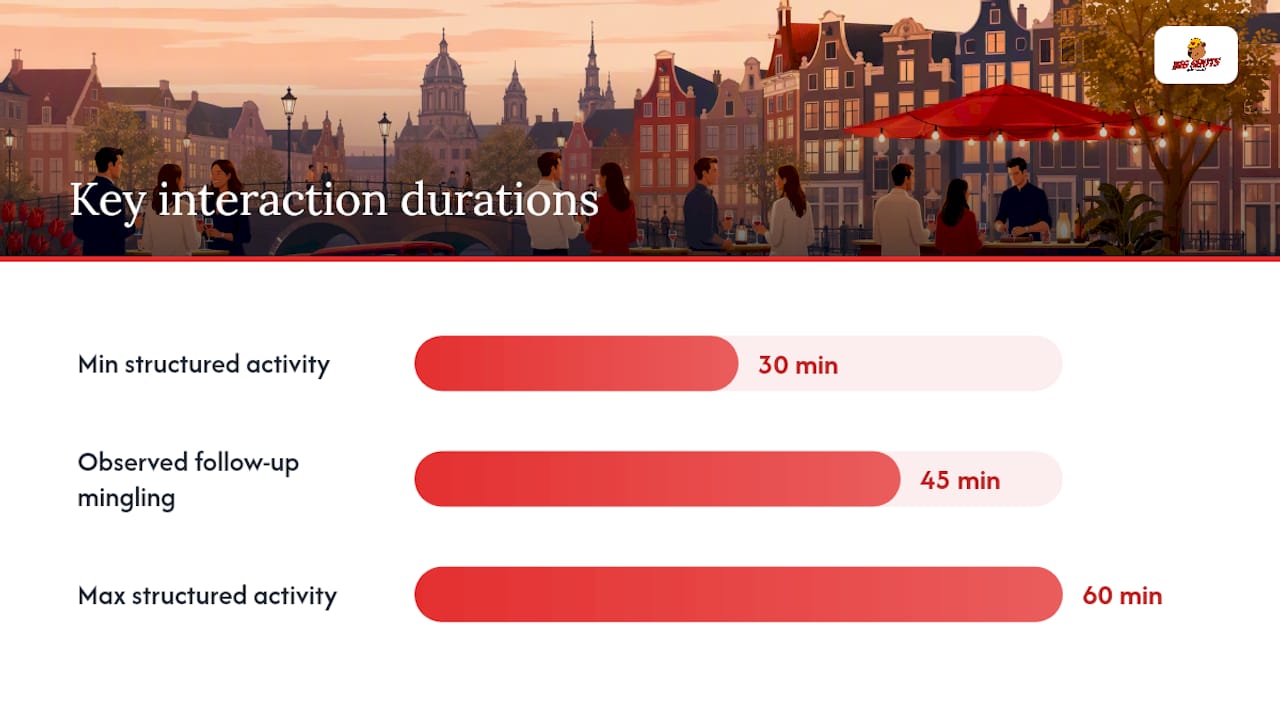
There's a cultural layer here too. A traditional Dutch borrel is informal by design, usually held late afternoon or early evening, meant for celebrating or networking without ceremony. That informality is a feature, not a bug, but informal doesn't mean unplanned. The loosest-feeling borrels are often the most carefully sequenced behind the scenes.
What good looks like on the day:
- People from different departments are still talking 45 minutes after the structured activity ends.
- You overhear at least a few conversations that clearly wouldn't have happened at someone's desk.
- Feedback afterward mentions the activity by name, not just "it was nice."
- Nobody is checking their phone by the bar alone for more than a few minutes.
One planning insight worth internalizing early: organizers who overprogram the evening, back to back activities with no breathing room, tend to kill the exact mixing they were trying to create. A single sharp activity beats three mediocre ones.
A Planning Framework You Can Reuse Every Time (ARC)
You don't need a fresh strategy for every borrel. Use the same three moves each time: Answer the objective, Reason through format and location, Choose the budget and schedule.
1. Answer the objective and guest profile. Is this internal team bonding, a client-facing networking event, or a mixed crowd? A borrel organizer setting these three variables from the start avoids the scramble that comes from deciding location before deciding purpose. A clear objective, realistic budget, suitable location, and managed guest list form the backbone of every successful business borrel, according to Dutch event planners.
2. Reason through format and location. On-site keeps costs down and needs no travel. Off-site at a dedicated venue raises the energy and removes the "we're still kind of at work" feeling. Hybrid works when remote colleagues need to feel included.
3. Choose budget and service model. Decide per-person spend early, then pick the service style that fits it: buffet for volume and low cost, passed bites for a client-facing polish, seated dinner for smaller senior groups.
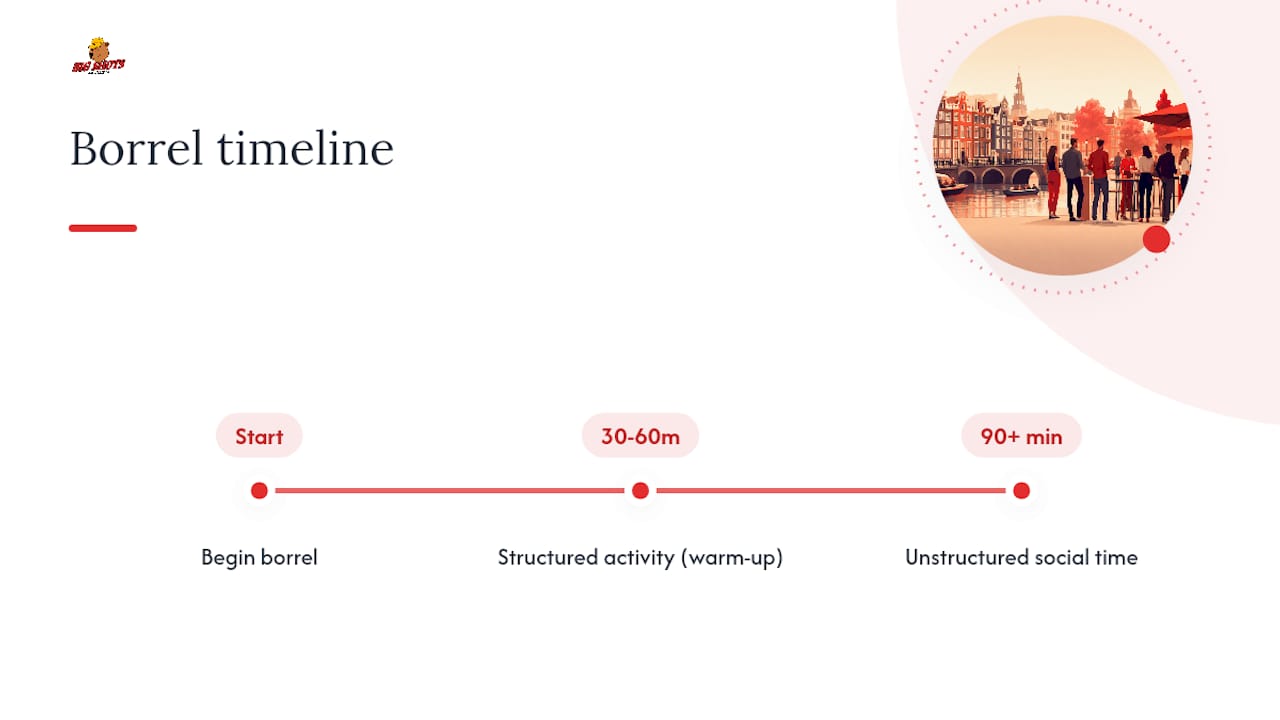
4. Plan the activity window and the open window. Block 30 to 60 minutes for one structured activity, then leave at least 90 minutes of unstructured time. Don't let the structured part run long; it should feel like a warm-up, not the main event.
5. Run the vendor and tech checklist. Confirm sound and lighting if there's any kind of activity, quiz, or music. Confirm waste routing and who handles it. Confirm staffing: who is running the bar, who is hosting, who is managing the door.
Pro Tip: Book your activity vendor and your venue in the same week. Borrels booked in isolation often end up with a mismatched room, either too big for a quiz or too loud for speed-networking.
The Copyable Checklist Every Organizer Forgets Half Of
The parts of a borrel that go wrong are rarely the big decisions. They're the small logistics nobody assigns to a specific person.
Run through this before you finalize anything:
- RSVP and capacity. Set a firm cutoff date, add a 10% buffer for no-shows and walk-ins, and confirm final numbers with the venue or caterer 48 hours out.
- Dietary needs. Ask about restrictions in the RSVP itself, not after. Label every food station clearly, and always have a vegetarian and an alcohol-free option visible, not hidden at the end of the table.
- Bar placement. Put the bar somewhere that doesn't bottleneck the entrance or the food. A single congested pinch point is the fastest way to kill early-evening energy.
- Waste and recycling. Assign this to a specific staff member or vendor. Nobody notices good waste management, but everyone notices overflowing bins by hour two.
- Staffing roles. Name a host, a bar lead, and someone watching the room's flow. Small events skip this and then wonder why service felt chaotic.
- A hard end time. Announce it during closing remarks so staff can start teardown with confidence and guests don't linger awkwardly waiting for a signal that never comes.
- Day-of contact list. One page, printed or in a shared note: caterer's phone number, venue contact, backup plan if someone drops out.
On budget: company events under €25 per person are entirely realistic when you lean on formats like a picnic, an on-site BBQ, a city game, or a smaller-scale escape room, rather than defaulting to a paid venue package. Cheaper formats often outperform pricier passive ones anyway, since they force interaction instead of letting people watch from the sidelines.
The Full Idea Menu: 25+ Bedrijfsborrel Ideeën By Category
Once your framework and checklist are set, the fun part is picking activities. Group your options by purpose so you're not scrolling a random list. Here's the menu, organized the way you'll actually use it.
Interactive and games
These are your structured 30 to 60 minute openers, the ones designed to break up existing groups and force new conversations.
- Pub quiz. Mix teams randomly across departments, not by desk cluster. Five to six rounds keeps it tight.
- Speed-networking. Two minutes per pairing, a bell or timer, rotate through as many people as the room allows. Works especially well for client-facing borrels.
- Cornhole or giant Jenga tournaments. Low skill floor, high visibility, easy for people in heels or a suit to join without changing clothes.
- Retro-game tournament. A console hooked up to a screen with something like Mario Kart pulls in a surprising cross-section of ages and seniority levels.
- Office scavenger hunt. Clues tied to inside jokes or company history work better than generic riddles, and they double as a subtle onboarding tool for newer staff.
Culinary and tasting
Food-led formats double as conversation starters because tasting something together is an easy, low-pressure shared activity.
- Tasting stations. Beer, wine, whiskey, or coffee flights let guests self-pace and mingle around a shared table rather than sitting in rows.
- Charcuterie challenge. Split guests into small teams to build the best board from a shared spread. Competitive but casual.
- Foodtruck market. Two or three trucks with different cuisines mimic a street market feel and remove the single-queue bottleneck of one buffet line.
- Live-cooking stations. A chef plating in front of guests turns catering into a small show, and it naturally clusters people around the action.
Five catering themes consistently work well for this kind of event: local and seasonal tasting menus, streetfood markets, plant-based or zero-waste concepts, live-cooking stations, and dessert or coffee-focused setups. A themed catering concept also raises how the food is perceived while naturally controlling portions, which cuts down on waste compared to an unthemed spread.
Entertainment
Entertainment formats work best in the open-mingling phase once the structured activity has already done its job of mixing the room.
- Silent disco. Multiple channels let different music tastes coexist in one space without volume wars, and the headphones themselves become a talking point.
- DJ plus live musician combo. A short acoustic set early, then a DJ once the room loosens up, keeps energy building rather than peaking too soon.
- Photobooth with branded props. Cheap to rent, guaranteed to generate content people actually share, and it gives quieter guests something to do that isn't just standing around.
- Stand-up comedy evening. A tighter, seated format that works well for smaller groups or a client dinner that wants something beyond background music.
Budget-friendly options
None of these require a big spend, and several works particularly well for smaller teams or a startup with a tight annual events budget.
- Office BBQ. Move it outside if you have any kind of courtyard or rooftop access. Minimal setup, maximum informality.
- Picnic in a nearby park. Works well for a summer afternoon borrel and removes any venue cost entirely.
- Board-game night. A handful of good group games (think Codenames or Werewolf) can carry an entire evening for the cost of the games themselves.
- Potluck or food-sharing format. Ask everyone to bring one dish. It's cheap, and it turns catering into a conversation starter on its own.
Seasonal and occasion ideas
- Nieuwjaarsborrel elements. A short toast, a look back at the year's wins, oliebollen if you want the classic touch.
- Kerstborrel variations. A mulled wine station, a gift exchange with a low spending cap, or a cozy indoor setup with festive lighting.
- Summer rooftop borrel. Outdoor seating, lighter food, and drinks that don't need to be piping hot all work in the venue's favor here.
- Outdoor garden or terrace formats. Good for client events where a relaxed, less corporate setting helps conversation flow.
Remote and hybrid
- Virtual escape rooms. Good for teams split across cities, though energy drops fast past 45 minutes online.
- Pre-shipped tasting kits. Send a small box of snacks or drinks ahead of a video call tasting session so remote staff aren't just watching everyone else eat.
- Hybrid quiz with an on-site hub. Run the main quiz in the office with a screen and microphone open for remote participants to answer live.
Every one of these formats, from the pub quiz to the silent disco to the escape room, shows up repeatedly across event idea guides because they're well-rated for actual engagement, not just novelty.
From Plan to Party: Timelines, Briefs, and the Day-Of Script
A good idea list means nothing without a schedule and a brief someone can actually hand to a vendor. Here's a template you can copy directly.
1. Sample two-hour timeline.
- 5:00 PM: Doors open, arrival drinks, name tags if it's a larger or mixed group.
- 5:15 PM: Welcome remarks, two minutes maximum, state the plan for the evening.
- 5:20 PM to 6:00 PM: Structured activity (quiz, speed-networking, tasting stations).
- 6:00 PM to 7:30 PM: Open mingling, food stations live, music at background volume.
- 7:30 PM: Closing remarks and the announced hard end time.
2. Vendor brief template. One page covering: expected guest count, arrival and end times, dietary notes collected from RSVPs, room layout with bar and food station placement marked, and a single point of contact with a phone number.
3. On-the-day script for your host or MC. Welcome line, one sentence explaining the activity, a clear transition into open time, and a closing line that states the end time out loud so nobody's caught off guard.
4. Contingency notes. Have an indoor backup for any outdoor plan. Keep a caterer's direct line in case of delays. Keep a small first-aid kit on-site regardless of group size. None of this needs a formal document, just a shared note everyone on staff can see.
How Big Shots Amsterdam Keeps a Borrel Running Smoothly
Running a borrel across a sports bar, shisha lounge, restaurant, and café teaches you fast that zoning matters more than almost anything else. Services are sequenced across bar, lounge, and dining areas specifically to avoid the crowding that kills momentum early in an event. Guests move naturally between zones instead of bottlenecking around one bar.
A few operational habits that translate to any borrel, regardless of venue:
- Pre-place drink stations before guests arrive, and stagger service rounds so nobody's queuing for ten minutes at the top of the hour.
- The menu is built around shareable plates, tapas, small steaks, and salads, so mixed groups with different appetites and diets can all find something without a separate ordering process.
- Mocktail and alcohol-free options are labeled clearly rather than tucked at the end of a drinks list.
- Online ordering is used for pre-orders on larger groups, so the kitchen isn't blindsided by a sudden rush.
- Someone is assigned specifically to merchandise or giveaway handling when branded items are available, so it doesn't fall on bar staff mid-rush.
Pro Tip: If you're hosting a mixed group of clients and staff, ask the venue about staggered service rounds in advance. It's a small ask that prevents the exact congestion that makes a borrel feel chaotic by hour two.
What I've Learned Hosting Borrels That Actually Work
The best borrel I've seen didn't have the biggest budget or the flashiest entertainment. It had a fifteen-minute icebreaker quiz that nobody expected to enjoy, and by the second round, people who'd never spoken were arguing over answers together. That's the whole trick. You don't need spectacle. You need one small forcing function that breaks the seating chart everyone defaults to.
Three things I'd tell any organizer: keep the structured part short, never longer than an hour. Announce your end time out loud, because guests relax more when they know the shape of the evening. And don't skip the RSVP buffer, since a borrel that runs 15% over capacity feels cramped no matter how good the food is.
Book seasonal dates, especially around December, well ahead. Venues fill up fast, and the good ones fill up faster.
— Leo
Book Your Bedrijfsborrel at a Venue That Handles the Logistics for You
Everything above works whether you host in your own office, a rented hall, or a venue built for exactly this. If you'd rather skip the vendor-hunting and staffing headaches entirely, Bigshotsamsterdam gives you a done-for-you alternative: one location with a sports bar, shisha lounge, restaurant, and café already zoned to handle groups without the crowding problems a single-room office borrel runs into.
You get group-friendly menus built around shareable plates, steaks, and tapas that suit mixed dietary needs without a separate ordering process, plus lounge experiences designed for private group hosting with bar service handled for you. If your team prefers catering in-house instead, the delivery menu covers that too. Reach out to check availability for your date, especially around busy December weeks, and get a straight answer on capacity and menu options before you commit.
Where This Advice Comes From
The planning framework, budget figures, and catering categories in this guide draw on practical guidance from Maat Events on structuring a business borrel, Guestlist Online on budget-conscious formats, and Alles over Catering on catering themes. For festive menu inspiration beyond the standard borrel spread, Wild Foodz covers seasonal plated concepts worth reviewing.
Sources
- Cvent — Netherlands corporate and business venues
- Maat Events — How to organise a business borrel: practical tips
- Guestlist Online — Bedrijfsfeest ideeën guide
- Alles over Catering — Catering ideas for borrels
FAQ
What Are Some Fun, Original Bedrijfsborrel Ideeën?
Pub quizzes, speed-networking rounds, tasting stations, and silent discos consistently rank among the most engaging formats because they force interaction rather than letting guests default to existing cliques.
What's Good to Do During a Borrel Besides Just Drinking?
A short structured activity of 30 to 60 minutes, like a quiz or a tasting station, works best, followed by open mingling with shared food so conversations can continue naturally.
What Are the Top Team Outing Ideas Right Now?
Interactive formats like scavenger hunts and retro-game tournaments, plus culinary formats like foodtruck markets and live-cooking stations, are among the most popular because they combine low cost with high engagement.
What Trends Are Shaping Company Events Lately?
Budget-conscious, interaction-forward formats are replacing passive entertainment: think tasting stations and hybrid setups over a simple drinks-only reception, with hybrid formats also growing for teams split across locations.
Does Big Shots Amsterdam Host Private Group Events?
Yes. Bigshotsamsterdam offers lounge experiences suited to private group hosting, with group menus and bar service available; current pricing is listed on the site rather than published here.