
TL;DR:
- Social smoking offers short-term bonding and relaxation benefits but causes long-term health risks.
- Managing triggers and substituting rituals can help enjoy social experiences more safely.
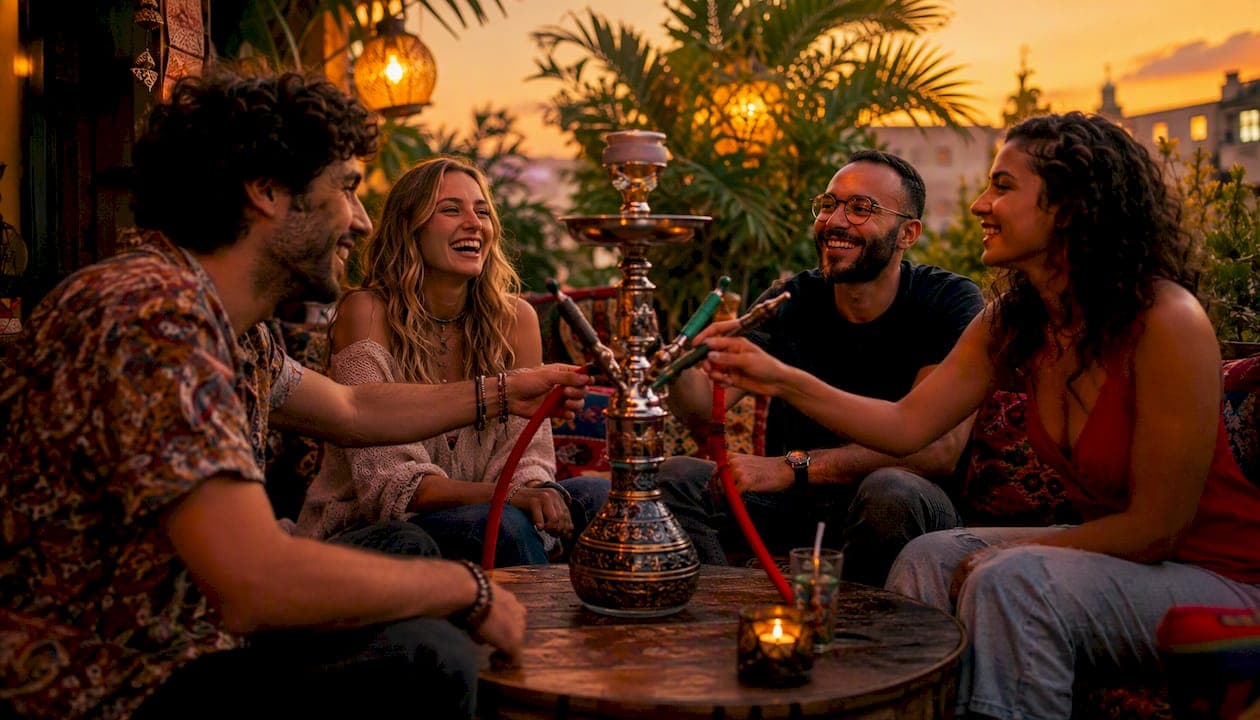
The perceived benefits of social smoking are real in the short term: people genuinely bond faster, feel more relaxed, and find natural conversation openings during a shared shisha session or a cigarette break. Research published in PMC identifies four main drivers behind this: social bonding, image and identity signaling, mood modulation, and ritual time-segmentation during events. The catch is that every one of those payoffs comes with a health cost that accumulates even at low frequency. Here is what the evidence actually says, and how to get the social upside with less of the downside.
Perceived benefits most people report:
- Shared ritual that creates a natural opening for conversation
- A sense of belonging and group identity
- Short-term relaxation and mood lift from nicotine and ritualized breathing
- A built-in "break" that segments an evening into distinct social moments
Table of Contents
- What makes social smoking feel so good?
- Why public-health experts push back on the "benefits"
- Why social smokers often resist quitting
- What triggers social smoking in hospitality settings?
- How to enjoy shisha more safely in a hospitality setting
- How to cut back or quit if you want to
- Key Takeaways
- What thoughtful shisha venues get right
- A shisha experience worth booking in Amsterdam
What makes social smoking feel so good?
The social functions of smoking are well-documented. Peer-reviewed public-health literature describes how the act of offering or accepting a smoke creates an immediate invitation cue. It pulls two people out of a crowd for a few minutes of low-stakes, private conversation. That is boundary mediation at work: smoking carves out a temporary social space that feels intimate precisely because it is brief and slightly separate from the main event.
- Bonding: Sharing a shisha pipe or stepping outside together signals mutual trust and openness.
- Image signaling: In certain social groups, smoking communicates a relaxed, confident persona.
- Ritual structure: A timed shisha session after a match or during a long dinner gives the evening a natural rhythm.
- Mood modulation: Nicotine produces a short-term lift in dopamine; the slow, deliberate breathing of a hookah session adds a layer of physical calm on top of that.
Pro Tip: Venues can replicate this ritual without smoke. A structured five-minute "flavor break" with a signature mocktail or a palate-cleanser between courses gives guests the same conversational pause and sense of occasion without the combustion.
Why public-health experts push back on the "benefits"
The social payoffs are short-term. The health costs are not.
Harvard Health Publishing is direct: light and intermittent smoking still raises the risk of heart disease, lung cancer, cataracts, respiratory infections, and premature death. Smoking one to four cigarettes a day increases heart disease risk almost as much as a pack a day. The risk range runs from a 50% increase for slower injury recovery to a 500% increase for lung cancer in women.
"Light or intermittent smoking may be safer than heavy smoking, but it still causes plenty of harm. Quitting completely is the best option for long-term health." — Harvard Health Publishing
Shisha adds another layer of misunderstanding. Smokefree.gov reports that a single hookah session can expose a person to the toxic load of multiple packs of cigarettes, including carbon monoxide, heavy metals, and carcinogens. The water in the pipe filters almost none of it.
Trade-offs beyond personal health:
- Secondhand smoke in enclosed hospitality spaces harms everyone nearby, not just the smoker.
- Smell and stigma increasingly exclude smokers from social settings rather than including them.
- Guests who do not smoke may avoid venues where smoke is poorly managed.
This article is general information, not medical advice. For personal health guidance, consult a qualified clinician or your primary care provider.
Why social smokers often resist quitting
Most social smokers do not think of themselves as smokers. Public-health research shows that nearly half of light and intermittent smokers deny dependence, underreport use, and believe they can stop whenever they choose. That identity gap is the core problem: if you are not a smoker, why would you engage with cessation resources?
Standard "smoking kills" messaging tends to miss this group entirely. What does land, according to the same research, is framing around secondhand smoke and the social impact on others. A social smoker who shrugs at personal risk often responds differently when the conversation shifts to what their smoke does to the people around them.
Pro Tip: Clinicians and venue staff get better information by asking "Have you smoked in the past month?" rather than "Are you a smoker?" The first question bypasses identity resistance and gets an honest answer.
- Situational drivers (alcohol, specific venues, peer offers) make social smoking feel involuntary, which reinforces the "I'm not really a smoker" belief.
- Tracking actual usage — including borrowed cigarettes and shared pipes — almost always reveals heavier consumption than self-reported figures suggest.
What triggers social smoking in hospitality settings?
Smokefree.gov identifies alcohol as the single strongest situational trigger for social smoking. It lowers inhibition and pairs with smoking behavior so reliably that many social smokers only light up when they drink. Other common triggers in shisha lounges and bars include:
- A friend offering a smoke or pipe
- Stepping onto a patio or outdoor terrace
- The end of a meal or a sports match
- Emotional cues: celebration, stress, or boredom during a slow moment
The relationship between alcohol and smoking in hospitality venues is well-established. Alcohol acts as a disinhibitor and a memory cue simultaneously. If you have smoked every time you drank for the past three years, the first drink becomes a conditioned trigger all on its own.
Pro Tip: Sit in a non-smoking section for the first hour of an evening out. Delaying the first drink by 30 minutes also reduces the window where alcohol and peer cues overlap most strongly.
How to enjoy shisha more safely in a hospitality setting
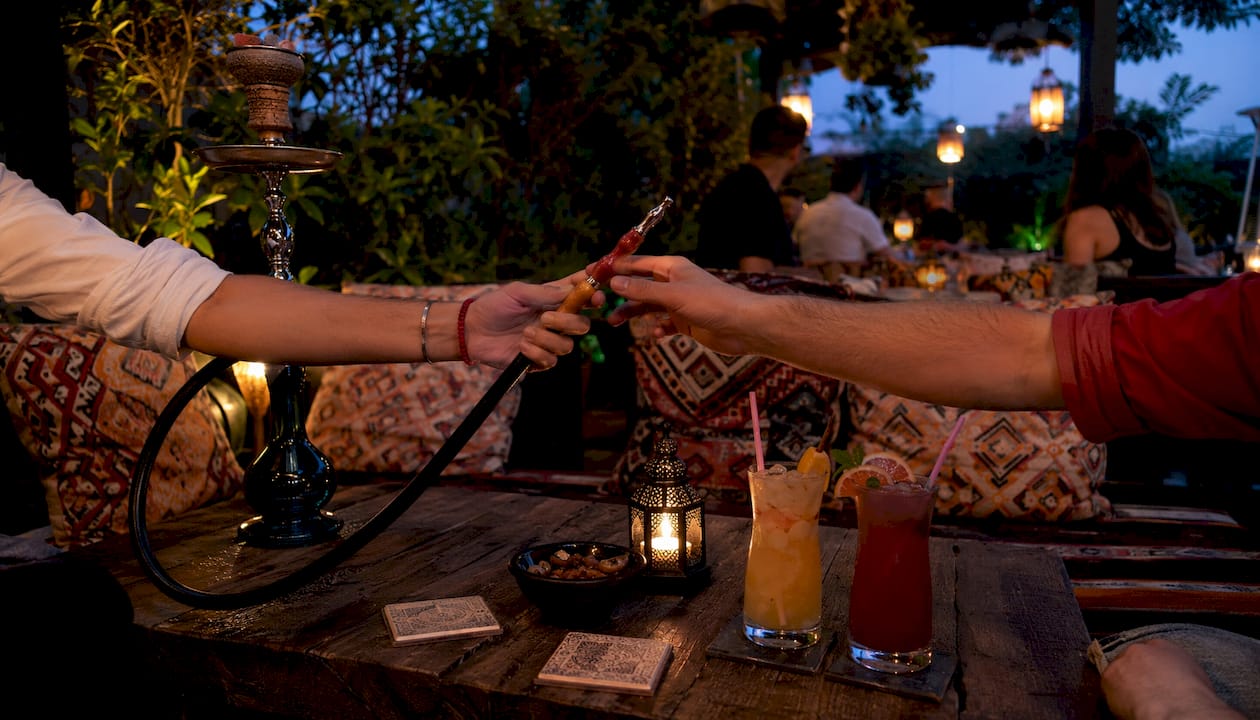
Harm reduction does not mean giving up the social experience. It means making smarter choices about how you engage with it.
For guests:
- Pace sessions: one shisha session per outing, not back-to-back.
- Use a personal mouthpiece tip and avoid sharing directly.
- Alternate drinks with water to slow consumption and reduce alcohol-trigger overlap.
- Choose venues with visible ventilation and well-maintained equipment.
- Rotate between indoor and outdoor seating where available.
For operators, session design matters as much as equipment. Ventilation upgrades, clearly zoned seating, timed session management, and staff trained in hygiene protocols all reduce guest exposure. Pairing shisha with cocktails thoughtfully, and offering a well-designed shisha menu, gives guests a richer experience that does not depend on volume of smoke.
Bigshotsamsterdam applies this approach directly: session pacing, quality equipment, and a food and cocktail menu designed to complement rather than accelerate shisha consumption. The social ritual stays intact; the harm profile shrinks.
| Practice | Guest benefit | Operator benefit |
|---|---|---|
| Personal mouthpiece tips | Reduced infection risk | Hygiene compliance |
| Timed session management | Natural social rhythm | Turnover and safety |
| Ventilation zoning | Lower secondhand exposure | Broader guest appeal |
| Drink-water alternation | Slower consumption | Reduced alcohol-trigger overlap |
Pro Tip: A flavored mocktail served between shisha rounds gives guests a sensory ritual that fills the same social pause without adding another smoke.
How to cut back or quit if you want to
- Track real usage for two weeks. Count every cigarette, shared pipe, and borrowed smoke. The number is almost always higher than expected.
- Map your triggers. Note when, where, and who you were with each time.
- Create a replacement ritual. A specific drink, a short walk, or a flavor break can fill the same social function.
- Set a situational rule. No smoking with alcohol for three weeks is more specific and more achievable than "I'll cut back."
- Tell one person. Social smokers respond to social accountability more than personal resolve.
- Use cessation resources when needed. Smokefree.gov offers free text and online support programs built for situational smokers. Nicotine gum can help bridge high-risk moments.
Pro Tip: If a venue is a consistent trigger, swap it for a different type of night out once a week. Amsterdam's nightlife offers plenty of social options that do not center on smoking.
Key Takeaways
Social smoking delivers real short-term social payoffs, but even light use carries measurable health risks, and the most effective path forward combines environmental awareness with deliberate ritual substitution.
| Point | Details |
|---|---|
| Perceived benefits are real but short-term | Bonding, mood lift, and ritual structure are genuine, but they do not offset long-term health costs. |
| Light smoking still harms | Harvard Health Publishing links even light cigarette use to a substantially increased risk of heart disease. |
| Identity resistance blocks quitting | Most social smokers deny being smokers; messages focused on secondhand harm land better than personal-risk framing. |
| Triggers are situational and manageable | Alcohol, specific venues, and peer cues drive most social smoking; changing the environment reduces the urge. |
| Bigshotsamsterdam models harm-aware hosting | Session pacing, quality equipment, and a paired food and cocktail menu let guests enjoy the ritual with less exposure. |
What thoughtful shisha venues get right
Most articles about social smoking treat the venue as a passive backdrop. That is the wrong frame. The venue is the environment, and the environment is the trigger, the ritual, and the harm-reduction opportunity all at once.
Operators who understand boundary mediation — the idea that smoking creates a temporary private social space — can design alternatives that preserve the payoff. A well-timed intermission, a signature non-alcoholic pairing, a staff member who knows how to pace a table without rushing it: these are not gimmicks. They are the hospitality equivalent of good clinical framing.
Cultural sensitivity matters here too. Shisha carries deep social meaning in Middle Eastern, North African, and South Asian traditions. Guests from those backgrounds are not engaging in a health-risk behavior first and a social ritual second. Venues that treat it only as a liability miss the point and lose the guest. The right approach acknowledges the cultural weight of the ritual while quietly reducing the harm through design choices guests barely notice.
The gap between what "harm reduction" sounds like in a public-health brief and what it looks like in a well-run shisha lounge is enormous. One is a warning. The other is a good evening.
A shisha experience worth booking in Amsterdam
Bigshotsamsterdam brings together a sports bar, shisha lounge, restaurant, and café under one roof in Amsterdam, with a specific focus on getting the session experience right. That means quality equipment, a food and cocktail menu designed to complement your shisha, and a space where the social ritual feels intentional rather than incidental.
If you want a night where the shisha is part of a well-designed evening rather than an afterthought, reserve your table at Bigshotsamsterdam. The venue also offers professional bartending guidance on pairing drinks with your session for guests who want to get the most out of the experience. Book directly through the website and arrive knowing the space was built for exactly this kind of night.