
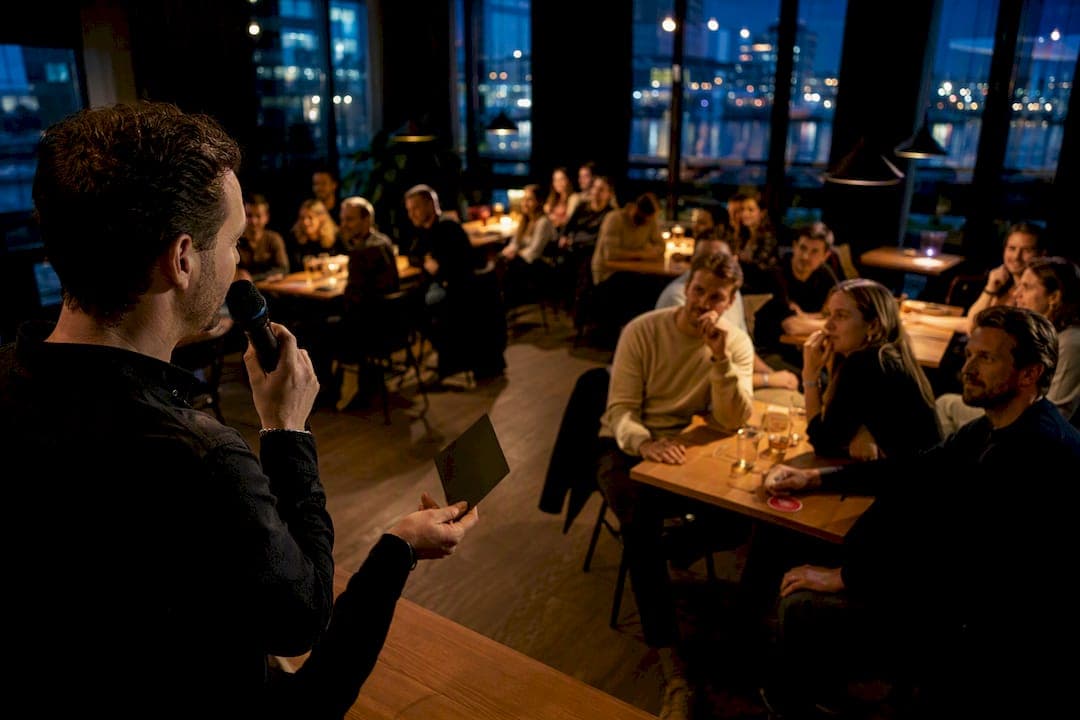
Pick your date and venue first, then lock a simple format before you write a single question. A solid pubquiz organiseren plan run on four things: a clear format, a booked venue, tested questions, and tech that won't quit halfway through round three. Book the room and set a content deadline within the first week. Most pubquiz events typically last between about 1.5 to 2 hours for six to eight teams of four to six people.
TL;DR:
- Booking the venue and confirming necessary AV equipment early is crucial, especially for larger groups, to avoid last-minute technical or layout issues.
- A clear set of rules and a designated quizmaster who reads questions confidently and manages disputes swiftly help ensure a fair, fun experience.
- Using ready-made venues with built-in AV and catering services can significantly reduce setup stress and improve logistical reliability.
- Proper planning, including test rehearsals and early communication with the venue, prevents common pitfalls like sound problems, awkward seating, and timing overruns.
Table of Contents
- Planning a Pub Quiz: Your 1 to 4 Week Timeline
- Choosing the Right Venue and Date for Your Quiz
- How Many Rounds Should a Pub Quiz Have?
- What Makes a Good Pub Quiz Question?
- How Do You Score a Pub Quiz Fairly?
- What Equipment Do You Need to Run a Pub Quiz?
- What Makes a Good Quizmaster?
- How Do You Plan Prizes and Drinks for a Pub Quiz?
- How Do You Get Enough Teams to Show Up?
- Why You Should Run a Rehearsal Before Quiz Night
- Running the Quiz: Pace, Pauses, and Problems
- Wrapping Up: Prizegiving and Feedback
- What Venues Expect From a Quiz Organizer
- Where Standard Pub Quiz Advice Gets It Wrong
- Book a Ready-Made Room Instead of Building One From Scratch
- Sources
Planning a Pub Quiz: Your 1 to 4 Week Timeline
Give yourself at least two weeks if you're writing everything yourself. One week works only if you buy a ready-made pack or hire a host.
- Week 4 (or day 1 if rushed): Book venue and date, confirm capacity, send save-the-dates.
- Week 3: Draft your format (rounds, timing), start writing or sourcing questions.
- Week 2: Finalize questions, gather multimedia clips, confirm scoring sheets and prizes.
- Week 1: Run a test session with friends, fix weak questions, send final invites.
- Day of: Arrive early for setup and a full tech check.
Writing a full quiz from scratch typically eats 8 to 12 hours for a single organizer, which is why so many first-timers quietly switch to a bought pack halfway through week two. Set a go/no-go checkpoint at the one-week mark. If questions aren't written and the venue isn't confirmed by then, either simplify the format or bring in outside help.
Choosing the Right Venue and Date for Your Quiz
Home works fine for six people and a laptop. Past that, you need a room built for it. An office breakroom handles casual work quizzes but rarely has decent sound. A pub, restaurant, or hired venue solves acoustics and seating in one move, especially once you're past four or five teams.
Before you commit to a date, confirm the room has what you actually need:
- Reliable Wi-Fi or a backup mobile hotspot
- A sound system with a microphone the quizmaster can actually be heard on
- A screen or projector visible from every table
- Enough power outlets near the AV setup
- Accessible toilets and a bar or kitchen that can serve during breaks
On timing, avoid clashing with major televised sports fixtures unless your quiz is built around them, and check the local events calendar so you're not competing with another gathering for the same crowd. A proper seating layout with clear sightlines to the screen prevents the "we couldn't see the picture round" complaints that sink otherwise good nights.
How Many Rounds Should a Pub Quiz Have?
Most pubquizzes run six to eight rounds of five to ten questions each, which fits a 90 minute to two hour night comfortably. A short version (four rounds, 60 to 75 minutes) suits office lunch breaks. An XL night (ten plus rounds, over two and a half hours) works for charity events or annual traditions where people expect to camp out.
Mix round types so energy doesn't flatline:
- General knowledge to open, since everyone can answer something
- A picture or logo round to break up the pace visually
- A music round using short clips, not full songs
- A specialist round (film, sports, local history) for personality
- A wildcard or physical challenge round near the end to wake the room back up
It is recommended to have a balanced mix of question difficulties within each round to maintain engagement. A themed sports round pairs naturally with a Premier League watch-night crowd if your audience skews that way. The standard commercial pack structure of six to eight rounds with five to ten questions each is a safe default if you're not sure where to start.
What Makes a Good Pub Quiz Question?
A good question has exactly one defensible answer and no wiggle room for arguments. That single rule solves most of the disputes that derail a quiz halfway through.
Balance each round across easy, medium, and hard questions, and test the whole set with a small group before quiz night to catch anything ambiguous. A question that seems obvious to you at your kitchen table can fall apart the moment ten teams argue over wording.
You have three realistic sourcing routes:
- Buy a pre-written pack when you're short on time or writing skill
- Use an AI quiz generator to draft a first pass, then edit for local relevance
- Crowdsource from friends or coworkers, one round each, then edit for consistency
For multimedia, keep clips to 10 to 15 seconds, stick to common formats like MP4 for video and MP3 for audio, and check you're not breaching copyright on music clips played to a paying audience. Free editing tools like CapCut or DaVinci Resolve handle trimming clips in minutes.
Pro Tip: Run your hardest round past someone who wasn't involved in writing it. If they get frustrated instead of challenged, cut the difficulty back a notch.
How Do You Score a Pub Quiz Fairly?
One point per correct answer, with a single tiebreaker question (closest numeric guess, like "how many steps in the Eiffel Tower") settles almost every dispute before it starts. Bonus rounds can carry double points if you want a mid-quiz swing in the leaderboard.
Announce these rules before round one, not halfway through:
- Phones away during questions. Confiscate or fine teams that get caught cheating.
- Written answers only, submitted before the quizmaster reveals the correct one.
- No shouting out. Answers not written down don't count, no exceptions mid-round.
- One team member finalizes each answer sheet to avoid last-second changes.
- Disputes go to the quizmaster only, resolved in under a minute, decision final.
Transparent scoring is what keeps a room fun instead of tense. The moment teams sense the rules are being bent for someone, the atmosphere sours fast, so decide your dispute process before the first question, not during an argument over round four.
What Equipment Do You Need to Run a Pub Quiz?
The core kit is short: a laptop, stable internet, a sound system with a working microphone, a projector or TV, and either pens with printed answer sheets or a digital scoring app. That's the whole list for a standard physical night.
- Laptop with your quiz file loaded and backed up
- Stable internet connection, plus a phone hotspot as a fallback
- Microphone and speakers loud enough for the back table
- Projector or TV visible from every seat
- Pens, printed answer sheets, or a tablet running your scoring app
- Spare HDMI or USB-C adapters, because someone's cable will fail
Reserve at least 30 minutes before the quiz starts purely for sign-in and tech checks. That half hour is what separates a quiz that starts on time from one apologizing to the room by 8:15.
For digital scoring, Kahoot! scores higher for engagement and Quizizz scores higher for ease of setup, so pick based on whether your priority is spectacle or speed. Always keep a paper scoring sheet as backup. Wi-Fi drops at the worst moment more often than anyone plans for.
What Makes a Good Quizmaster?
A good quizmaster reads questions clearly, keeps a steady pace, and can improvise when a question flops or a team argues a point. Comedy timing helps; loud, confident delivery matters more.
Look for someone comfortable holding a microphone in front of strangers and quick enough to defuse an argument without killing momentum. Give them a short briefing covering the running order, the tiebreaker rule, and how disputes get resolved.
- Quizmaster: reads questions, keeps time, announces scores between rounds
- Scorekeeper: tallies points independently as a check against the app or sheet
- AV operator: cues music and video clips, watches for tech glitches
Practice the transitions between rounds with your quizmaster beforehand, especially the score announcement moment. That's the part that drags if it isn't rehearsed.
Pro Tip: Have your quizmaster read the hardest question out loud to you once, cold, before the night. If they stumble on pronunciation, you'll want to know that now, not in front of forty people.
How Do You Plan Prizes and Drinks for a Pub Quiz?
Prizes don't need to be expensive to work. A bottle of wine, a gift card, or bragging rights on a shared trophy motivates most teams just fine. Add a joke "booby prize" for last place, something silly rather than insulting, and you'll get more laughs than the actual winner does.
- Top prize: modest value, gift card or bottle, nothing that feels like overkill
- Middle tiers: small tokens like chocolate or a round of drinks on the house
- Last place: a genuinely silly, low-cost joke prize
Time your breaks around natural pauses, between rounds three and four works well, so the bar or kitchen isn't slammed mid-question. Offering a discount on the next quiz or a small loyalty perk for returning teams is a cheap way to build a repeat crowd.
How Do You Get Enough Teams to Show Up?
Send invites two to three weeks out through group chats, email, or a simple event page, then follow up with a reminder 48 hours before. Cap team sign-ups at a fixed number so you know your final headcount before you finalize round-by-round timing.
- WhatsApp group or email blast for the first invite
- A follow-up reminder 48 hours out to catch late responders
- Simple RSVP form or team sign-up sheet with a hard cap
- Optional pre-pay to reduce no-shows for larger events
Platforms like Served can help if you're managing recurring bookings or want a more structured way to list the event. After the night, a few photos and a quick "thanks for coming, see you next time" post do more for turnout than any flyer.
Why You Should Run a Rehearsal Before Quiz Night
A short rehearsal catches the problems a written run-through never will. Block 30 to 60 minutes before doors open for a full tech check: sound levels, screen visibility from the back row, media playback, and a scoring sheet dry run.
- Test every multimedia clip on the actual projector and speakers, not your laptop screen.
- Run one full round with two or three volunteers to check timing and scoring flow.
- Confirm every staff role out loud, who's on AV, who's keeping score, who's greeting teams.
- Print backup answer sheets even if you're running a digital app.
Monthly test nights are standard practice among people who run quizzes regularly, precisely because pacing problems only surface once real people are answering in real time.
Running the Quiz: Pace, Pauses, and Problems
Open with a two-minute rules explanation, cover phones, answer format, and the tiebreaker, then start immediately so momentum doesn't die before round one. Speed up during easy rounds and slow slightly for picture or audio rounds so nobody misses the clue.
- Announce scores after every two rounds, not every single one, to keep energy up
- Build in one short break around the midpoint for drinks and bathroom runs
- If tech fails, switch to a backup round or a verbal question while it's fixed
- Resolve disputes fast and in private with the affected team, not over the microphone
If you're running behind schedule, cut a bonus round rather than rushing the finale. Nobody remembers a shortened quiz. Everyone remembers a rushed prize-giving.
Wrapping Up: Prizegiving and Feedback
Announce final scores from last place to first, building suspense into the win. Get a group photo with the winning team holding whatever trophy or prize you've got. It's the image people actually share afterward.
- Ask one simple feedback question on the way out: "What would you change?"
- Archive your question set and running order for next time, editing out anything that fell flat
- Post a thank-you message and a photo within a day or two to keep momentum for the next event
What Venues Expect From a Quiz Organizer
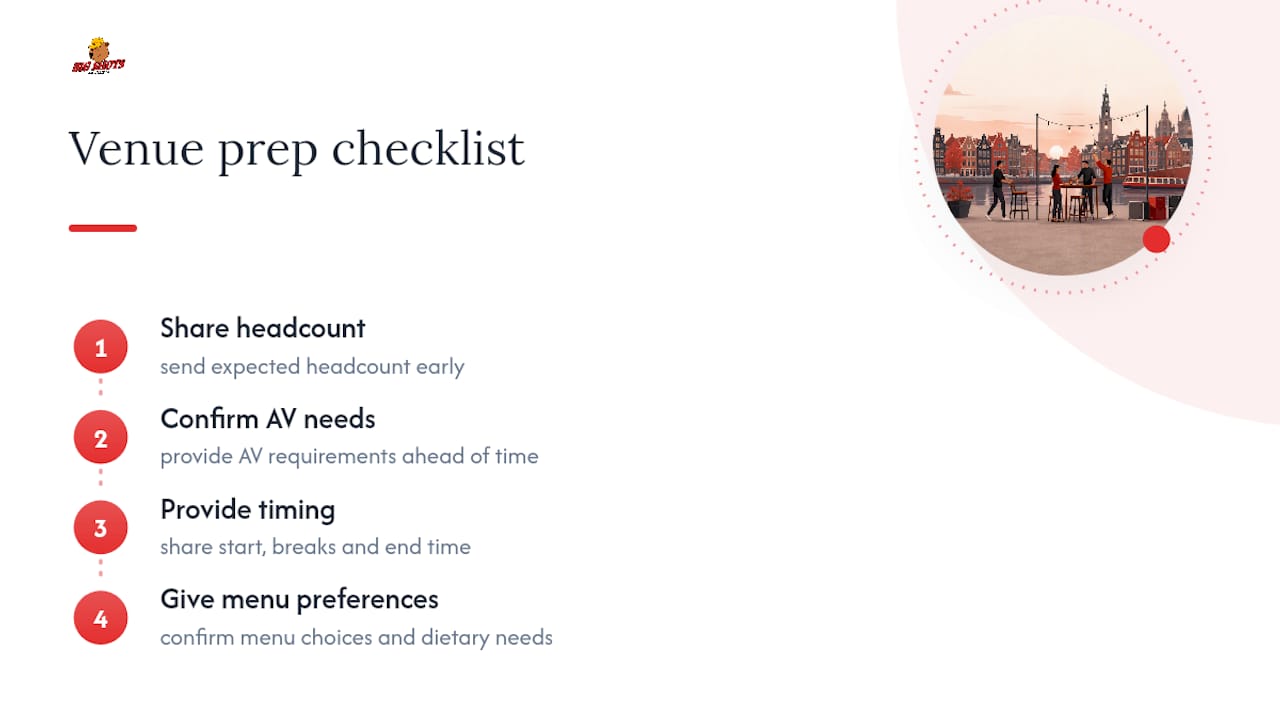
Booking a room changes what you're responsible for. Venues need your expected headcount, AV requirements, and menu choices well before the date to set up efficiently. Sharing those details early speeds up the whole process on both sides.
A good seating layout matters more than most organizers expect. Bar-adjacent tables work for casual groups; clustered seating with clear sightlines to the screen works better for competitive teams. Sharing a short checklist, headcount, AV needs, timing, and menu preferences, with your venue ahead of time cuts setup time significantly on the night.
Where Standard Pub Quiz Advice Gets It Wrong
The advice that circulates most, "just write some fun questions and wing it", underestimates how much of a quiz's success comes down to logistics nobody thinks about until it's too late. Sound quality, seating layout, and a working tiebreaker rule matter more than clever trivia. A brilliant question read into a dead microphone helps nobody.
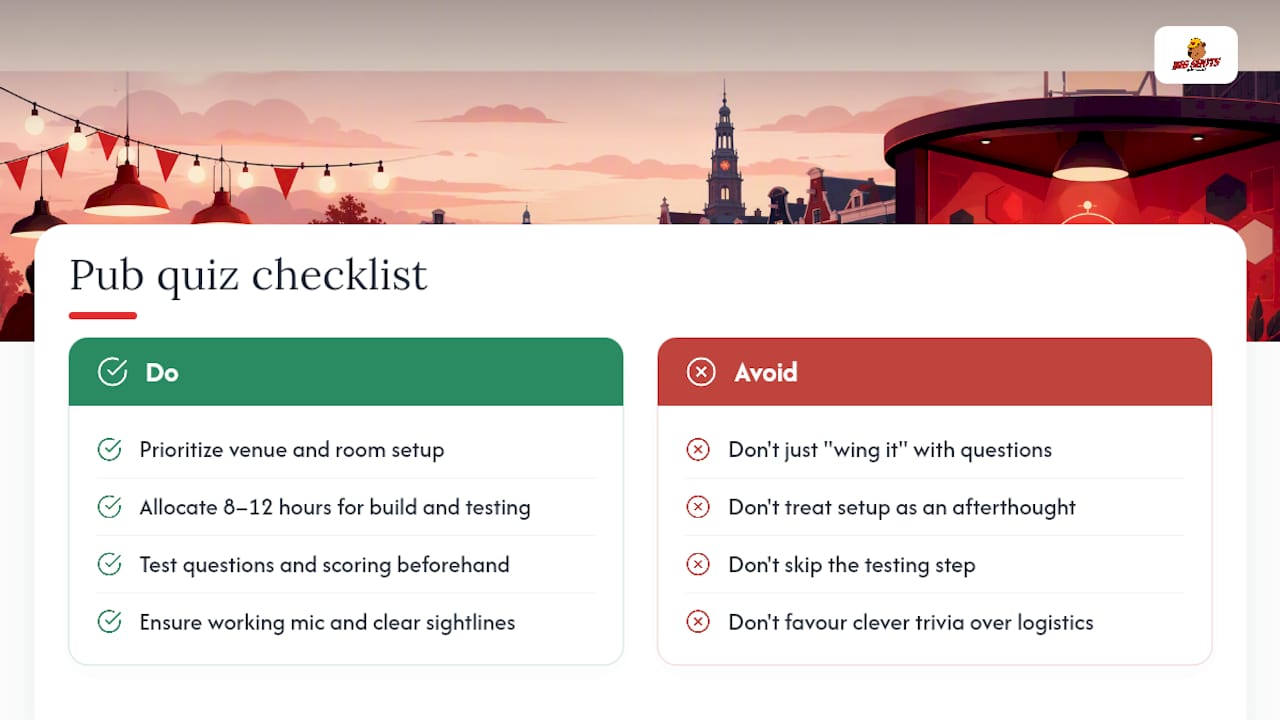
The bigger blind spot is time. Most first-time organizers plan for the fun part, writing questions, and treat setup and scoring as an afterthought. That's backwards. The 8 to 12 hours a solo organizer typically spends building a quiz from scratch mostly goes into structure and testing, not clever trivia. Skip the testing step and you'll find out live, in front of your guests, that question 14 has two correct answers.
If there's one thing worth prioritizing above all else, it's the venue and the room's setup. A great quiz in a room with bad sound and awkward seating still fails. A decent quiz in a well-run room, clear sightlines, working mic, sensible seating, survives a few weak questions without anyone noticing. Fix the room first. The trivia can be good enough; the room has to be right.
— Leo
Book a Ready-Made Room Instead of Building One From Scratch
Skip the venue-hunting, the sound system troubleshooting, and the seating-chart guesswork. There are venues in Amsterdam that offer rooms built for pub quizzes, including working AV and microphones, bars and kitchens ready to serve during breaks, and staff familiar with quiz nights.
That's the trade a hired venue makes for you. Instead of spending your prep hours testing projector cables and rearranging tables, you hand over your headcount, timing, and menu preferences, and the room is ready when your teams walk in. Some sports bars and lounge setups in Amsterdam can accommodate events from small office quizzes to larger charity nights without requiring additional seating rentals.
If that sounds like less hassle than running it yourself, get in touch through Big Shots Amsterdam to check dates and lock in your next quiz night.
Sources
- Een PubQuiz organiseren: Compleet draaiboek met tips & schema
- Quiz-vragen
- Pubquiz Organiseren | Checklist + Wanneer Uitbesteden | QuizX
- Quizizz vs Kahoot! — Jotform blog