
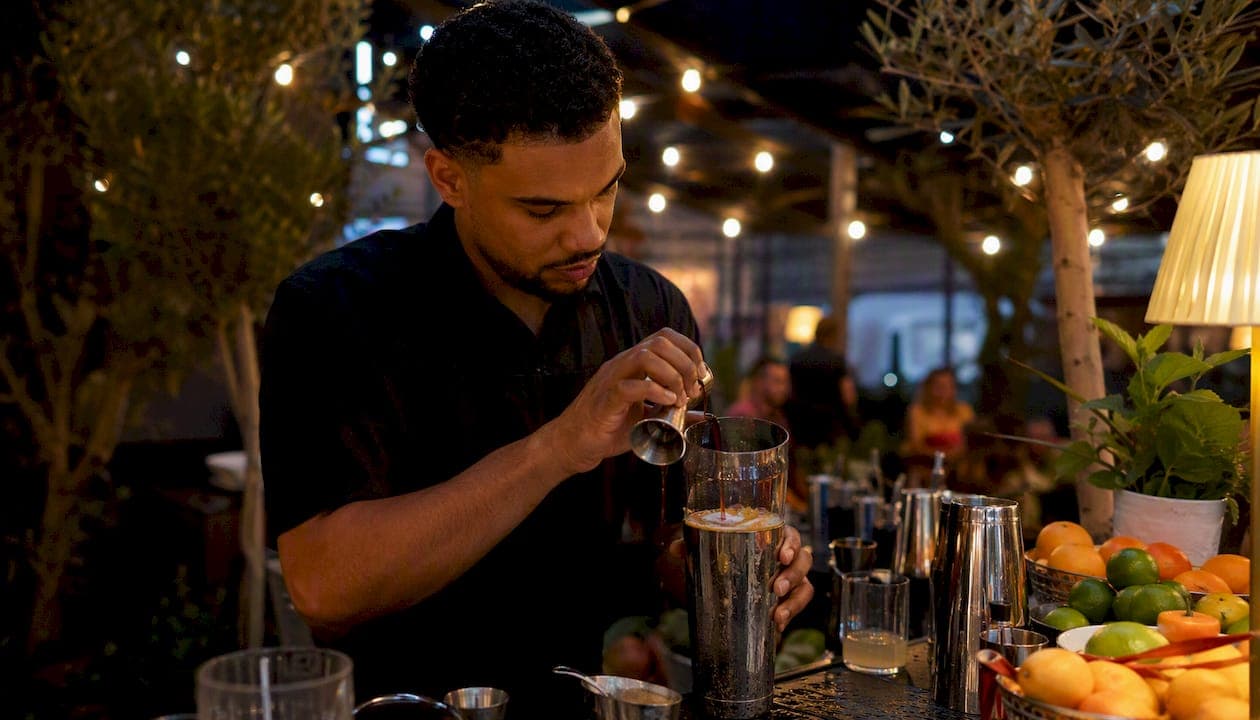
A bartender shapes the drink experience through three channels working at once: technical craft (the recipe, the pour, the balance), service rituals (timing, presentation, pacing), and emotional presence (tone, attentiveness, how safe and seen you feel). None of these works alone. A perfectly balanced Negroni served by someone who won't make eye contact tastes worse than a slightly heavy-handed one delivered with warmth and good timing.
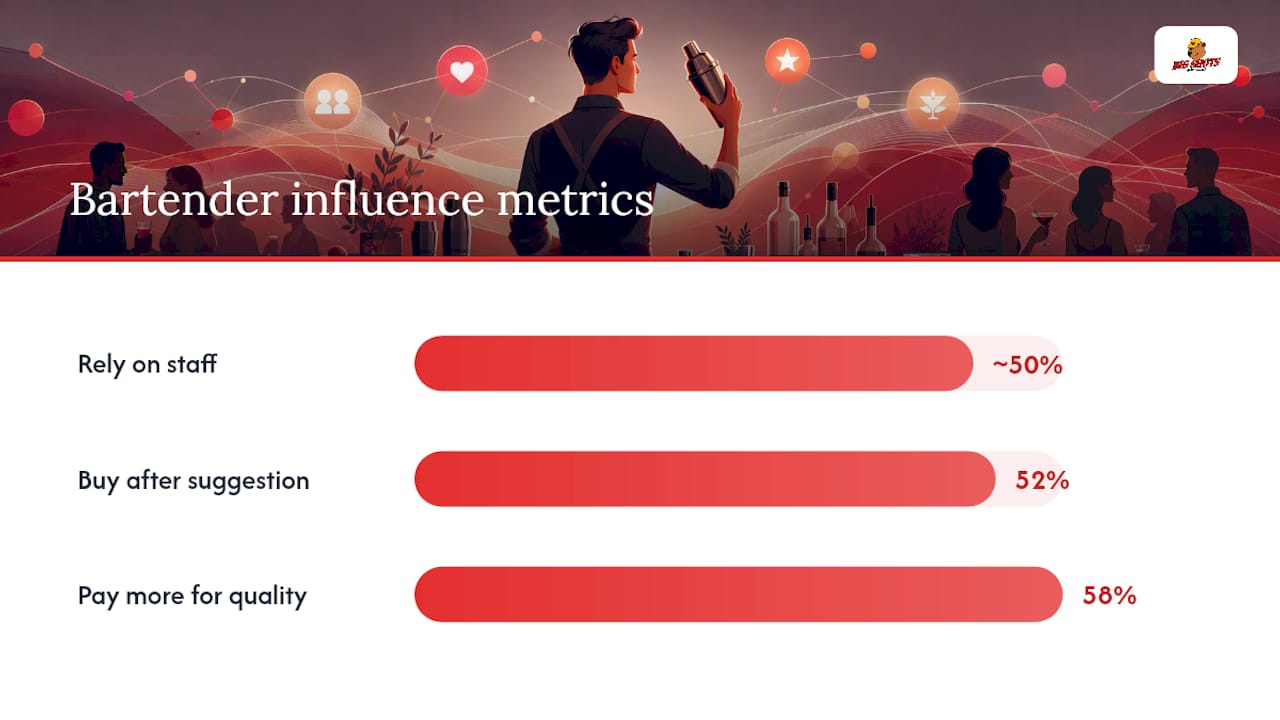
The numbers back this up. Roughly 58% of on-premise drinkers say they'll pay more for a better-quality drink, a figure that has climbed two points since 2024. Meanwhile, about half of consumers lean on staff recommendations when deciding what to order, and 52% say a bartender's suggestion directly drives their purchase. That's not a minor influence. It's the difference between a bar selling what's on the shelf and a bar selling what people actually remember.
Here's what that influence looks like in practice, broken into the moves you can actually observe at the rail:
- Recommendations that steer guests toward drinks they'll enjoy more and remember longer
- Presentation choices (glassware, garnish, plating) that change perceived quality before the first sip
- Pacing that controls how a session feels, from the first pour to last call
- Harm reduction that keeps guests safe without them noticing the intervention
By the numbers: The average premium-tier bartender influences an estimated 10,976 individual drink decisions every year — nearly 11,000 moments where a recommendation, a tone, or a pour either built loyalty or lost it.
Key Takeaways
Guest satisfaction with a drink depends more on service delivery, timing, and emotional presence than on the recipe alone, and that gap converts directly into recommendation-driven sales and repeat visits.
| Point | Details |
|---|---|
| First contact anchors everything | Greeting tone and response speed shape how guests judge the entire visit, drink included. |
| Consistency beats novelty | Standardized recipes and portion control keep the guest experience identical across every shift. |
| Recommendations drive real revenue | Around 52% of guests buy based on staff suggestions, making trained, knowledgeable staff a sales lever. |
| Safety work happens quietly | Bartenders moderate consumption and de-escalate conflict as routine, informal harm reduction. |
| Training compounds over time | Recipe drills, sensory calibration, and hospitality psychology together produce measurable consistency. |
Table of Contents
- What Is the Role of Bartenders in the Drink Experience?
- How Does First Contact Shape a Guest's Whole Experience?
- What Skills Do Bartenders Need to Deliver Consistent Service?
- What Is the 3:2:1 Rule and Why Does Consistency Matter More Than Creativity?
- Why Do Two Identical Cocktails Create Different Memories?
- How Do Bartenders Actually Drive Sales and Loyalty?
- What Harm-Reduction Role Do Bartenders Play?
- How Do Venues Train and Retain Staff Who Deliver Consistently?
- What Can Bartenders Do Right Now to Improve Tonight's Service?
- How Big Shots Amsterdam Puts These Principles Into Practice
- Frequently Asked Questions
- Sources
What Is the Role of Bartenders in the Drink Experience?
The standard industry term for this work is guest experience management, and it's a more accurate label than "bartending" alone because it captures everything that happens around the glass, not just in it. A bartender is simultaneously a technician, a host, a salesperson, and an informal safety monitor. Miss any one of those roles and the whole experience wobbles, even if the cocktail itself is flawless.
Qualitative research on bar service backs this up directly: guests rate their experience on service speed, friendliness, accuracy, and creativity together, not on liquid quality alone. One study tracking real bar interactions found average service times of two to three minutes created the strongest positive impressions, provided the bartender was also warm and precise. Speed without warmth reads as transactional. Warmth without speed reads as disorganized. You need both.
How Does First Contact Shape a Guest's Whole Experience?
Guests decide how they feel about a bar before they've tasted anything. The greeting, the eye contact, the speed of acknowledgment, all of it sets a frame the rest of the visit gets measured against. Hospitality psychology research on guest experience shows that micro-behaviors like eye contact, tone, and ritual anchor how someone evaluates everything that follows, including the drink itself.
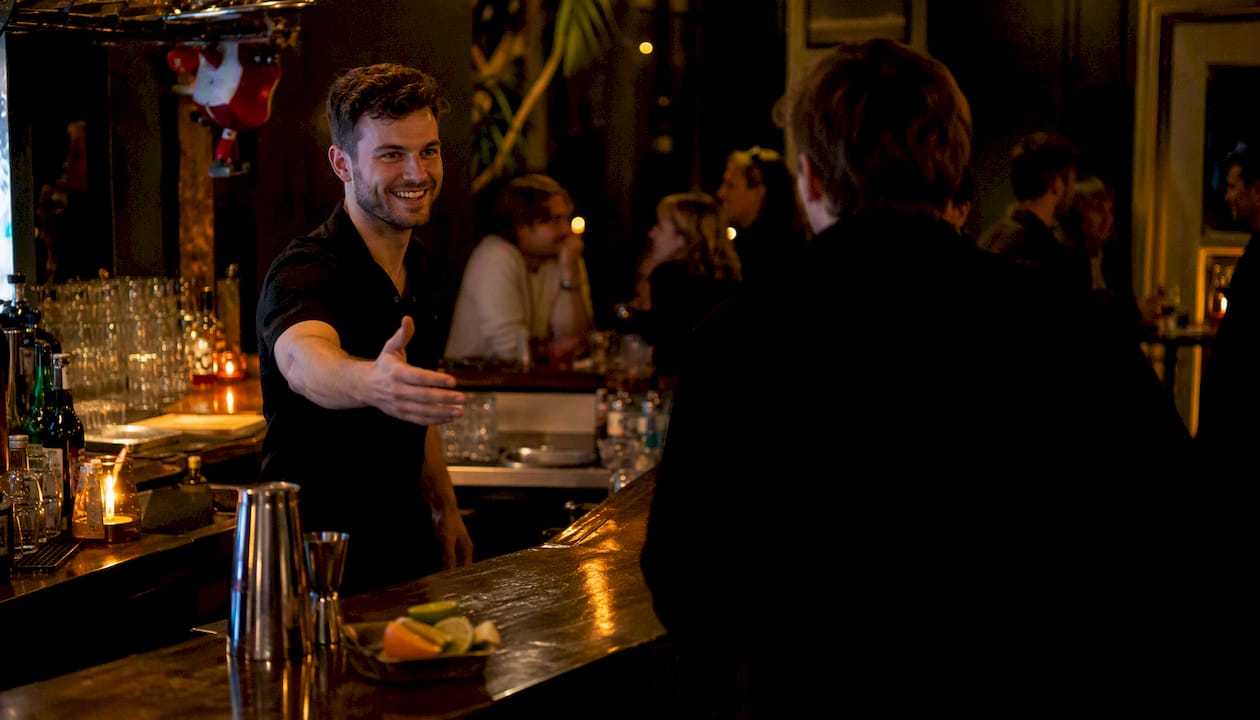
This is expectation anchoring, and it works both ways. A guest who feels ignored for ninety seconds at an empty bar will rate an objectively good drink lower than a guest who got a nod, a "be right with you," and a menu within fifteen seconds. The drink hasn't changed. The frame around it has.
Anticipatory service matters just as much as the initial greeting. Refilling a water glass before it's empty, noticing a guest checking the game on the TV and adjusting the volume without being asked, remembering that a regular takes their whiskey neat rather than asking again. These small acts of attention compound. They tell a guest that someone is actually paying attention to their evening, not just processing their order.
Do this at first contact:
- Make eye contact and acknowledge every guest within 30 seconds, even if you can't serve them yet.
- Read the group's energy before pitching anything (a first date needs a different tone than a group watching a match).
- Use a name or a recognizable detail if you've served someone before.
Avoid this at first contact:
- Don't stay heads-down on a task when someone new sits at the bar.
- Don't launch into a scripted greeting that ignores what the guest is actually doing (on the phone, mid-conversation, clearly in a hurry).
- Don't oversell before you've read whether the guest wants conversation or space.
Pro Tip: Time your first check-in for right after the guest's second sip, not the first. The first sip is about the drink; the second is when they've settled in and are open to conversation. A well-timed check-in at that moment sticks in memory far better than one delivered too early or too late.
What Skills Do Bartenders Need to Deliver Consistent Service?
Good bartending splits cleanly into technical skill, interpersonal skill, and operational discipline, and venues that only train for one of the three end up with inconsistent guest experiences no matter how talented individual staff members are.
On the technical side, a competent bartender needs accurate free-pouring or jiggering, correct shake-versus-stir judgment (shaking aerates and dilutes faster, stirring preserves clarity and silkiness in spirit-forward drinks), garnish and glassware selection that matches the drink's category, and consistent quality control across every ticket. On the interpersonal side, it's active listening, tactful recommendation-making, reading group dynamics (is this table celebrating or unwinding after a hard day), and de-escalation skills for when a guest has had one too many. Operationally, it's mise-en-place before doors open, stock rotation so nothing goes stale behind the bar, hitting speed targets during a rush, and getting payments and orders right the first time.
A bartender should be able to do all of this on a typical shift:
- Set up a full mise-en-place (garnishes, syrups, citrus, ice) before the first guest arrives
- Build any of the bar's core drinks from memory without checking a recipe card
- Process a payment and confirm an order accurately even mid-rush
- Read a group's mood within the first exchange and adjust tone accordingly
- Track and rotate stock so nothing sits past its usable window
- Recognize signs of overserving and adjust pacing before it becomes a problem
Venues track this performance with a handful of recurring metrics: average service time, recommendation-to-purchase rate, pour variance, and waste percentage. The 2–3 minute service window flagged in research on bartender-driven consumer experience is a useful internal benchmark, though the right number depends on your venue's format and volume. If you're building out your own bartending fundamentals, our guide to cocktail basics for beginners covers the technical starting point in more depth.
What Is the 3:2:1 Rule and Why Does Consistency Matter More Than Creativity?
Creativity gets the attention, but repeatability is what actually keeps guests coming back, because a guest who loved a drink last month expects the same drink this month. That tension between novelty and consistency defines most of what separates a good bar program from a mediocre one.
The 3:2:1 rule is one of the simplest frameworks for keeping a sour-style drink balanced: three parts base spirit, two parts sweet, one part sour. It's the backbone of classics like the Daiquiri and the Whiskey Sour, and it gives bartenders a reliable starting ratio they can adjust for specific spirits or citrus acidity without guessing from scratch every time. Beyond that ratio, every competent bartender should be able to build the handful of drinks that anchor most menus: an Old Fashioned, a Margarita, a Negroni, a Martini, a Mojito, and a Whiskey Sour. These aren't just crowd-pleasers. They're the drinks that reveal whether someone actually understands balance, because there's nowhere to hide a bad ratio in a three-ingredient cocktail.
Presentation changes perceived taste even when the liquid inside is identical. A properly chilled coupe glass, an expressed citrus oil over the top instead of a garnish dropped in as an afterthought, the right ice format for the drink's dilution needs — these sensory cues shift how a guest experiences the first sip before they've even tasted it. Temperature alone can make a well-made cocktail taste flat if it's served a few degrees too warm.
Steps that make creative drinks repeatable across a whole team:
- Write recipes in exact weights or milliliters, not "a splash" or "a dash."
- Photograph the finished, correctly built drink and post it at the station as a visual reference.
- Standardize garnish size and placement so every version looks identical.
- Run a short calibration tasting whenever a new drink goes on the menu, with every bartender on shift.
Pro Tip: Standardize the small stuff nobody talks about, like garnish weight and pour cutoffs, because that's where consistency quietly breaks down under pressure. A Friday-night bartender who eyeballs a lime wheel differently than a Tuesday-afternoon bartender is the reason regulars notice "it tastes different tonight" even when the recipe card hasn't changed.
For more on how creativity and technique come together at a working bar, see our breakdown of what makes Amsterdam's mixologists genuinely skilled.
Why Do Two Identical Cocktails Create Different Memories?
Give two guests the exact same Old Fashioned. One gets it slid across the bar with no comment. The other gets a brief note about the orange peel being expressed rather than dropped in, and why that changes the aroma. Those two guests will describe the drink differently a week later, even though the glass contents were identical down to the milliliter.
This is the mechanism behind expectation anchoring and the peak-end rule in hospitality psychology: people don't remember an entire experience evenly, they remember the emotional peaks and the ending. A short story about where an ingredient comes from, or why a particular bitters was chosen, creates a peak that a silent pour never will. Research on hospitality psychology in bar settings points to exactly this: perception and delivery shape memory and loyalty as much as the liquid does.
Ritual works the same way. Flaming a citrus peel, presenting a shared punch bowl with a bit of ceremony, or plating a garnish tableside instead of behind the bar all signal that a drink required craft and attention. None of that ceremony changes the recipe. It changes what the guest believes they're drinking, and belief shapes taste more than most people realize.
Storytelling prompts a bartender can actually use without sounding scripted:
- "This one uses a bitters blend we don't see much outside small producers, want to know what's in it?"
- "That garnish is expressed, not just dropped in. Smell it before you take a sip."
- "This recipe's basically unchanged since the 1930s. Some things don't need fixing."
| Point | Details |
|---|---|
| Anchoring happens early | First-contact tone and pacing set the frame guests use to judge everything after. |
| Story raises perceived value | A short ingredient or method note turns a routine pour into a memorable moment. |
| Endings stick | The last interaction of a visit weighs heavily on how the whole evening gets remembered. |
How Do Bartenders Actually Drive Sales and Loyalty?
The connection between a bartender's recommendation and a venue's revenue is more direct than most owners assume. About half of consumers rely on staff knowledge to decide what to order, and 52% say they're likely to buy something specifically because a bartender suggested it. That recommendation behavior concentrates heavily in spirits and cocktails, with whiskey, gin, and agave-based spirits coming up as frequently requested categories.
Run the math and the scale becomes obvious. If a premium-tier bartender influences close to 11,000 individual drink decisions a year, even a modest shift in which drinks get recommended (steering toward higher-margin cocktails, or toward a new product the venue is trying to move) compounds into a measurable revenue swing over a full year.
| Metric | Reported Figure |
|---|---|
| Consumers relying on staff recommendations | about half |
| Consumers likely to purchase based on bartender suggestion | 52% |
| Consumers willing to pay more for better quality | 58% |
| Estimated drink decisions influenced per bartender annually | ~10,976 |
Familiarity and training drive most of this influence. Bartenders who actually know a spirit brand, its production process, or its flavor profile recommend it more often and more convincingly than staff working off a laminated menu they've never tasted from. That's a training investment, not a marketing one.
For managers, the ethical version of incentivizing this behavior looks like education first, spiffs second. Train staff thoroughly enough that recommendations come from genuine familiarity, then track recommendation-to-purchase rate as a performance metric alongside speed and accuracy, not as a replacement for them. A menu that's actually designed to prompt these moments helps too. Our guide to building a drinks menu covers how menu structure itself nudges recommendation behavior.
What Harm-Reduction Role Do Bartenders Play?
Bartenders perform an informal public-health function that rarely gets named directly but shows up constantly in how bars actually operate. Researchers studying this behavior call it an "infrahealth" role: bartenders moderate consumption, prevent conflicts from escalating, and sometimes act against a short-term sale to keep a guest or a room safer. A more recent ethnographic study of bar service confirms this isn't occasional. Field research across working bars found that anticipatory harm-reduction and conflict-management techniques show up routinely, even in venues with no formal safety program telling staff to do it.
In practice, this looks like slowing the pace of pours for a guest who's clearly speeding up their own intake, offering water or food without making it feel like an accusation, and occasionally refusing another round even when the sale would be easy money. It also looks like reading a group's dynamic before a disagreement turns into something physical, and quietly separating people or redirecting attention before staff or security have to step in.
The barriers to doing this well are real. Sales pressure, a packed room during a rush, and inconsistent training all work against a bartender's ability to intervene early. Venues that take this seriously build it into training rather than leaving it to individual instinct.
SOP-style steps for managing intoxication and de-escalation:
- Watch for early signs (slurred requests, slower reaction time, mood shift) before a guest reaches a visibly impaired state.
- Slow the pace by extending time between orders or suggesting a lower-proof option, without framing it as a refusal.
- Offer water or food naturally, as part of the service rather than as an intervention.
- If a guest becomes disruptive, redirect calmly and involve a manager or security before the situation escalates, not after.
- Document any refused service per house policy to protect both the guest and the venue.
Pro Tip: Frame every safety intervention as hospitality, not enforcement. "Let me get you some water while that comes up" lands completely differently than "I think you've had enough." Same outcome, opposite guest experience.
How Do Venues Train and Retain Staff Who Deliver Consistently?
Training priorities that actually move the needle cover five areas: recipe drills until execution is automatic, sensory calibration so the whole team tastes and smells the same reference points, hospitality psychology basics like the anchoring effects covered earlier, responsible-service protocols, and upselling grounded in real product knowledge rather than a script.
Retention matters just as much as training, because a bar that constantly rehires and retrains never reaches the consistency guests notice and reward. Bartenders who stay tend to cite ongoing education, real relationships with suppliers and brand reps, fair and predictable scheduling, and some level of support for the physical and emotional wear of the job. Brands that invest in bartender education earn stronger, more genuine advocacy than brands that lean on promotions or one-off tasting events, and the same principle applies to venues investing in their own staff.
A readiness checklist managers can run before trusting a new hire on the floor solo:
- Can they build every core menu drink from memory, correctly, twice in a row?
- Do they know the story or provenance of at least three featured spirits on the back bar?
- Have they demonstrated a real de-escalation moment, even a minor one, during training shifts?
- Can they hit the venue's target service time during a simulated rush?
Standardization tactics worth building into daily operations:
- Written SOPs for opening, closing, and mid-shift resets
- A fixed mise-en-place checklist posted at every station
- Portion control tools (jiggers, calibrated pour spouts) rather than relying purely on free-pour skill
- Recorded pour variance checks a few times a month to catch drift early
Track training effectiveness with a small number of honest metrics: recommendation rate, variance in pour size across staff, and direct customer feedback. The 2 to 3 minute service window that correlated with strong guest satisfaction in bar-service research is a reasonable internal benchmark to train toward, adjusted for your own venue's volume and format.
What Can Bartenders Do Right Now to Improve Tonight's Service?
Everything above is strategy. This is the shift-ready version, organized by when in the shift each move matters most.
Before doors open:
- Complete full mise-en-place: garnishes cut, syrups stocked, ice bins full, glassware chilled where needed.
- Taste-check any batch syrups or infusions for consistency against yesterday's batch.
- Review the night's likely crowd (reservations, events, sports schedule) and mentally prep pacing.
During service: 4. Acknowledge every new guest within 30 seconds, even with just eye contact and a nod. 5. Read the table or group before pitching a recommendation, don't lead with the same line every time. 6. Time your check-ins for after the second sip, not immediately after delivery. 7. Watch pacing on every guest, not just the ones who look like they're struggling. 8. Keep pours consistent even when the bar is three-deep and the pressure to speed up is real.
At shift end: 9. Restock and rotate for the next shift so nobody inherits your mess. 10. Note anything unusual (a drink that didn't land, a guest who needed extra attention) for the next bartender or manager.
Quick fixes for the most common problems:
- Slow service during a rush: pre-batch your highest-volume drinks before doors open, not during the rush itself.
- Noisy environment killing conversation-based recommendations: lean on visual cues (a chalkboard special, a pointed gesture at the menu) instead of shouting over the crowd.
- Inconsistent pours across a shift: switch to a calibrated jigger for the busiest hours, when free-pour accuracy naturally drifts.
Pro Tip: The highest-impact habit that costs nothing is simply repeating a guest's order back before you walk away. It cuts mistakes, and it also signals attentiveness that guests register even when they can't articulate why the service felt better.
For venues thinking through layout and flow issues that make these habits harder or easier to execute, our piece on bar design in Amsterdam covers how physical space affects service speed and sightlines.
How Big Shots Amsterdam Puts These Principles Into Practice
Every principle in this article shows up somewhere in how a multi-format venue like Bigshotsamsterdam actually runs a shift. Combining a sports bar, a shisha lounge, a restaurant, and a café under one roof means the front-of-house team constantly shifts tone across very different guest occasions: a table settling in for a quiet dinner sits a few feet from a group watching a match at full volume, and the greeting, pacing, and recommendation style has to flex for each.
Challenge: A venue this varied risks inconsistent service, where a guest's experience depends heavily on which bartender happens to be working and which section they're seated in.
Actions: Staff at Bigshotsamsterdam are trained to read the occasion fast, whether that's a first date needing a quieter touch or a group of regulars settling in for a match. Recipe standardization keeps the craft cocktail menu consistent across shifts, and front-of-house rituals (the initial greeting, the timing of a first check-in, attentiveness to a shisha table's pacing) get applied across every format the venue runs, not just the bar.
Observations: Guest feedback and testimonials consistently point to the relaxed, attentive atmosphere as the differentiator, more than any single menu item. That tracks with everything the research on guest experience shows: delivery and presence shape memory as much as the liquid in the glass.
A bar that runs a sports section, a shisha lounge, and a full kitchen under one roof only works if every staff member can read a room and adjust tone in seconds, not minutes. That flexibility is the actual product, more than any single drink on the menu.
Specific practices a multi-format venue like this relies on:
- Menu prompts that make it easy for staff to suggest a pairing between food and a specific cocktail
- Cross-training so bartenders can competently handle both the sports-bar rush and quieter café service
- A consistent check-in cadence regardless of section, so a shisha lounge guest gets the same attentiveness as someone at the main bar
- Standardized recipe cards for the core cocktail menu to keep quality identical across shifts and staff
- Built-in harm-reduction awareness during high-volume sports nights, when overserving risk climbs
If you're planning a group visit and want to see these rituals applied to a curated cocktail session, our group cocktail experience booking guide walks through how that works in practice, and the full menu and reservation options live at Bigshotsamsterdam.
A Personal Take on What Actually Separates Good Bartenders From Great Ones
Watching enough shifts across enough different bars teaches you that talent behind the stick is common. Consistency under pressure is rare. The bartenders who leave a lasting impression aren't usually the ones with the flashiest technique, they're the ones who read a room correctly on their worst night, not just their best one.
A few things I weigh most heavily when judging whether a bartender is actually good at this job, beyond whether the drink tastes right:
- Consistency under pressure matters more than peak performance on a slow Tuesday. Anyone can make a great cocktail with no line behind them.
- Emotional intelligence shows up in the gap between what a guest says and what they actually need, and the best bartenders close that gap without being asked.
- Safety instincts that kick in before a situation requires intervention are the clearest sign of real experience, not training that stuck versus training that's just theory.
The research backs a version of this that surprised me: the 2 to 3 minute service window tied to strong guest satisfaction wasn't about raw speed. It was speed paired with friendliness and accuracy at the same time. Bars that chase speed alone tend to lose the warmth that actually makes people come back.
Frequently Asked Questions
What is the main role of bartenders in the drink experience? Bartenders shape the drink experience through three combined channels: the technical quality of the drink itself, the service rituals surrounding it (timing, presentation, pacing), and the emotional tone they set through attentiveness and hospitality. Research on consumer experience in bars confirms that service speed, accuracy, and friendliness together drive satisfaction more than the recipe alone.
How much do bartender recommendations actually influence sales? About 52% of consumers say they're likely to purchase a drink specifically because a bartender recommended it, and roughly half rely on staff knowledge when deciding what to order in the first place.
What is the 3:2:1 rule in bartending? It's a balancing ratio for sour-style cocktails: three parts base spirit, two parts sweet, one part sour. It's the structural foundation behind classics like the Daiquiri and the Whiskey Sour, and it gives bartenders a reliable starting point for building new drinks without guessing.
Do bartenders play a role in guest safety? Yes. Field research on bar service documents bartenders performing an informal harm-reduction role, moderating pours, offering water or food, and de-escalating conflict, often even when it works against an immediate sale. Academic work on this describes it as an infrahealth function that operates alongside formal responsible-service training.
How do venues keep drink quality consistent across different bartenders? Through standardized recipes measured in exact weights rather than approximations, calibrated tools like jiggers and pour spouts, written SOPs for opening and closing, and regular sensory calibration tastings so the whole team shares the same reference point for how a drink should taste and look.
Sources
- Why bartenders still hold the keys to on‑premise success
- The power behind the bar: how brands can influence 11k purchases a year
- Ethnographic study of bartenders’ harm-reduction practices (2025)
- The Bartender's Role in Creating a Consumer Experience (IRJEMS)