
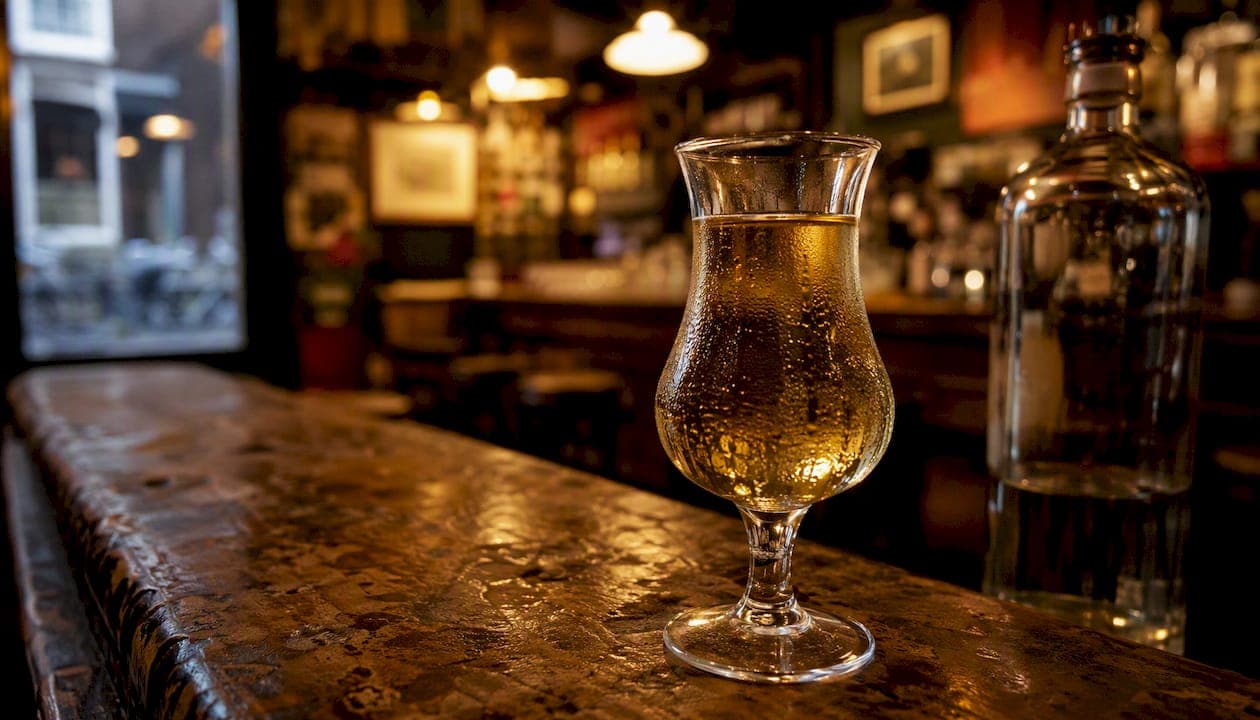
Jenever is the Netherlands' traditional grain-and-juniper spirit and the living center of Dutch borrel culture. No other drink carries the same weight in Dutch social life: it predates gin by at least a century, holds EU protected geographical indication status, and is still served in a ritual that has not changed in three hundred years.
- Protected identity: Jenever may only be produced in the Netherlands, Belgium, and designated regions of France and Germany under EU law, making it one of the few spirits with the same legal protection as Champagne or Cognac.
- Ritual distinction: The tulip glass filled to the brim, the first sip taken without lifting it, and the kopstoot (jenever chased with lager) are customs that set Dutch drinking culture apart from anywhere else in the world.
Key Takeaways
Jenever is the Netherlands' most historically significant spirit, and its rituals, types, and protected status make it irreplaceable in Dutch drinking culture.
| Point | Details |
|---|---|
| Cultural centrality | Jenever anchors borrel culture, ceremonies, and regional identity across the Netherlands. |
| Type differences | Jonge is light and neutral (1.5%–15% malt wine); oude and korenwijn are richer, grain-forward, and best sipped neat. |
| Ritual etiquette | First sip from a brim-filled tulip glass without lifting it; kopstoot pairs jenever with lager for a classic Dutch experience. |
| Protected status | EU geographical indication law limits authentic jenever production to the Netherlands, Belgium, and designated French and German regions. |
| Try it in Amsterdam | Bigshotsamsterdam offers jenever alongside gourmet food and a lively social atmosphere in the heart of Amsterdam. |
Table of Contents
- How did jenever shape Dutch drinking culture over the centuries?
- What are the main types of jenever and how is it made?
- How do the Dutch actually drink jenever?
- Which cities and distilleries define jenever culture?
- How does jenever differ from gin?
- What does the contemporary jenever scene look like?
- How to order and taste jenever like a local
- Why does jenever still matter in Dutch society?
- An honest perspective on trying jenever today
- Experience jenever at Bigshotsamsterdam in Amsterdam
- Sources
How did jenever shape Dutch drinking culture over the centuries?
The role of jenever in Dutch drink culture stretches back to the 1500s, when distillers in the Low Countries were producing grain-based "aqua vitae" flavored with juniper berries for medicinal purposes. Juniper was believed to treat kidney ailments and digestive complaints, so early jenever was pharmacy stock, not bar stock.
By the 1600s, production had outgrown the apothecary. Dutch trade networks carried the spirit across Europe, and English soldiers fighting in the Low Countries during the Thirty Years' War brought it home, giving rise to the phrase "Dutch courage." That export moment planted the seed for what would eventually become London Dry gin, though the two spirits diverged sharply in character and culture.
- 1500s: Grain distillates flavored with juniper appear in the Low Countries as medicinal preparations.
- 1600s–1700s: Commercial distillation expands rapidly; Schiedam becomes the world's largest jenever-producing city, with hundreds of windmills grinding grain for local distilleries.
- 1800s: Industrialization consolidates production; jenever becomes a mass-market commodity, and per-capita consumption in some Dutch regions reaches levels that alarm temperance reformers.
- Early 1900s: The temperance movement and two world wars disrupt production and consumption; lighter, more neutral styles begin replacing the heavy malt-wine-forward originals.
- Post-WWII: Jonge jenever, a lighter style with lower malt-wine content, dominates the market as consumer tastes shift toward cleaner, less grain-heavy spirits.
- Late 1990s–2000s: A craft revival begins; small distilleries revive traditional oude and korenwijn recipes, and bartenders rediscover jenever's role in 19th-century cocktail history.
The EU's decision to codify jenever's production rules under a geographical indication formalized what distillers had practiced for centuries and gave the Dutch spirits tradition a legal backbone that protects it from imitation.
What are the main types of jenever and how is it made?
Jenever's character comes from moutwijn (malt wine), a pot-still distillate made from a grain mash of corn, rye, and malted barley. Think of it as an unaged, low-proof whisky-like spirit. That moutwijn is then blended with a neutral grain spirit and redistilled with botanicals, primarily juniper. The ratio of moutwijn to neutral spirit is what separates the legally defined types and their regulatory markers.
The four main types:
- Jonge jenever: The modern, lighter style. Malt-wine content runs 1.5%–15%, minimum ABV is 35%, and sugar is capped at 10 g/L. The result is a clean, relatively neutral spirit that is easy to drink but lacks the depth of older styles.
- Oude jenever: The traditional style, with at least 15% malt wine and sugar permitted up to 20 g/L. Richer, rounder, with a noticeable grain backbone that can remind you of a light whisky.
- Korenwijn: The most malt-wine-forward category, containing 51%–70% moutwijn. Often aged in oak casks, it develops vanilla and wood notes alongside the grain. Sipped neat, slowly.
- Graanjenever: A grain-only style, typically lighter and drier, with juniper playing a supporting role rather than leading.
The malt-wine base is the technical detail that separates jenever from every other juniper spirit. It gives older styles their weight and texture, and it is the reason jenever's flavor profile sits closer to a grain whisky than to a modern gin.
How do the Dutch actually drink jenever?
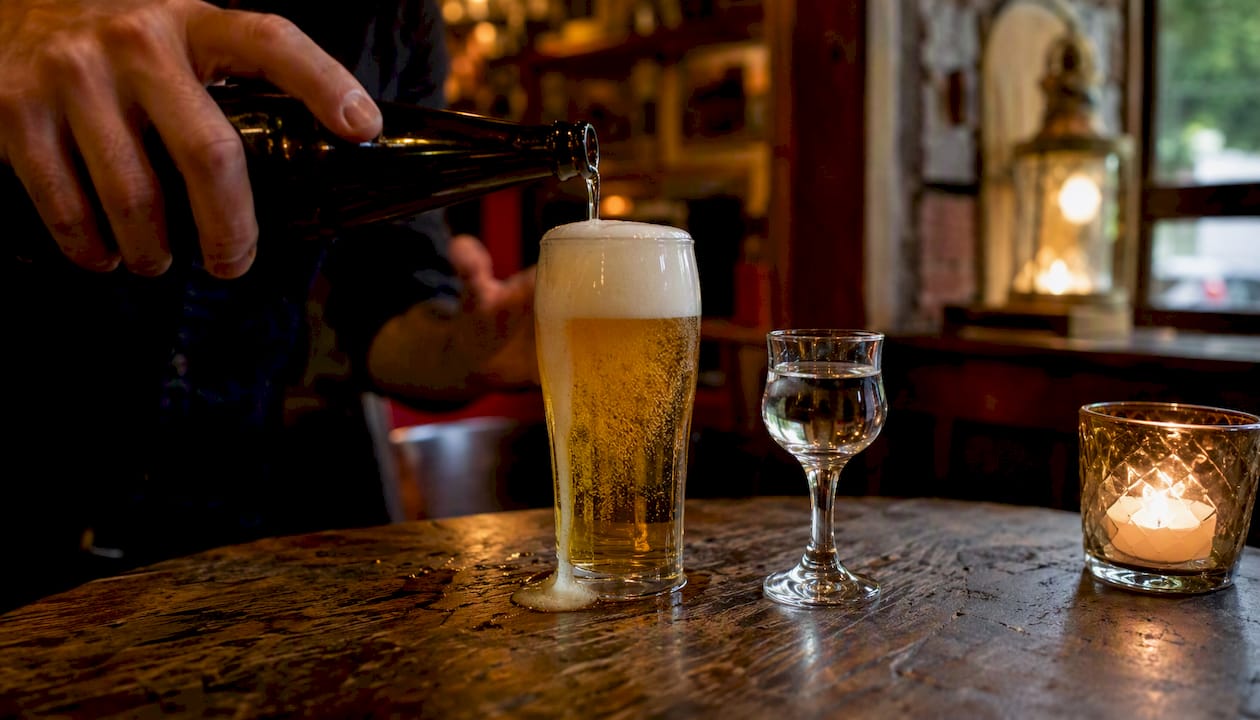
Ordering jenever in Amsterdam or Schiedam is not complicated, but doing it right signals that you know what you are dealing with. The rituals are specific and worth learning before you walk into a proeflokaal.
The tulip glass ritual:
- The bartender fills a tulip-shaped glass to the absolute brim. This is intentional, not careless.
- You lean forward, place your lips on the rim, and take the first sip without touching the glass with your hands.
- Only after that initial sip do you pick up the glass. The custom originated as a practical way to avoid spilling a glass filled past any reasonable margin.
The kopstoot (literally "head butt"):
- Order a small jenever alongside a glass of Dutch lager (Heineken, Amstel, or a local pilsner).
- Sip the jenever in one or two short draws, chilled or at room temperature depending on style.
- Follow immediately with a pull of beer. The grain notes in both the spirit and the lager complement each other in a way that makes the pairing feel designed rather than accidental.
The duikboot ("submarine"):
A variation where the jenever glass is submerged into the beer glass and drunk together. Less common today, more of a party move than a traditional ritual, but you will still see it in brown cafés on a Friday evening.
Etiquette dos and don'ts:
- Do ask for jonge if you want something light and approachable; ask for oude or korenwijn if you want to taste what jenever actually is.
- Do serve jonge chilled or straight from the freezer; serve korenwijn at room temperature.
- Don't mix korenwijn into a tonic drink. The malt-wine weight clashes with carbonation in a way that wastes a good pour.
- Don't rush. A kopstoot is a ritual, not a shot sequence.
Pro Tip: In a traditional proeflokaal, asking for "een borrelglaasje jenever" (a small glass of jenever) is the correct phrasing. Specifying "jonge" or "oude" immediately marks you as someone who has done their homework.
Which cities and distilleries define jenever culture?
The jenever cities of the Netherlands are not just historical footnotes. Several of them still anchor active distilling traditions, and visiting them is the fastest way to understand the spirit's cultural geography.
Key jenever cities:
- Schiedam: The undisputed capital of Dutch jenever production. At its peak in the 19th century, Schiedam had over 400 distilleries and the tallest windmills in the world, built to grind grain for the industry. The National Jenever Museum sits here.
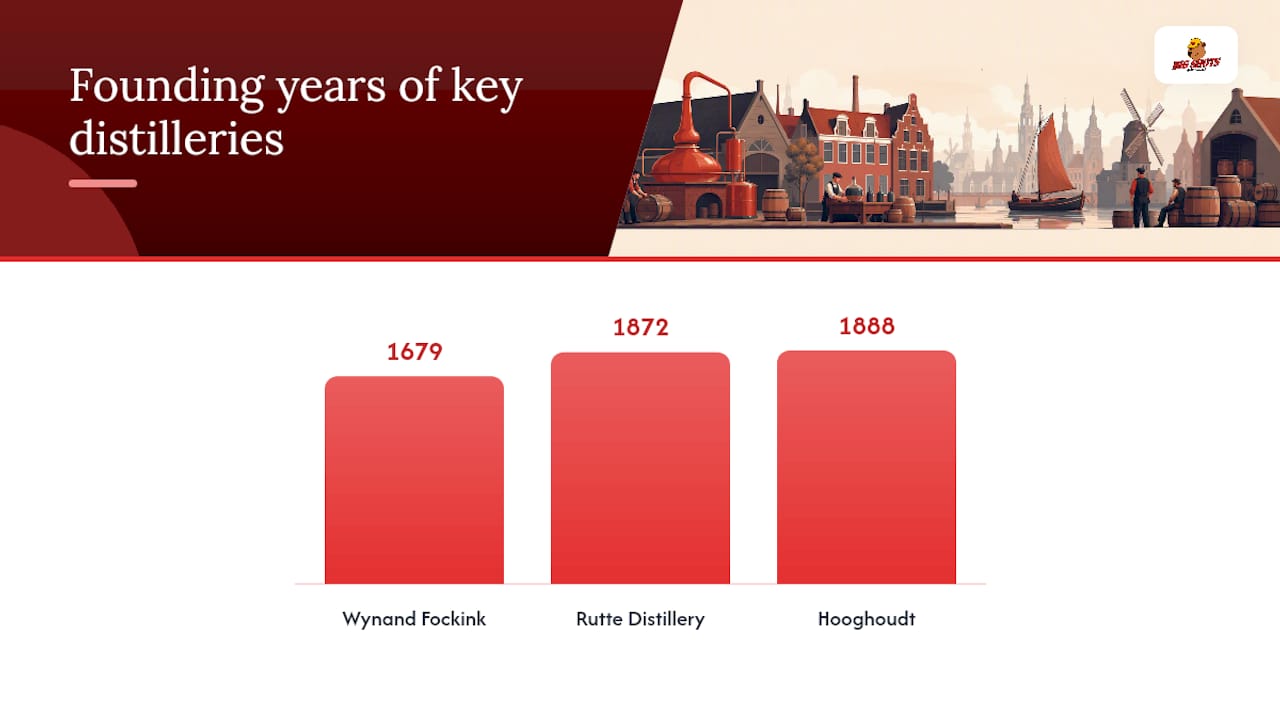
- Dordrecht: Home to Rutte Distillery, one of the oldest continuously operating distilleries in the Netherlands, founded in 1872. Known for careful, traditional production methods.
- Amsterdam: Two essential stops: Wynand Fockink, a proeflokaal operating since 1679 in a narrow alley behind the Krasnapolsky hotel, and Van Wees, producer of the De Ooievaar range, which include some of the most respected aged jenevers in the country.
- Groningen: Northern Dutch jenever tradition, anchored by Hooghoudt, a distillery producing both jenever and other spirits since 1888.
- Baarle-Nassau: Home to Zuidam Distillers, a family-run operation known for meticulous grain sourcing and extended barrel aging, particularly their Millstone whisky and aged korenwijn expressions.
- Hasselt, Belgium: Across the border but deeply connected to the same tradition. The Jenevermuseum Hasselt is one of the best resources for jenever history in the region, and Filliers Distillery (Deinze, Belgium) produces widely respected jenever available throughout the Dutch market.
For visitors: Wynand Fockink in Amsterdam and the National Jenever Museum in Schiedam are the two most accessible starting points. Both offer tasting flights and historical context. Combining a local culinary experience with a jenever tasting route is one of the more rewarding ways to spend a day in either city.
How does jenever differ from gin?
Gin was derived from jenever, but the two spirits ended up in very different places. Understanding that gap explains why jenever occupies a distinct cultural niche rather than competing directly with London Dry on cocktail menus.
| Category | Jenever | London Dry Gin |
|---|---|---|
| Base spirit | Moutwijn (malt wine) + neutral grain spirit | Neutral grain or other spirit |
| Botanical approach | Juniper-forward but grain-led | Juniper-dominant, wide botanical range |
| Typical ABV | 35%–38% | 38%–40% |
| Flavor profile | Grain-forward, round, whisky-like notes in older styles | Dry, botanical, aromatic, lighter body |
| Serving style | Tulip glass, neat, kopstoot | Highball, G&T, cocktail |
| Best use | Sipping neat, historical cocktails, kopstoot | Long drinks, modern cocktails |
Jenever preceded gin historically and was the spirit that early English bartenders called "Holland gin" when writing 19th-century cocktail recipes. The Martinez, considered by many historians to be the precursor to the Martini, was originally built on genever, not London Dry. That historical cocktail connection explains why bartenders interested in classic cocktail reconstruction keep returning to jenever.
The critical difference is the malt-wine base. Gin is built on a neutral spirit that lets botanicals dominate. Jenever's moutwijn gives it weight and grain character that botanicals sit on top of rather than lead. Substituting jenever for London Dry in a tonic drink is usually a mismatch; substituting it in an Old Fashioned or a Sling often works beautifully.
What does the contemporary jenever scene look like?
Jenever's modern story is one of contraction followed by a quiet, quality-driven revival. The mass-market dominance of jonge jenever through the 1970s and 1980s pushed the spirit toward commodity status. Younger Dutch drinkers moved toward wine, beer, and imported spirits. For a period, jenever felt like something your grandfather ordered.
The reversal started with craft distillers and bartenders, not marketing campaigns.
- Craft revival: Small distilleries like Zuidam began releasing aged korenwijn expressions that attracted whisky drinkers and spirits collectors. The quality argument changed the conversation.
- Cocktail history interest: As bartenders dug into pre-Prohibition recipes, they kept finding genever as the base spirit. That historical legitimacy gave jenever a credibility boost in serious cocktail bars.
- Tourism-driven tasting routes: Schiedam and Amsterdam now market jenever tasting experiences actively, and proeflokalen have seen renewed foot traffic from international visitors.
- Limited export: Despite the revival, jenever remains largely regional. Production scale, EU GI restrictions on where it can be made, and the challenge of explaining a spirit that sits between whisky and gin to international markets have kept global distribution thin.
Amsterdam's mixologists have been central to this revival, using jenever in historically informed cocktails and introducing it to visitors who arrive expecting gin and leave curious about something older and more complex. The spirit's regional stubbornness is, paradoxically, part of its appeal: you cannot fully experience it without coming here.
How to order and taste jenever like a local
Walking into a proeflokaal without a plan is fine. Walking in with a few phrases and a tasting framework is better.
Ordering checklist:
- Decide on style first: jonge for something light, oude for traditional character, korenwijn for a full, whisky-adjacent experience.
- Ask: "Een jonge jenever, alsjeblieft" (a young jenever, please) or "Heeft u een oude jenever?" (Do you have an old jenever?).
- If you want to know about malt-wine content or aging, ask: "Hoeveel moutwijn zit erin?" (How much malt wine is in it?) or "Is hij gerijpt op vat?" (Is it barrel-aged?).
- Request temperature: jonge is typically served chilled; korenwijn at room temperature. If unsure, ask the bartender.
- For a kopstoot, order: "Een kopstootje, graag" and a lager will arrive alongside the jenever automatically in most traditional bars.
What to look for when tasting:
- Nose: Grain and bready malt in older styles; lighter, slightly sweet grain in jonge. Juniper is present but rarely dominant.
- Palate: Older styles show vanilla, light wood, and a round oiliness from the moutwijn. Jonge is cleaner, closer to a light vodka with grain character.
- Finish: Korenwijn lingers with warmth and wood; jonge finishes quickly and cleanly.
Small-plate pairings: Dutch bitterballen (fried beef ragout balls), aged Gouda, and pickled herring are the classic companions. The fat and salt in each cut through the grain weight of older jenevers. For food and drink pairing ideas that go beyond the classics, the same principles apply: rich, savory, and slightly salty foods work best.
Proeflokaal etiquette:
- Don't rush the bartender. Proeflokalen are not cocktail bars; the pace is deliberate.
- Order one style at a time rather than a flight if you want to have a real conversation about what you're drinking.
- Tipping is appreciated but not mandatory; rounding up the bill is the norm.
Why does jenever still matter in Dutch society?
The authentic experience of tasting jenever in the Netherlands is not just about the drink itself. It is about what the drink carries: a set of social rituals, regional identities, and shared memories that no other spirit in the Dutch market replicates.
- Borrel culture: The Dutch borrel (an informal after-work or social drink gathering) is built around small glasses of jenever and shared snacks. It is the social glue of Dutch professional and community life, and jenever is its default spirit in traditional settings.
- Ceremonial use: Jenever appears at weddings, Sinterklaas celebrations, and regional festivals. In some parts of the Netherlands, a glass of jenever at a funeral reception is as expected as coffee. The spirit marks transitions.
- Regional identity: Schiedam residents identify with jenever the way Bordeaux residents identify with wine. Groningen's Hooghoudt is a point of local pride. The distilleries are not just businesses; they are civic institutions.
- Generational bridge: Older Dutch drinkers grew up with jenever as the default spirit. Younger drinkers who discover it through craft expressions or cocktail bars often describe it as finding something that was always there but overlooked. The proeflokaal is one of the few spaces where multiple generations drink the same thing in the same way.
- Demographic patterns: Jenever consumption skews older and more rural in traditional forms, but urban craft bars and tourism have introduced it to younger and international audiences. The kopstoot ritual, in particular, has seen a small but real revival in Amsterdam's brown café scene.
That connection to history is what makes jenever more than a regional curiosity. It is a living document of Dutch social life, and the rituals around it are the text.
An honest perspective on trying jenever today
The first time you lean over a tulip glass in a Schiedam proeflokaal and take that initial sip without lifting it, the ritual feels slightly absurd. Then you taste the jenever, and the absurdity disappears. There is something in the deliberateness of the gesture that changes how you pay attention to what you are drinking.
Amsterdam's café culture gives you plenty of entry points, from the historic Wynand Fockink to newer bars that put aged korenwijn on their spirits lists alongside single malts. What strikes me every time is how little the ritual has changed and how much that consistency matters. Jenever is not trying to be gin. It is not trying to be whisky. It occupies its own space, and the Dutch have never felt the need to explain or apologize for that.
The craft revival has been good for quality but has not fundamentally altered what jenever is. The best bottles being made right now, whether from Zuidam, Rutte, or Van Wees, are better expressions of a centuries-old tradition rather than departures from it. That is a rare thing in spirits.
Experience jenever at Bigshotsamsterdam in Amsterdam
If you want to taste jenever in Amsterdam without hunting down a proeflokaal on your own, Bigshotsamsterdam gives you a direct route. The venue combines the lively energy of a sports bar and café with a drinks menu that reflects Amsterdam's real drinking culture, jenever included.

Bigshotsamsterdam is a multi-experience venue where you can order jenever alongside gourmet food, watch live sports, and settle into the kind of relaxed, social atmosphere that borrel culture is built on. No reservation required for a casual visit. For groups or private events, book your table or event directly on the website and arrive ready to drink something genuinely Dutch.
Sources
- Jenever — Wikipedia
- Exploring...Genever - CLASS
- Jenever history | Jenevermuseum Hasselt
- Genever: The Original Juniper Spirit | Saveur
- A Drink You Must Taste in the Netherlands (18+): Jenever - Amsterdam Guide