
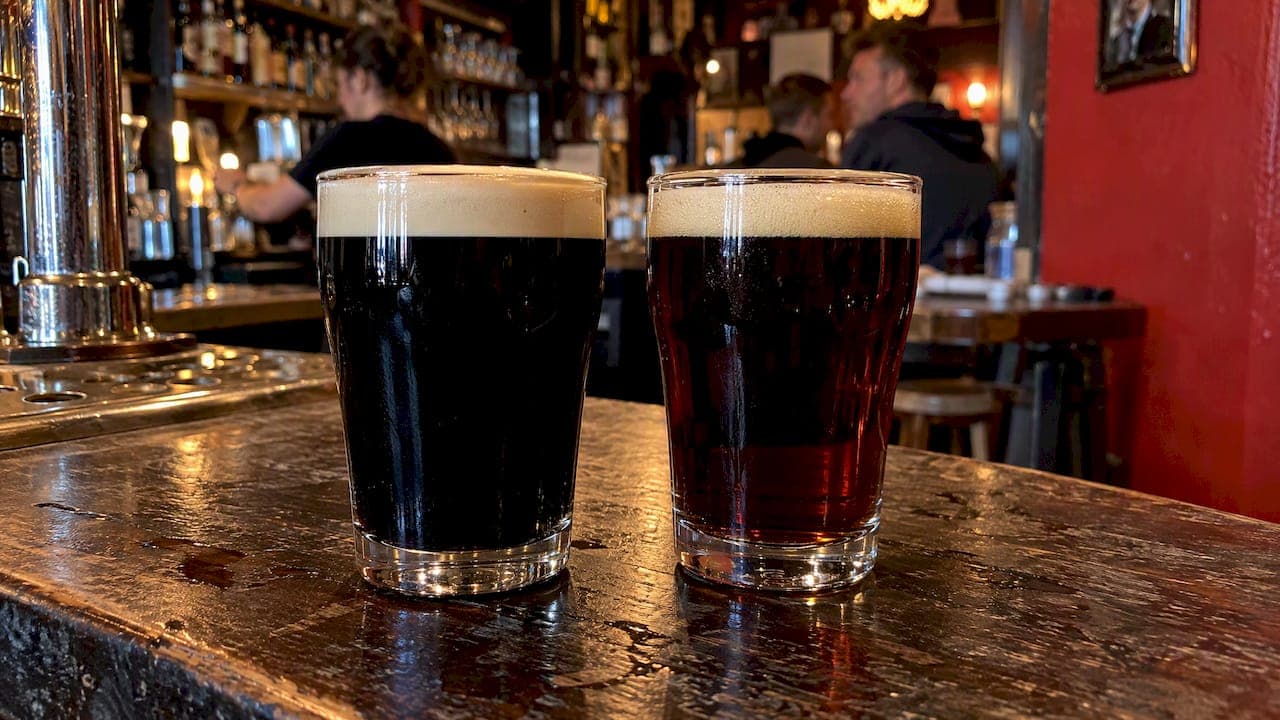
Stout and porter are close relatives, and the line between them is blurry. Stouts usually taste more roasty, dry and coffee-like, and porters usually taste rounder, maltier and a touch sweeter, with notes of toast, caramel or chocolate. But brewers break that rule all the time, so the beer's name tells you less than its ABV, its description and the first sip.
Below you'll find where the two styles come from, what actually differs in the glass, which dark beers are lighter than you'd think, and what to eat with each one.
TL;DR
- Stout began as shorthand for "stout porter", a stronger porter, so the two share one family tree.
- The textbook split: stouts use unmalted roasted barley (drier, more bitter, more coffee), porters lean on malted barley (softer, toastier, nuttier).
- Color tells you nothing about strength: standard Guinness Draught is 4.2% ABV, lower than many craft IPAs.
- Pair roasty stouts with steak, burgers and rich stews. Pair porters with grilled meat, pizza and smoky dishes.
- When you're unsure what to order, read the ABV and the tasting note, not the style name.
Table of Contents
- Where porter and stout come from
- The difference in the glass
- Is dark beer really heavy?
- How to choose between them
- What to eat with stout and porter
- Our perspective: drink the beer, not the label
- Where to try them in Amsterdam
- Eat and drink at Big Shots Amsterdam
- FAQ
- Sources
Where porter and stout come from
Porter appeared in England in the 1700s, and its exact origin is murky. The story that a London brewer named Ralph Harwood invented it is repeated often, but Serious Eats notes the early history is unclear. What is certain is that porter became hugely popular and brewers made it in several strengths.
The strongest version was called a stout porter. Over time the name was shortened. Brew Your Own explains that stout is a shortened form of stout porter, meaning a stronger, fuller-bodied porter. In that sense "stout" was originally an adjective, not a separate style.
Ireland pushed the story further. The Guinness Storehouse says Arthur Guinness started with ale and began brewing porter in the 1770s. His brewery later experimented with stronger versions, including a hoppier, more alcoholic "West India Porter" built to survive long sea voyages, as Wikipedia describes. Those export beers are the ancestors of the stouts people drink today.
The Netherlands has its own stout story. A historic Amsterdam stout once dominated local taps, and Horecatrends recounts that Van Vollenhoven's Extra Stout was the best-selling beer of a once huge Amsterdam brewery and the only one to survive its closure.
The difference in the glass
The roasted barley rule
The most quoted distinction comes from beer judging guidelines: porters are brewed with malted roasted barley, and stouts with unmalted roasted barley. Food Network sums it up by defining stouts as beers brewed with unmalted roasted barley. Unmalted roasted barley gives a sharper, more bitter, espresso-like edge. Malted grain gives a softer, bready, toasty character.
There is a catch. Craft Beer & Brewing points out that 18th-century porters and stouts didn't use roasted barley at all, because it wasn't yet technically possible or legal in British brewing until the 19th century. The tidy modern rule is a recent simplification, and many brewers ignore it.
Body, strength and flavor
Food & Wine reports that stouts range from about 4.0 to 5.0% ABV for dry versions up to 12% for imperial ones, while typical porters sit around 4.5 to 6.5%. Porters tend toward lighter body, and stouts toward fuller body and a more pronounced roasted character. Both styles overlap heavily, which is why a strong porter can easily out-muscle a mild stout.
Here is a practical cheat sheet:
| Porter | Stout | |
|---|---|---|
| Typical flavor | Toasty, nutty, chocolate, caramel | Roasty, coffee, dark chocolate, sometimes burnt toast |
| Sweetness | Often rounder and a little sweeter | Often drier, more bitter |
| Body | Light to medium | Medium to full (but see Irish dry stout) |
| Usual ABV range | About 4.5 to 6.5% | About 4.0 to 5.0% (dry) up to 12% (imperial) |
| Grain focus | Malted barley | Unmalted roasted barley |
Treat the table as a tendency, not a law. Home brewers on forums say it plainly: there is no clear line, and some porters are stronger than some stouts.
Common stout sub-styles
- Irish dry stout: light-bodied, dry, low in alcohol, with a creamy head.
- Milk (sweet) stout: rounder and sweeter, with a dessert-like finish.
- Oatmeal stout: silkier mouthfeel.
- Imperial stout: big, boozy and intense, a beer to sip slowly.
- Foreign extra stout: stronger and more bitter, rooted in the export beers of the 1800s.
Is dark beer really heavy?
No. This is the biggest misconception, and it keeps people from ordering a beer they would enjoy. Food Network's guide stresses that classic Irish stout is surprisingly drinkable and light-bodied. Food & Wine gives a concrete case: Guinness Draught is typically around 4.2% ABV, lighter in body and alcohol than many modern craft IPAs. Guinness's own FAQ lists Draught at 4.2%, Foreign Extra Stout at 7.5% and Special Export at 8%, so strength varies a lot within one brand.

So does Guinness make a porter? Yes, in a way. The same FAQ lists a West Indies Porter at 6% ABV in its range, which is a nod to its roots. But the beer most people know is a stout. Availability of that porter differs by country, so check the menu or the label where you are.
The lesson: look at the ABV on the menu or the can, not the color of the beer.
How to choose between them
Use this short decision guide next time you're staring at a tap list.
- You want something easy and sessionable: go for an Irish dry stout or a standard porter around 4 to 5%.
- You like coffee and dark chocolate: a stout, ideally a dry or oatmeal one.
- You prefer sweet and smooth: a milk stout, or a porter described as caramel or chocolate-forward.
- You want a dessert in a glass: an imperial stout, served in a small pour.
- You don't know the brewery: ask for a taste, and check the ABV before you commit to a big glass.
If you normally drink lager, start with a porter. It's the gentler step into dark beer. If you already drink black coffee or espresso, a stout will feel familiar.
What to eat with stout and porter
Dark beers are among the easiest to match with food, because roasted malt echoes the browning you get from grilling, searing and baking.
- Steak and grilled red meat: the roast in a stout mirrors the char, and the bitterness cuts through fat. A porter is a gentler partner for leaner cuts.
- Burgers: a porter's toasty, nutty notes work with a seared patty, cheese and caramelized onion.
- Pizza: a porter handles tomato, cured meats and a blistered crust well.
- Pasta with rich sauces: meat ragù and mushroom sauces suit a medium-bodied porter.
- Slow-cooked stews: this is the classic stout territory. Dutch brewers pair a historic Amsterdam extra stout with dishes like beef stew and wild boar, according to the brewery's profile.
- Dessert: sweet stouts and imperial stouts with chocolate, tiramisu or vanilla ice cream.
One rule of thumb: match intensity. A light Irish stout suits snacks and tapas, while a big imperial stout needs a rich dish or dessert, or nothing at all.
Our perspective: drink the beer, not the label
We run a sports bar, shisha lounge, restaurant and café, and we spend our days watching how people order. Here's what we see: guests worry about style names far more than they need to. Someone orders a lager because "dark beer is too heavy", when a 4.2% stout would be lighter than the IPA the next table is drinking.
Our advice is simple. Decide the occasion first. A long match night with friends calls for something sessionable, so a lower-ABV porter or dry stout is a fine choice. A slow dinner with a steak calls for something with more roast and body. A late evening in the lounge is the time for a small, strong pour you sip.
And always ask what's on the drinks list today, because tap and bottle selections change. Don't trust the color. Trust the ABV, the tasting note and your own taste buds.
— Leo
Where to try them in Amsterdam
Amsterdam is a good city for dark beer. Specialist beer cafés and craft brewery taprooms pour a rotating mix of Dutch and Belgian stouts and porters, and the fastest way to learn the difference is a side-by-side comparison. Ask for two small pours, one porter and one stout of similar strength, and taste them next to each other with food.
If you're planning a wider beer trip, Belgium is a short train ride away, and signature drinks in Bruges include local gin and historic beer styles worth knowing about before you go.
For your evening in the city, our guides can help you shape the night: the bar dining guide covers eating well where you drink, and the sports bar checklist is useful if a match is the reason you're out.
Eat and drink at Big Shots Amsterdam
Dark beer works best with a proper meal, and our menu covers breakfast, tapas, soups, salads, steaks, burgers, pizza, pasta and shared plates, plus a drinks list. Steaks and burgers are natural partners for the roasty beers described above, and tapas suit a lighter dry stout or porter. Ask our team what's on today, and we'll help you pick something that fits your taste and your plate.

Prefer to stay in? You can order delivery and pour your own beer at home. If you want a longer, more relaxed evening, look at our lounge experiences. You'll find everything else on our homepage.
FAQ
What is the difference between a stout and a porter?
Historically, stout meant a stronger porter, so the two began as one style. Today the usual rule is that stouts use unmalted roasted barley for a drier, more roasty, coffee-like flavor, while porters use malted barley for a softer, toastier, nuttier one. Many beers blur the line, so check the description.
Is stout stronger than porter?
Not necessarily. Dry stouts commonly sit around 4.0 to 5.0% ABV and typical porters around 4.5 to 6.5%, according to Food & Wine. Imperial stouts can reach 12%, though. Always check the ABV on the label or menu.
Does Guinness make a porter?
Guinness is best known for its stout, Guinness Draught, at 4.2% ABV. Its own FAQ also lists a West Indies Porter at 6% ABV. Which products you can buy depends on your country and venue.
What foods pair well with stout?
Steak, burgers, stews and other rich, grilled or slow-cooked dishes are the classics, because the roasted malt echoes the browning on the food. Sweeter and imperial stouts also work with chocolate desserts. Lighter Irish stouts go well with tapas and snacks.
Sources
- A Beginner's Guide to British Beer Styles, Serious Eats
- Irish Stout, Brew Your Own
- Discover the Story of Guinness, Guinness Storehouse
- Arthur Guinness, Wikipedia
- Poesiat & Kater: one of the former biggest breweries in Holland is back, Horecatrends
- Porter vs Stout, Food Network
- What's the Difference Between Porter and Stout?, Craft Beer & Brewing
- Porters vs. Stouts: What's the Difference?, Food & Wine
- Frequently Asked Questions, Guinness
- Poesiat & Kater, Bierbrouwerij in Nederland