
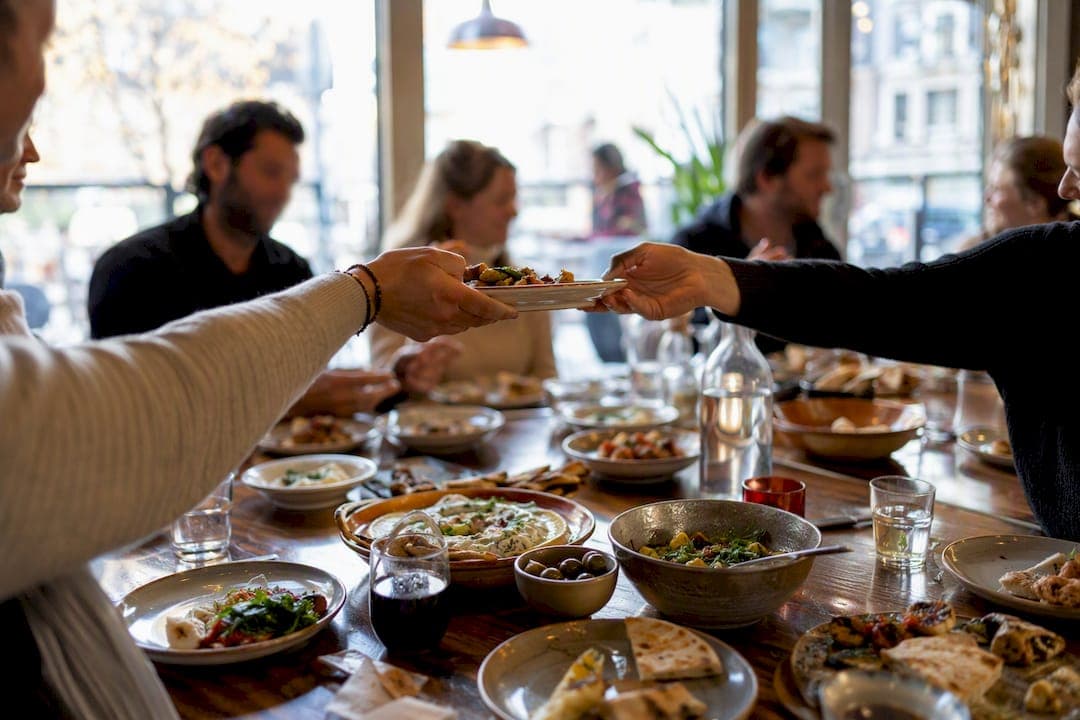
A community dining experience is any meal shared with a group, often strangers, structured to encourage conversation, connection, and a sense of belonging over food. The purpose runs deeper than eating: it's built around commensality, the practice of sharing meals to build social bonds. The wellbeing payoff is real. The World Happiness Report 2025 found that eating with others eight or more times a week produces a happiness boost on par with doubling your income in places like North America and Australia. Add in evidence from Frontiers in Nutrition on nutrition and National Geographic on brain chemistry, and you get a practice with real, measurable effects. You'll typically run into it as:
- Long communal tables at restaurants
- Supper clubs hosted in private homes
- Neighborhood pop-up meals and potlucks
Key Takeaways
Community dining works because shared meals reliably boost wellbeing, strengthen social ties, and improve nutritional outcomes for older adults more than eating alone does.
| Point | Details |
|---|---|
| Definition matters | Community dining means sharing meals to build connection, not just to eat efficiently. |
| Wellbeing effect is large | Frequent shared meals produce happiness gains comparable to doubling income in some regions. |
| Structure helps | A named host and light facilitation reduce awkwardness far more than good food alone. |
| Evidence has limits | Most nutrition and wellbeing research is cross-sectional, showing association rather than proof of cause. |
| Formats vary widely | Options range from supper clubs and long-table restaurants to virtual shared meals and meal exchanges. |
Table of Contents
- What Does Community Dining Look Like in Practice?
- What Are the Benefits of Communal Dining?
- Where Did Communal Dining Come From?
- What Are Common Types of Community Dining Events?
- How Do You Join or Host a Community Dining Event?
- How Does Community Dining Change Restaurant Design and Business?
- What Are the Downsides of Communal Dining?
- What Does the Research Actually Say About Shared Meals?
- A Hospitality Perspective on Why This Matters
- Frequently Asked Questions
- Sources
What Does Community Dining Look Like in Practice?
Strip away the branding and a few features show up again and again. Long or communal tables replace individual two-tops. Food arrives family-style, meaning platters get passed rather than plated per person. Seating is open, so strangers end up next to each other by design, not accident. Some events add light structure, like a host who kicks off introductions or a prompt card on the table to get conversation moving.
Private and public versions differ in tone. A dinner party at someone's home relies on the host's personality to set the mood. A restaurant running long-table service leans on layout and staff cues instead. Charity models go further still: FeedNC's community dining concept deliberately seats neighbors together at free daily meals specifically to build ties between people who might never otherwise sit down together.
A few concrete pictures help:
- A steakhouse swaps four small tables for one twelve-seat table on a Friday night.
- A block association hosts a potluck where every household brings one dish to share.
- A nonprofit kitchen seats regulars at the same table each week so relationships form over time.
What Are the Benefits of Communal Dining?
The case for eating together starts with the numbers. That World Happiness Report finding tying frequent shared meals to income-level happiness gains isn't a fluke result. It's consistent enough across regions that researchers treat commensality as a genuine wellbeing lever, not a nice side effect of socializing.
The benefits split into three buckets:
- Social: Shared tables build social capital, connect people across age, income, and background lines, and chip away at loneliness in a way solo meals can't.
- Health and nutrition: Communal meals tend to run longer, and longer meals correlate with higher caloric and nutrient intake in older adults, along with better appetite and mood, according to the Frontiers synthesis.
- Economic: Group dining supports small restaurants through higher per-table spend, and charitable models give people low-cost or free access to a real meal.
World Happiness Report 2025: Moving from eating alone to eating with others eight or more times a week delivers a wellbeing boost comparable to doubling household income in North America, Australia, and New Zealand.
Worth flagging: most of the nutrition and psychological research is cross-sectional, meaning it shows a strong association, not proof that shared meals directly cause better health. The Frontiers researchers say as much themselves and call for longer studies to nail down cause and effect.
Where Did Communal Dining Come From?
Eating together isn't a modern invention dressed up in new branding, as explained in Defining Culinary Experiences: a Traveler’s Guide. It's one of the oldest social technologies humans have.
- Ancient rituals. Shared feasts marked religious ceremonies, harvests, and truces long before restaurants existed, according to the Wikipedia entry on communal meals.
- Family and religious meals. Thanksgiving, iftar during Ramadan, and the Passover Seder all built entire traditions around who sits at the table and how food gets passed.
- Industrial-era shift. Factory schedules and suburban living pulled meals apart, turning dinner into a smaller, more private affair for many households.
- Recent revival. Supper clubs, pop-up dinners, and restaurant design choices are bringing the long table back, driven partly by loneliness and a hunger for experiences that feel genuine rather than transactional.
What Are Common Types of Community Dining Events?
You'll find community dining in more shapes than most people expect:
- Supper clubs — recurring dinners, often in someone's home, built around a rotating guest list.
- Long-table restaurant service — a shared table replacing individual seating for part or all of a dining room.
- Family-style events — weddings, reunions, and holiday dinners where platters get passed rather than plated.
- Pop-up community meals — one-off gatherings in parks, community centers, or empty lots.
- Meal-exchange groups — services like Supper Commons that organize reciprocal home-cooked meal swaps between neighbors.
- Charity and community kitchens — free or low-cost meals, often intentionally seated to build relationships, as with FeedNC's model.
- Civic-scale events — programs like The Longest Table that turn a city block into one giant shared meal.
- Virtual shared meals — video calls where distant friends or family eat "together" on screen, a format that grew during periods of forced isolation and hasn't fully disappeared since.
How Do You Join or Host a Community Dining Event?
Getting started is less complicated than it sounds, whether you're showing up or running the show.
For participants:
- Search local event listings, restaurant newsletters, or community boards for long-table nights and supper clubs.
- RSVP promptly. Most communal events run on fixed headcounts for food planning.
- Flag allergies or dietary restrictions ahead of time, not at the table.
- Bring a dish if it's potluck-style, and arrive with one or two conversation starters ready.
- Sit where you're placed rather than clustering with people you already know. That's the entire point.
For hosts:
- Set a clear structure: seating plan, timing, and a rough sense of how food will be served.
- Plan portions family-style, and always ask about allergies during RSVP collection.
- Think about accessibility: seating height, noise levels, and mobility around the table.
- Advertise clearly and track RSVPs so you're not guessing on food quantities.
Pro Tip: A named host who kicks off with a simple icebreaker or conversation prompt does more to loosen up a room than any amount of good food. Structure isn't the opposite of spontaneity here. It's what makes spontaneity possible.
If you're planning something with more moving parts, a step-by-step guide to group dining covers the logistics in more detail.
How Does Community Dining Change Restaurant Design and Business?
Restaurants that lean into shared dining rethink more than just the menu. Long communal tables replace two-tops, acoustics get more attention since a noisy room kills conversation fast, and service stations move to keep staff mobile between family-style platters.
Operationally, this means:
- Family-style plating that scales for groups instead of individual courses
- Reservation policies built around shared seating instead of private tables
- Service and tipping models adjusted for group checks rather than single-party bills
The payoff can show up as higher table turnover during busy shifts, a livelier atmosphere that keeps people ordering another round, and in some cases membership or recurring-event revenue. Steakhouse formats built around social scenes show how far this design philosophy can go.
What Are the Downsides of Communal Dining?
Community dining isn't universally comfortable, and pretending otherwise does a disservice to people who genuinely prefer privacy.
- Some diners find shared tables intrusive rather than inviting, and forcing the format on everyone ignores real differences in social preference.
- Noise levels can make conversation difficult, and mobility or sensory needs don't always get considered in seating layouts.
- Cultural and dietary differences require real attention, not an afterthought tacked onto the invite.
- Allergy management gets harder when food is shared and passed hand to hand.
- Family-style service simply doesn't work for every group. A table of near-strangers with wildly different dietary needs is a bad candidate for one giant shared platter.
What Does the Research Actually Say About Shared Meals?
The strongest data point comes from the World Happiness Report 2025, which ties frequent shared meals to a happiness gain comparable to doubling income in wealthier regions. That's a striking number, though it's drawn from specific geographic contexts and doesn't necessarily generalize worldwide.
The 2026 Frontiers synthesis reviewed 21 cross-sectional studies and found consistent links between commensality and better nutritional intake and psychological resilience in older adults, while flagging the need for longitudinal research to confirm cause and effect.
On the biology side, National Geographic's reporting points to endorphin, oxytocin, and dopamine activity during shared meals, the same neurochemical pathways involved in trust and bonding. Together, this gives community dining a genuinely multidisciplinary evidence base spanning economics, nutrition science, and neuroscience.
A Hospitality Perspective on Why This Matters
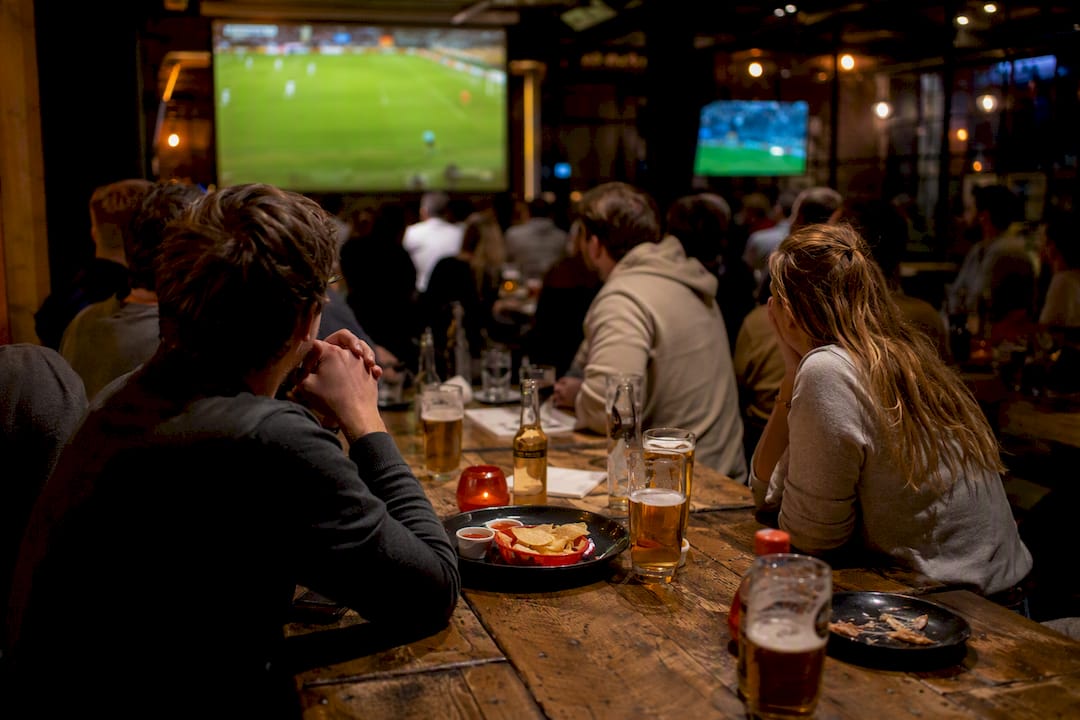
Running venues built for people to gather has taught us that the best nights rarely come from a perfect menu alone. They come from a table where strangers end up talking by the second round. Bigshotsamsterdam leans into that with communal seating around sports viewing and lounge spaces, less about copying a supper club format and more about giving people a reason to linger and talk. That's the whole business, honestly: food and drink as the excuse, connection as the point.
Frequently Asked Questions
What is community dining exactly? It's the practice of sharing a meal with others, often in a communal or family-style setup, designed to build conversation and connection rather than just serve food efficiently.
Is communal dining the same as family-style dining? Family-style serving is one common feature of communal dining, but the broader concept also includes seating arrangements, facilitation, and the social intent behind the meal.
What's a good first step if I want to try it? Look for a long-table night at a local restaurant or a community potluck. Both are low-commitment ways to experience shared dining without hosting anything yourself, and resources like this guide to dining out with friends can point you toward the right kind of spot.
Does community dining work for people who don't like crowds? Not every format suits every person, and that's fine. Smaller supper clubs or meal-exchange groups like Supper Commons offer more intimate versions of the same idea.
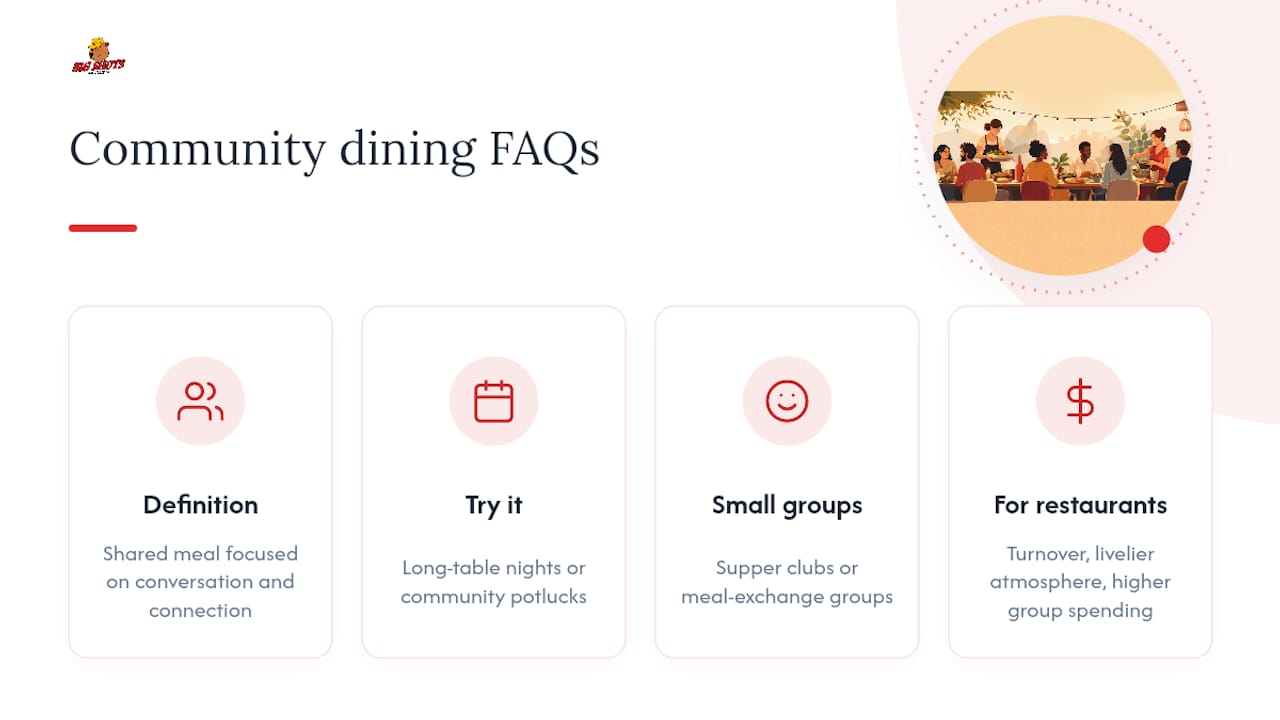
How do restaurants benefit from offering communal dining? Long tables can increase turnover during busy periods, create a livelier atmosphere, and encourage higher group spending, particularly when paired with flexible reservation systems built for shared seating.
Sources
- World Happiness Report 2025 — people are much kinder than we expect, research shows
- Sharing a meal with friends and family could be the key to better mental health | National Geographic
- Frontiers in Nutrition systematic synthesis on commensality and geriatric nutrition
- Community dining concept — FeedNC
- Communal meal