
TL;DR:
- Sports bars open early to maximize pre-match revenue and avoid service bottlenecks during game time. Arriving 60-90 minutes early secures better seats, deals, and social rituals that drive spending. Implementing pre-match promotions and stage staffing during this period enhances profitability and customer experience.
Sports bars open early for matches to capture pre-match revenue, lock in viewing spots before the room fills, and smooth service pressure during live play. The business logic is straightforward: the 60–120 minutes before kick-off is the single most valuable commercial window on matchday, with beer volume peaking in that window and stabilizing once the game starts.
The main drivers, in brief:
- Fan behavior: supporters arrive early to claim tables, meet their group, and settle in before the whistle
- Revenue: pre-match dwell time converts directly into food and drink orders before service slows during play
- Operations: spreading arrivals across a longer window prevents the bottleneck that hits when everyone shows up at once
- Promotions: early drink specials and group packages give fans a financial reason to arrive ahead of schedule
For patrons: arrive 60–90 minutes early and you get the best seat, the best deal, and the best atmosphere. For operators: open early or leave your most profitable window on the table.
Table of Contents
- Why fans arrive early: social rituals and sightlines
- The business case for opening early on match days
- How early openings improve staffing and service flow
- Licensing and opening hours in the United States
- Does opening early actually pay off?
- Why fans choose bars over watching at home
- How to secure good seats and support the venue when you arrive early
- What Bigshotsamsterdam does on match days — lessons for U.S. bars
- How major events and time zones shape opening hours
- How sports bars compete with other venue types on match days
- Key Takeaways
- The pre-match window is where loyalty is built
- Watch the next match at Bigshotsamsterdam
Why fans arrive early: social rituals and sightlines
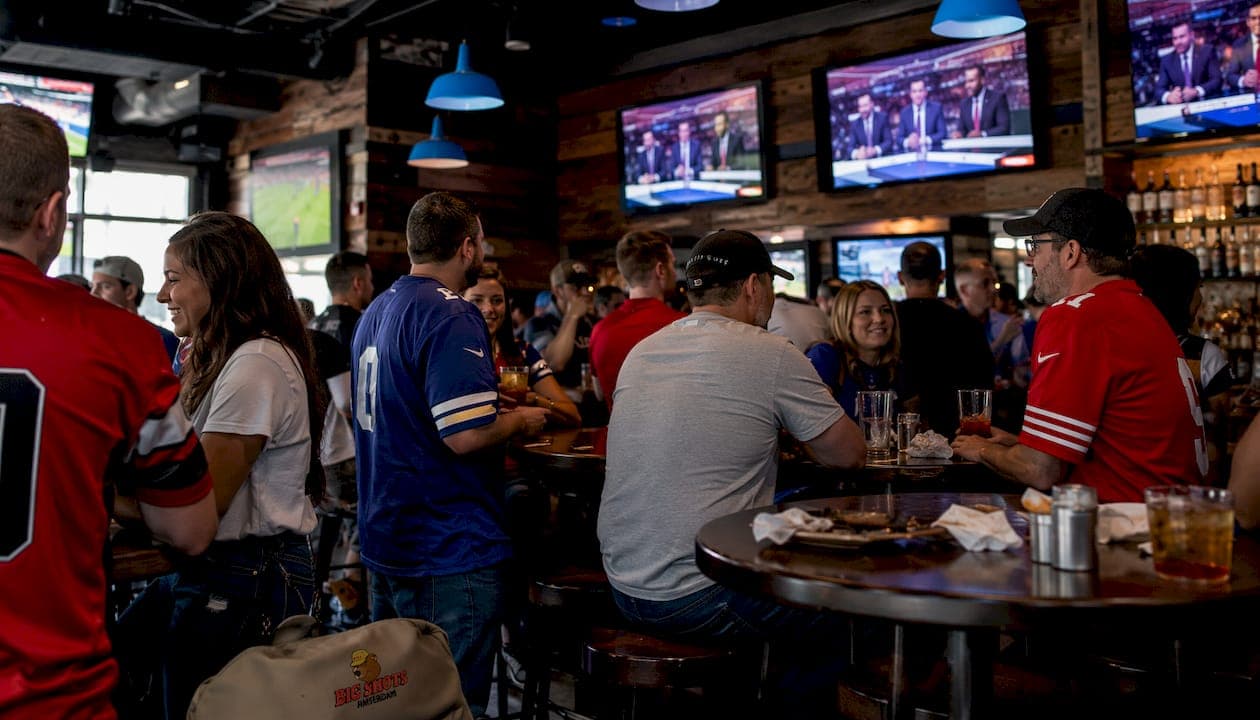
Fans arrive early because a good seat at a sports bar is not guaranteed, and losing your sightline to a pillar or a late-arriving crowd is a real risk. The social ritual matters just as much: supporter groups coordinate jerseys, claim their regular corner, and run through pre-match conversation that is part of the experience itself.
Soccer's continuous play — two uninterrupted 45-minute halves — makes early arrival especially important. Once the whistle blows, you are not getting up to order, find a better seat, or greet a latecomer without missing something. That structure pushes fans to front-load everything: drinks, food, seating, and socializing.
- Supporter groups often reserve a section or arrive as a bloc 90+ minutes before kick-off
- Pre-match conversation, kit display, and chanting are part of the ritual, not just waiting
- Fans use the pre-match window to order food they would skip during play
Pro Tip: Book a table when the venue allows it, and confirm your reservation the day before. For high-demand fixtures, walk-in capacity fills fast — around 30% of fans expect to book ahead, which means the other 70% are competing for walk-in spots (Oxford Partnership research).
The business case for opening early on match days
Pre-match windows drive the largest share of matchday revenue for many venues. Bookings for England's first FIFA World Cup 2026 match were up 184% compared with a typical trading day; across the wider sector bookings were up 64% year on year. That kind of demand spike does not materialize at kick-off — it builds in the hour before.
Pubs benefited most with sales rising about 60% during England fixtures, with the hours before kick-off generating strong, sustained demand. Operators who open early capture that curve. Those who open at the standard time miss the front end of it entirely.
| Revenue driver | What operators report |
|---|---|
| Pre-match bookings uplift | Significantly higher than a typical trading day |
| Sector-wide year-on-year bookings | Notable year-on-year increases |
| Sales increase during fixtures | Notable increases for high-profile matches |
| Peak beverage window | 60–120 minutes before kick-off |
Promotions are the mechanism that converts early arrivals into higher checks. Pre-kickoff happy hours with set drink prices and group arrival bonuses are proven structures. Stacking promotions across pre-kickoff, halftime, and extra time keeps spend elevated throughout the event, not just at the start.
How early openings improve staffing and service flow
Early openings let operators front-load staffing and smooth the service curve before play starts. Once the match kicks off, service intensity shifts toward drink delivery and away from full table service — fans are watching, not browsing menus. Venues that staff for this shift serve faster and frustrate fewer customers.
Operators use early openings as a risk-management tool to shift peak footfall to pre-match periods and prevent service bottlenecks during the game. When everyone arrives at once, the bar queue backs up, orders slow, and the experience suffers. Spreading arrivals across a 90-minute pre-match window solves that problem before it starts.
Practical steps for operators:
- Schedule your full floor staff to arrive 90 minutes before kick-off, not at opening
- Pre-set tables with menus, condiments, and water so staff focus on orders, not setup
- Run a pre-batch of high-volume cocktails and pre-pour draft lines before the rush
- Assign a dedicated drinks runner for the first 30 minutes of play when table service slows
- Brief staff on the promotion structure so every server can upsell the pre-match special
Crowd control benefits follow naturally. Fans who arrive steadily over 90 minutes are easier to seat, serve, and manage than a crowd that piles in at 2:55 for a 3:00 PM kick-off.
Licensing and opening hours in the United States
Licensing in the U.S. is state- and local-level, which means there is no single national rule governing when a sports bar can open or how late it can serve. Every venue must check its county or municipal alcohol control ordinances, because last-call times and special-event extensions vary significantly by jurisdiction.
The "2-hour pub rule" that circulates online is not a federal standard. It typically refers to informal shorthand for last-call extensions — some states allow venues to apply for a temporary extended-hours permit for special events, which can push last call back by one to two hours. That permit process differs by state.
- Standard last-call times range from 1:00 AM to 4:00 AM depending on the state
- Special-event permits (for World Cup fixtures, Super Bowl, etc.) are available in many jurisdictions but require advance application
- Some states allow local municipalities to set their own hours within state limits
- Opening-hour restrictions are less common than closing-hour rules, but some localities require a minimum opening time
Pro Tip: Operators should check their state's Alcohol Beverage Control (ABC) board website directly for special-event permit applications. Processing times vary — some states require 30 days' notice, others less. Don't assume a verbal confirmation from a local official is sufficient.
Does opening early actually pay off?
For most venues, yes — incremental revenue from pre-match dwell time outweighs added operating costs, especially for high-profile fixtures. The math depends on location, event size, and how well the venue executes its pre-match promotions.
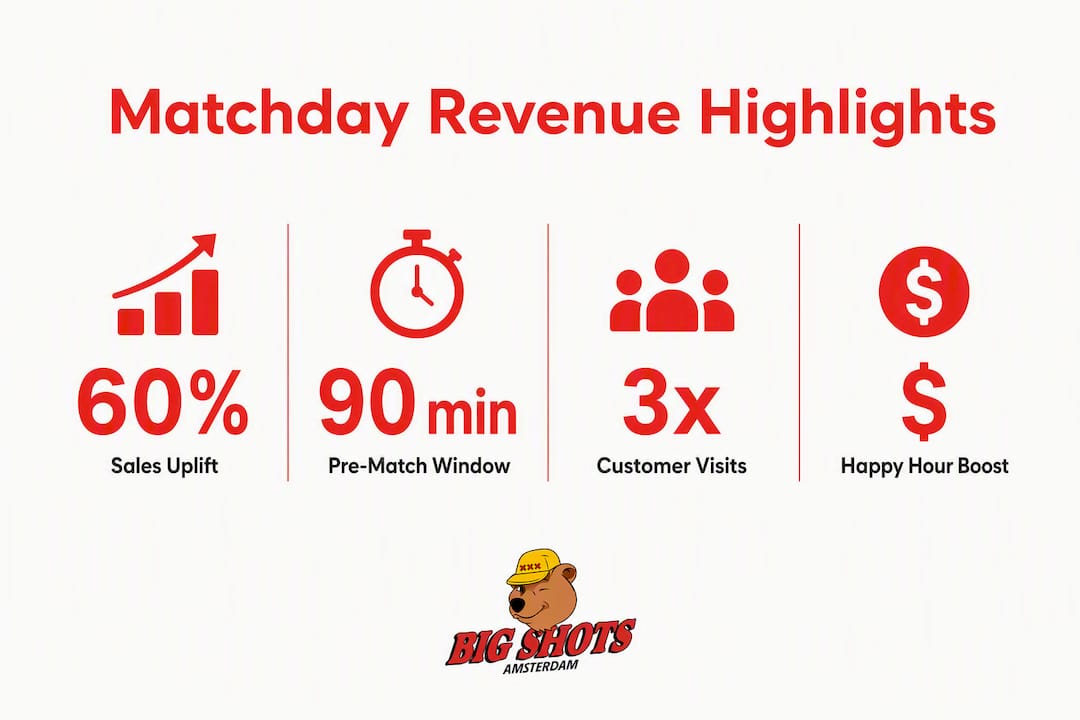
Drink sales can spike by more than 300% during match periods in some analyses. Even a fraction of that uplift in the pre-match window covers the cost of an extra two hours of staffing.
A quick cost-versus-revenue check for operators:
- Staff cost: extra hours × hourly rate for floor and bar staff
- Utility/overhead: marginal cost of opening two hours earlier (usually low)
- Incremental sales: estimated covers × average spend per head in the pre-match window
- Promotion cost: discount value per drink special × projected redemptions
| Cost item | Typical range |
|---|---|
| Extra staff hours (couple of hours, multiple staff) | Typical cost varies depending on market |
| Pre-match average spend per head | Higher than in-match (food + drinks ordered together) |
| Peak beverage window | 60–120 minutes pre-kick-off |
| Bookings uplift for major fixtures | Significantly higher than typical day |
The venue that opens two hours early for a World Cup group-stage match and runs a pre-match special almost always comes out ahead. The venue that opens at its standard time misses the most profitable window of the day.
Why fans choose bars over watching at home
The honest answer is atmosphere. A 65-inch TV at home is good. Forty screens, coordinated audio, and a room full of people who care about the same result is something else entirely.
Specific benefits fans cite for watching sports at a bar:
- Multiple screens showing different angles or simultaneous matches
- Crowd energy that amplifies big moments — a goal lands differently when 80 people react at once
- Themed menus and match-day food that you would not bother making at home
- Official watch parties with supporter groups, flags, and organized chanting
- No setup, no cleanup, and someone else handles the drinks
Venues design seating and sightlines specifically to maximize this. A well-planned sports bar seating layout eliminates dead zones and ensures every seat has a clear view of at least one primary screen.
How to secure good seats and support the venue when you arrive early
Arrive 60–90 minutes before kick-off. That single habit solves most problems fans encounter on match day.
- Book when possible: reservation systems are increasingly common; use them, especially for World Cup or playoff fixtures
- Come as a group: venues prioritize larger parties for prime tables; a solo walk-in at 30 minutes before kick-off will struggle
- Use deposit systems: some bars require a deposit for reserved match-day seating — pay it, it holds your spot
- Order at the bar occasionally: it supports service flow and keeps your relationship with the staff positive
- Follow venue rules on seat-claiming: blocking a four-top with bags for friends who arrive at kick-off creates friction with staff and other guests
Pro Tip: Stacked promotions across pre-kickoff, halftime, and extra time are common at well-run venues. Ask your server what the halftime special is when you order your first round — you will often get a better deal than the menu price.
What Bigshotsamsterdam does on match days — lessons for U.S. bars
Bigshotsamsterdam operates as a multi-format venue that treats match days as a structured commercial event, not just an extended opening. Pre-match offers, bookable tables, and staged staff deployment are built into the matchday plan from the start.
The pre-match window is where the experience is set. Fans who arrive early, find their table, order their first round, and settle in before kick-off spend more, stay longer, and come back. Venues that treat the pre-match period as dead time before the real event miss the point entirely.
Three lessons U.S. bars can take directly from this model:
- Convert pre-match dwell into higher check averages by pairing drink specials with food bundles — fans who order food in the pre-match window spend significantly more per visit
- Reserve seats strategically rather than first-come-first-served: a deposit-based booking system fills the room with committed customers, not walk-ins who leave at halftime
- Match staffing to the pre-match window, not to kick-off — the busiest service moment is the 60 minutes before the whistle, not during play
For operators building this model from scratch, the sports bar startup guide covers the venue-level decisions in detail.
How major events and time zones shape opening hours
The FIFA World Cup 2026 is being hosted across the U.S., Canada, and Mexico, which means kick-off times span multiple time zones. A 12:00 PM ET kick-off is a 9:00 AM PT start — and bars on the West Coast that want to capture that audience need to open before most restaurants serve lunch.
Time zone differences are one of the most underappreciated drivers of early opening decisions. A Champions League final in Europe kicks off around 3:00 PM ET, which is manageable. A Premier League Saturday fixture at 7:30 AM ET requires a venue to open before most of its staff would normally arrive for a brunch shift.
Major events compress the calendar in ways that force operational decisions. During the World Cup group stage, multiple matches run on the same day — a venue that opens early for the 9:00 AM match and stays open through the 6:00 PM match is running a 9-hour matchday operation. Staffing, promotions, and licensing all need to account for that span.
How sports bars compete with other venue types on match days
Sports bars compete directly with casual dining chains, hotel bars, stadium watch parties, and home viewing during major fixtures. The competitive edge is specialization: a sports bar is built for this, and a casual dining chain is not.
A chain restaurant with a few TVs can show the match, but it cannot replicate the audio mix, the screen density, or the supporter-group atmosphere that a dedicated sports bar delivers. Stadium watch parties offer scale but not intimacy. Home viewing offers comfort but not community.
The real competitive pressure comes from other sports bars in the same neighborhood. During the World Cup, every bar with a screen is competing for the same fans. Early opening, pre-match specials, and reservation systems are the primary tools venues use to differentiate. A bar that opens two hours earlier than its nearest competitor and runs a structured pre-match promotion has a meaningful first-mover advantage on any given match day.
Key Takeaways
Sports bars open early for matches because the pre-match window is the most commercially valuable period of the day, and fans who arrive early spend more, stay longer, and have a better experience.
| Point | Details |
|---|---|
| Peak revenue window | The 60–120 minutes before kick-off is when beer volume peaks and average spend is highest. |
| Demand spikes are real | Bookings for major fixtures can run significantly above a typical trading day. |
| Operations benefit too | Early openings spread arrivals, reduce bottlenecks, and let staff front-load service before play starts. |
| Fan tip | Arrive 60–90 minutes early, book when possible, and ask about halftime specials. |
| Bigshotsamsterdam model | Bigshotsamsterdam uses bookable tables, pre-match offers, and staged staffing to convert early arrivals into higher checks and repeat visits. |
The pre-match window is where loyalty is built
The conventional wisdom treats early opening as a concession to fans who want to watch the game. That framing gets it backwards. The pre-match window is not a warm-up act — it is the main event for venue economics and for the fan experience.
Fans who arrive early, find their group, order food, and settle in before kick-off are not just spending more money. They are building a habit. The bar becomes their place for this match, and then for the next one. Venues that treat the pre-match period as dead time before the real event are optimizing for the wrong hour.
The operational evidence backs this up. Spreading arrivals across a 90-minute pre-match window reduces service pressure during play, improves average order times, and produces a better experience for everyone in the room. That is not a coincidence — it is what happens when a venue designs its matchday around fan behavior instead of around a standard opening schedule.
Watch the next match at Bigshotsamsterdam
If you want the full matchday experience without the logistics of finding a venue that actually has the match, the screens, and the atmosphere, Bigshotsamsterdam is built for exactly that. As a multi-format sports bar, shisha lounge, restaurant, and café in Amsterdam, it runs pre-match offers, bookable tables, and a menu designed around match days — not just a few TVs bolted to a restaurant wall.
The pre-match window is the best time to arrive: better seats, better deals, and the full build-up before kick-off. Check availability and book your table at Bigshotsamsterdam before the next fixture fills up.