
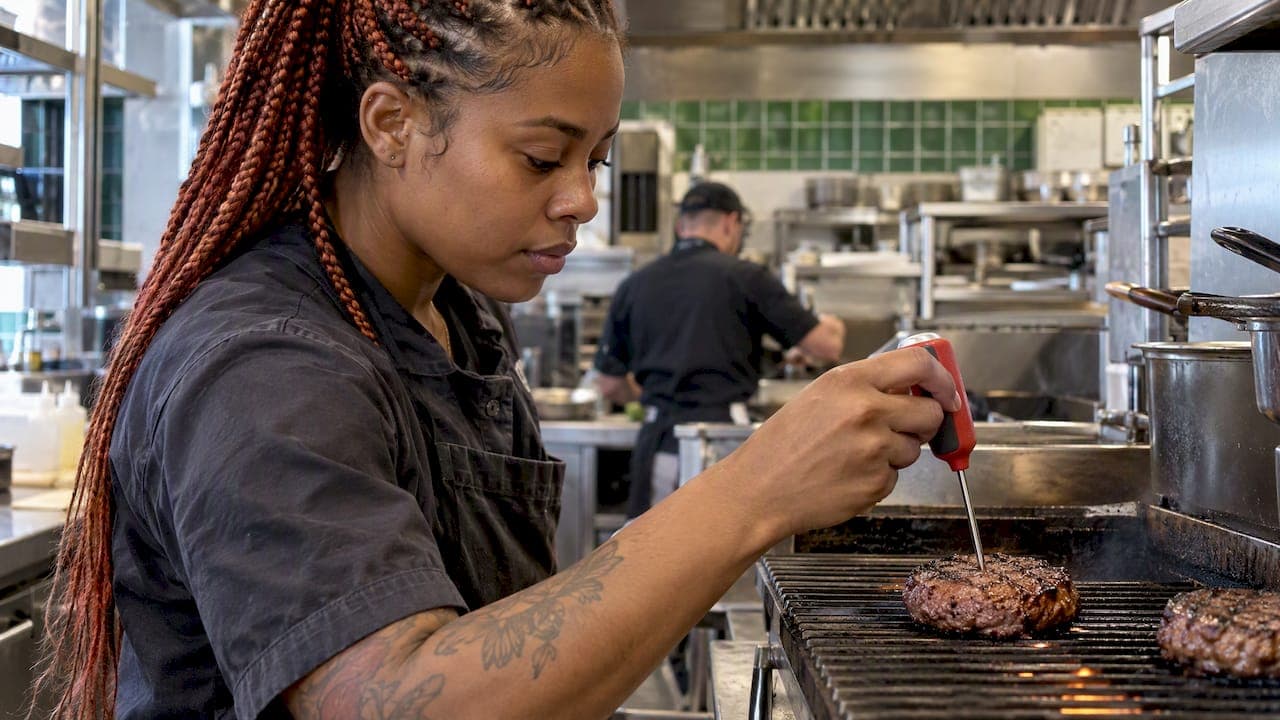
A burger is done when its center reaches a safe core temperature, and in the Netherlands that number is 75°C (167°F) for minced meat. The classic doneness labels, from medium-rare at 54–57°C to well done at 71°C and above, come from American cooking guides. They describe texture and color, and they are not all safe for ground beef. This guide gives you the full chart in both scales, explains the gap between taste and safety, and shows how to check a thick patty, a thin smash burger and a burger you cannot probe.
TL;DR
- Doneness chart for beef burgers: medium-rare 130–135°F (54–57°C), medium 140–145°F (60–63°C), medium-well 150–155°F (66–68°C), well done 160°F (71°C) and up.
- Dutch practice for minced meat is a core temperature of at least 75°C, whatever the cut or the price of the beef, so burgers here are not served medium or rare.
- Medium and medium-well differ by about 10°F (6°C), but the texture gap is bigger than the number suggests: pink and springy against barely pink and firm.
- A smash burger is too thin to probe. Cook it through and cut it open: it should be gray-brown all the way across.
- Use a digital probe thermometer, put it in the center from the side, and rest the burger for a few minutes before you serve it.
Table of Contents
- The burger doneness chart
- Safe burger temperature in the Netherlands
- Medium vs medium-well: what actually changes
- Smash burger vs regular burger
- How to check doneness with a thermometer
- How long to cook a burger
- Kitchen habits that keep burgers safe
- Our perspective: a good burger is a safe burger
- Burgers, steaks and the rest at Big Shots
- FAQ
- Sources
The burger doneness chart
The ranges below are the ones most American guides use. Burger doneness ranges run from rare at 120–125°F through medium-rare at 130–135°F, medium at 140–145°F, medium-well at 150–155°F and well done at 160–165°F. The Celsius values are straight conversions, rounded to the nearest degree.
| Doneness | Fahrenheit | Celsius | What you see | Texture |
|---|---|---|---|---|
| Rare | 120–125°F | 49–52°C | Red, cool center | Soft, loose |
| Medium-rare | 130–135°F | 54–57°C | Red-pink center | Tender, slightly firm |
| Medium | 140–145°F | 60–63°C | Warm pink center | Firm and springy |
| Medium-well | 150–155°F | 66–68°C | Faint pink at most | Mostly firm |
| Well done | 160–165°F | 71–74°C | Brown throughout | Firm, drier |
| Dutch safe minimum | 167°F | 75°C | Brown throughout | Firm |
The last row is the one most charts leave out, and it matters if you cook or eat burgers in the Netherlands. The next section explains why.
Safe burger temperature in the Netherlands
A steak is a solid piece of meat. Bacteria sit on the outside, and a hot pan kills them even when the middle stays red. A burger is different. Grinding mixes surface bacteria through the whole patty, so the center is no longer clean. That is why guidance for minced meat is stricter than for steak.
The US figure is 160°F (71°C), which the USDA gives as the minimum safe temperature for ground meat. Dutch practice is stricter. A 2026 guide from Foody Magazine says minced beef burgers must reach a core temperature of 75°C, including luxury types such as Angus or Wagyu, and that they are never served medium or rare. The food safety authority NVWA points the same way: in its checklist for food at markets and events, raw ingredients and products must be heated above 75°C to be safe. The Dutch nutrition center Voedingscentrum likewise advises heating food above 75°C to kill most pathogens.
What does this mean on your plate?
- If you eat out in Amsterdam, expect a burger cooked through. A kitchen that follows Dutch practice will not offer you a pink-centered patty from ground beef.
- If you cook at home, the doneness labels in the chart are for orientation. A burger at medium is a taste choice, and it carries a risk that a burger at 75°C does not.
- If you are pregnant, elderly, very young or have a weakened immune system, ask your doctor or midwife about eating undercooked minced meat. The safe answer is a burger cooked through.
One caution on color. A burger can look brown before the center is hot, and it can stay pink when it is safe. Judge by temperature, not by the shade of the cut.
Is 160°F or 71°C enough?
In the US, yes: the USDA treats 160°F as the safe point for ground beef. Some home guides go further, aiming for 160°F in the pan and letting carryover heat during the rest bring it to 165°F. In the Netherlands, aim for 75°C in the center and you are covered, whichever guide you follow.
Medium vs medium-well: what actually changes
On paper the two stages sit next to each other. Medium is 140–145°F (60–63°C) and medium-well is 150–155°F (66–68°C). That is a gap of about 10°F, and it takes perhaps a minute on a hot pan. Yet the burgers eat differently.
Medium has a warm, light-pink center. According to one restaurant-supply guide, the texture is firm and springy and the cook time is around six to seven minutes in total. The patty still holds a good amount of juice, and the fat has begun to render without having run out.
Medium-well is similar in outline but has less pink, only a slight blush in the center, and a mostly firm bite. The same guide puts its total cooking time at seven to eight minutes. The juice you lose in that extra minute is what you notice most. Lean beef dries quickly here, and a patty with more fat forgives it better.
A simple way to remember it:
- Medium: you can still see pink and the burger gives under your thumb.
- Medium-well: the pink is a hint, and the burger pushes back.
- Well done: no pink, firm all through, and the best choice if you want to stay safe with minced meat.
If you like the juicy side of the scale but have to cook to 75°C, the fix is in the meat and the method, not the label. Choose a blend with enough fat, do not press the patty while it cooks, and rest it afterwards. A burger cooked to a true 75°C from a well-fatted blend is still a good burger.
Smash burger vs regular burger
The two styles are cooked in opposite ways, so they are checked in opposite ways.
A regular (classic) burger is thick, often 2 cm or more. It is cooked gently enough that the center lags behind the crust. That gap is why you need a probe: the outside looks done long before the middle is. Foody Magazine notes that a patty 2 cm or thicker can be checked by measuring its center.
A smash burger is a ball of beef pressed flat on a very hot surface, around half a centimeter thick. It cooks in a couple of minutes, with a lacy, dark crust. The same guide points out that it is too thin to measure with a probe, so you cut one through and check that it is gray-brown across. The safe minimum does not change: it is still 75°C, and still minced meat. A smash burger does not get a pass for being thin, it just reaches that temperature faster because there is hardly any distance for the heat to travel.
| Regular burger | Smash burger | |
|---|---|---|
| Thickness | 2 cm or more | About ½ cm |
| Cooking | Medium heat, flipped once or twice | Very hot surface, pressed flat, flipped once |
| Doneness check | Probe in the center | Cut open, gray-brown throughout |
| Safe minimum in NL | 75°C core | 75°C (cooked through) |
| Typical eating quality | Juicy middle, lighter crust | Crisp edges, thin, beefy, often stacked in two or three patties |
If you are choosing between them when you eat out, our own take on the thin style is in our guide to the best smash burger in Amsterdam.
How to check doneness with a thermometer
Guessing with a spatula is how most burgers get overcooked. A thermometer takes thirty seconds and tells you the truth. The NVWA recommends a digital probe thermometer for checking food temperatures, and says minced meat and chicken heated to 75°C or higher should be checked with one.
- Pull the burger toward the end of the cooking time. Do not wait until it looks finished.
- Insert the probe from the side. Push the tip into the center of the patty, horizontally, so it sits in the middle and not at the top or bottom.
- Wait for the reading to settle. A digital probe gives a stable number within a few seconds.
- Clean the probe between patties. Raw meat on the tip should not touch a cooked burger.
- Rest the burger. Resting for three to five minutes lets the juices redistribute and the temperature climb a few degrees.
Thin patties are the exception. If it will not hold a probe, use the cut-and-look method from the smash burger section.
No thermometer? Three fallbacks
- Cut and look. Slice one burger in half. The center should be brown or gray with clear juices. A pink center on a minced patty means keep cooking.
- Use time as a starting point. Cooking times are only a guide, because thickness, heat and your pan or grill all change them. For example, for a 1/3-lb, 3/4-inch burger, Food & Wine suggests 3–5 minutes per side on the grill depending on doneness, and also says to use a thermometer.
- Lean on size. A patty of even thickness cooks evenly. Press a shallow dimple into the center of each raw patty so it does not puff up and cook unevenly.
None of these replaces a probe. A cheap digital one is the best money you can spend on burgers.
How long to cook a burger
Times depend on three things: patty thickness, heat and the surface. A cast-iron pan, a charcoal grill and a gas grill each behave differently, and a cold patty from the fridge takes longer than one that has stood for ten minutes.
Use these as a starting point for a 3/4-inch patty and then verify with a thermometer:
| Target | Approx. total time | Notes |
|---|---|---|
| Medium-rare | About 5 minutes | Not a safe target for minced meat in the Netherlands |
| Medium | About 6–7 minutes | Not a safe target for minced meat in the Netherlands |
| Medium-well | About 7–8 minutes | Closer, but still under 75°C |
| Cooked through (75°C) | A few minutes longer, check with a probe | The Dutch standard for burgers |
Times for the first three rows come from the restaurant-supply guide quoted above. The last row is a reminder, not a time: cook until the probe says 75°C, not until the clock says so.
Do not char the patty to get there. Voedingscentrum advises avoiding dark or blackened food, because it can contain acrylamide and PAHs. Lower the heat and cook longer instead of burning the outside.

Kitchen habits that keep burgers safe
Temperature is one part of the job. These habits come from Dutch guidance for kitchens, and they work at home too.
- Keep raw and cooked apart. Voedingscentrum says to use separate knives and cutting boards for meat and for other foods. Do not put a cooked burger back on the plate that held the raw patty.
- Hold hot food hot. The NVWA says warm-held food must stay at 60°C or higher.
- Cool leftovers fast. Cooked food that is not served right away should drop below 7°C within five hours, according to the same NVWA page.
- Know the standards behind the menu. If you are curious how a kitchen turns rules like these into daily routine, this piece on food quality standards for dining covers the basics.
Our perspective: a good burger is a safe burger
People ask us about burger doneness more than almost anything else, usually because they have eaten a burger abroad and expect to get it pink here. We understand the question. A medium burger can be lovely, and the chart makes it look like a free choice.
In the Netherlands it is not. Minced meat is cooked to 75°C in the center, and that is the standard any serious kitchen here works to. We do not see this as a limit on flavor. The craft is in the blend, the fat content, the seasoning, the sear and the rest, and those are what make a cooked-through burger juicy instead of dry. For people who want that red-center experience, a steak is the honest answer, because a solid cut can be cooked rare safely. We wrote about it in our steak doneness chart.
So our advice is plain. If you cook at home, buy a probe and trust it. If you eat out, ask how the burger is cooked and be happy when the answer is "through." And if you want pink, order the steak.
— Leo
Burgers, steaks and the rest at Big Shots
If you would rather let someone else watch the thermometer, our menu has burgers and steaks alongside pizza, pasta, tapas and breakfast. We run three central venues in Amsterdam that combine a sports bar, a restaurant, a café and a shisha lounge, so it works for a match night or a long dinner with friends. See the full menu, or order at home through our delivery page.
FAQ
At what temperature is a burger done?
In the Netherlands, a minced beef burger is done at a core temperature of at least 75°C (167°F). In the US the USDA minimum for ground meat is 160°F (71°C). Any of the lower doneness stages, such as medium or medium-well, are taste preferences that sit below these safety figures.
What is the safe temperature for a burger?
Aim for 75°C in the center if you are in the Netherlands. The figure applies to every minced meat burger, whatever the quality or type of beef, because grinding spreads bacteria through the whole patty. Check with a digital probe thermometer, not by color.
What is the difference between medium and medium-well?
Medium is 140–145°F (60–63°C) with a warm pink center and a springy bite. Medium-well is 150–155°F (66–68°C) with only a trace of pink and a firmer, drier bite. Neither reaches the Dutch 75°C standard for minced meat.
How do I check a smash burger?
A smash burger is about half a centimeter thick, so it is too thin to probe. Cut one open and check that it is gray-brown all the way through. It is still minced meat, so the safe minimum is still 75°C.
Can I eat a medium burger if the meat is high quality?
Quality does not change the rule for minced meat. Dutch guidance says that even Angus or Wagyu burgers are cooked to 75°C and never served medium or rare, because grinding mixes surface bacteria into the center. A whole steak is the better choice if you want a pink middle.
Sources
- Kerntemperatuur hamburger: altijd 75 graden, Foody Magazine
- Checklist veilig omgaan met eten op markten en evenementen, NVWA
- HACCP-regels in de keuken en andere ruimten, NVWA
- Bereiden van voedsel, Voedingscentrum factsheet
- Guide to Internal Temperature for Burgers, The Spruce Eats
- How to Cook The Very Best Burger, Schweid & Sons
- Here's Exactly How Long to Cook Burgers, Food & Wine
- Hamburger Temperature: Blue Rare to Well Done, WebstaurantStore
- Explaining Food Quality Standards for Smarter Dining, Wild Foodz