
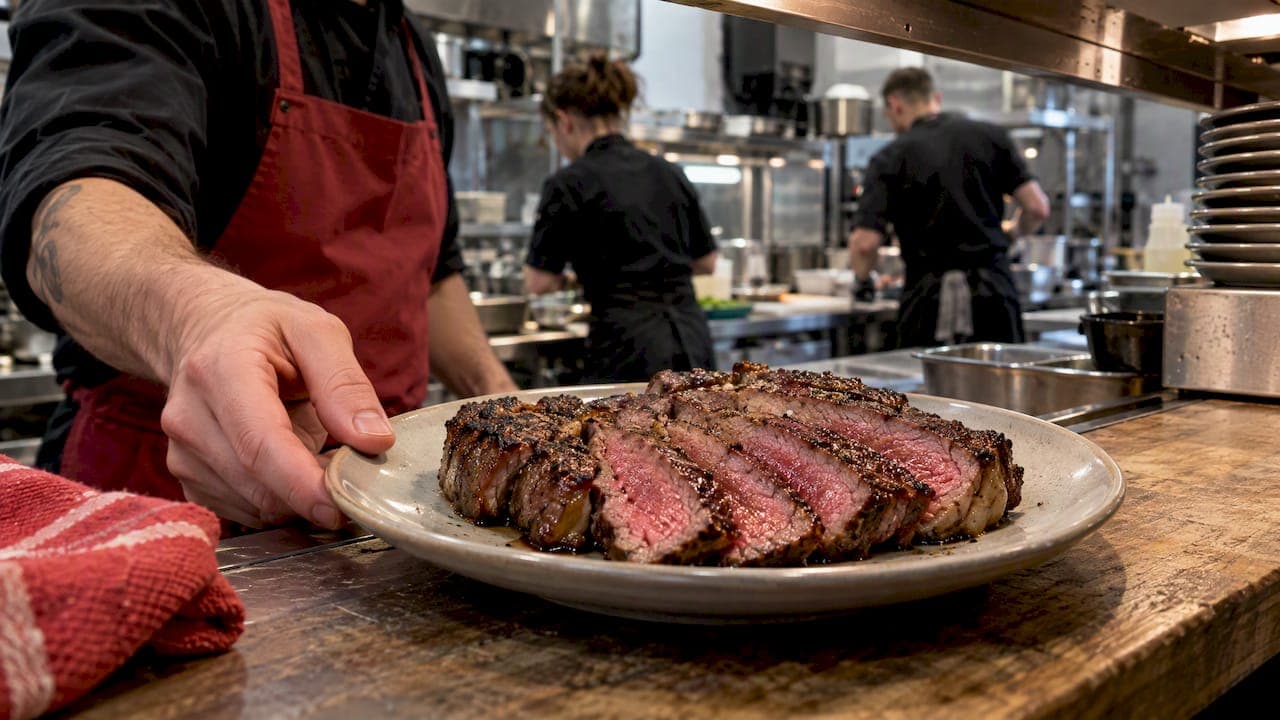
Blue rare corresponds to a very low internal temperature, rare is slightly higher, medium-rare is warm pink, medium is firmer, medium-well has slight pink, and well-done has no pink, with typical temperatures in increasing order without specific numbers. Pull your steak off the heat slightly before it reaches the target temperature, since carryover cooking keeps raising the temperature while it rests. The chart, the technique for measuring it, and the timing rules that back it up are below.
TL;DR:
- Thinner steaks under 1.5 cm can reach doneness in less than a minute per side, requiring close attention during cooking.
- Thick cuts over 3 cm should be seared then finished at lower heat or in the oven to avoid burning the crust or uneven cooking.
- Using a thermometer, you should pull the steak 1 to 3°C below the target temperature to account for residual heat and carryover cooking.
- Resting a small steak for about 5 minutes and a larger cut for 8 to 10 minutes helps juices redistribute and the temperature rise to complete.
- Medium-rare, around 54°C (130°F), is the most widely recommended doneness for balancing tenderness and juiciness across popular cuts.
Table of Contents
- Steak doneness chart: temperatures, texture cues, and starter cook times
- How to measure internal temperature correctly and use the pull-temp method
- Cook-time rules of thumb and how to scale for thickness and starting temperature
- Seasoning, resting, and finishing steps that change the outcome
- Backup checks: how to judge doneness without a thermometer
- Safety considerations regarding minimum safe internal temperatures
- Publisher perspective: how Big Shots Amsterdam approaches steak doneness
- Try a steak cooked to these temperatures at Big Shots Amsterdam
- FAQ
Steak doneness chart: temperatures, texture cues, and starter cook times
Every steak doneness level has a target internal temperature, a texture you can expect at the center, and a rough cook time that gets you in the neighborhood before a thermometer confirms the result. These cook times assume a 2 to 3 cm (3/4 to 1 1/4 inch) steak on a very hot pan or grill, flipped once, starting at room temperature. Thickness, cut, and starting temperature all shift the numbers, which is why the chart is a starting point rather than a guarantee.
| Doneness | Internal temp (°C) | Internal temp (°F) | Center texture | Minutes per side |
|---|---|---|---|---|
| Blue rare | 43°C | 110°F | Cool, deep red, very soft | 1 to 2 minutes |
| Rare | 49°C | 120°F | Red center, soft and juicy | 2 to 3 minutes |
| Medium-rare | 54°C | 130°F | Warm pink center, firm but yielding | 3 to 4 minutes |
| Medium | 60°C | 140°F | Pink throughout, firmer | 4 to 5 minutes |
| Medium-well | 65°C | 150°F | Slight pink, mostly firm | 5 to 6 minutes |
| Well-done | 74°C | 165°F | No pink, firm throughout | 6 to 7 minutes |
A few things to keep in mind when you use this chart at the stove:
- Thin steaks under 1.5 cm cook faster than these ranges suggest, sometimes in under a minute per side.
- Thick cuts over 3 cm often need a sear followed by gentler heat to hit the center temperature without burning the crust.
- Bone-in cuts like a porterhouse or T-bone cook slightly unevenly near the bone, so check both sides of it.
How to measure internal temperature correctly and use the pull-temp method
An instant-read digital thermometer gives you a fast spot check and works for nearly any cut. A leave-in probe thermometer tracks temperature continuously, which helps for thicker steaks or when you are also managing an oven finish. Either tool beats guessing.

Insert the probe into the center of the thickest part of the steak, away from bone, fat pockets, and the outer crust, since those areas read hotter or cooler than the actual center. For thin steaks, insert the probe sideways rather than straight down to avoid hitting the pan.
Pull the steak 1 to 3°C (3 to 5°F) below your target, because residual heat keeps cooking the center for a few minutes after it leaves the pan or grill. A restaurant kitchen in Spain that specializes in grilled meats documents the same carryover principle, pulling meat before it reaches the final serving temperature to account for the rise during rest.
- Use instant-read thermometers for quick checks on thinner cuts.
- Use leave-in probes for thick steaks or oven-finished cooking.
- Check your thermometer's accuracy in ice water: it should read the freezing point of water.
Pro Tip: Test a new thermometer in ice water once before trusting it on a $30 ribeye.
Cook-time rules of thumb and how to scale for thickness and starting temperature
Time is a useful starting guide, but it only works once you know your steak's thickness and starting temperature.
- Thin steaks need roughly a very short time per side on high heat and reach doneness fast, so stay close to the pan.
- Medium steaks generally need several minutes per side depending on target doneness, following the chart above.
- Thick steaks often need longer per side or a sear followed by a gentler heat method to cook the center without scorching the surface.
- A steak from the fridge needs extra time compared to one at room temperature, since the center starts colder.
- Once you are within a couple of degrees of your target, switch from timing to temperature checks and let the thermometer make the final call.
Searing first over high heat builds the crust, then moving to lower heat, a cooler part of the grill, or a 150°C (300°F) oven lets thick cuts finish evenly without burning. Time tells you when to start checking. Temperature tells you when to stop cooking.
Seasoning, resting, and finishing steps that change the outcome
Salting early, 40 minutes or more before cooking, draws out moisture that then reabsorbs and seasons the meat deeply while helping the crust form. Salting right before the pan seasons only the surface and risks drawing out moisture without enough time to reabsorb it, which can leave the crust slightly damp.
Resting matters as much as the cook itself:
- Rest smaller steaks (under 300 g) for about 5 minutes.
- Rest larger cuts like a porterhouse or T-bone for 8 to 10 minutes.
- Tent loosely with foil to keep the surface warm without softening the crust.
Resting lets juices redistribute through the meat instead of spilling out onto the cutting board, and it accounts for part of that carryover temperature rise. A butter baste with garlic and herbs near the end of cooking adds flavor without changing the pull temperature much, while an oven finish on thick cuts means pulling a few degrees earlier since the center keeps climbing in that residual heat. Slice against the grain and serve right away.
Backup checks: how to judge doneness without a thermometer
The finger test compares the firmness of your steak to the muscle at the base of your thumb: relaxed hand feels like rare, thumb to middle finger feels like medium, thumb to pinky feels close to well-done. It is a rough guide at best, since hand firmness varies from person to person.
- Rare centers look deep red with watery juices pooling on the surface.
- Medium-rare centers look warm pink with slightly thicker, rosy juices.
- Well-done centers show no pink and release clear juices.
Lighting in your kitchen and the few minutes a steak spends resting can both make color harder to judge accurately. Treat the finger test and color checks as temporary backups, and keep an inexpensive instant-read thermometer on hand for consistent results.
Safety considerations regarding minimum safe internal temperatures
Whole cuts of beef including steaks reach a minimum safe internal temperature after cooking and resting to address surface bacteria, which differs from ground beef that requires a higher internal temperature. The common food-safety threshold for whole steaks lies around medium-rare to medium doneness levels. Cooking a steak to rare or blue rare, both below that threshold, carries more risk than cooking it to medium-rare or higher, so people with weaker immune systems, young children, or pregnant people are often advised to stay at or above that line.

Searing the exterior thoroughly before cooking to a lower internal temperature is a common practice because it addresses the surface, where contamination is most likely to sit on a whole cut. This is different from the eating experience many home cooks and chefs prefer, which often lands at medium-rare for flavor and texture reasons rather than strict food-safety minimums. Know the difference between the two, and make the call that fits your own household.
Publisher perspective: how Big Shots Amsterdam approaches steak doneness
We cook steaks using the same temperature-first approach laid out in this chart: we check internal temperature rather than guessing by time, and we pull steaks early enough to let carryover heat finish the job cleanly. If you want to compare your own results against a restaurant benchmark, our menu lists the steaks we serve, and trying one in person or through delivery gives you a reference point for what a properly rested, properly timed steak should taste like.
— Leo
Try a steak cooked to these temperatures at Big Shots Amsterdam
Reading a chart is one thing. Tasting the result cooked by someone who does it daily is another. Our menu carries steak options alongside burgers, pasta, and tapas, and we take orders through delivery if you would rather eat at home.

- Browse the full steak and food lineup on our menu.
- Order online through our delivery page for home delivery.
- Book a table or group visit through our lounge experiences page.
FAQ
What is the 3-3-3 rule for steak?
The 3-3-3 rule is a cooking shortcut suggesting 3 minutes per side on the grill or pan followed by a 3-minute rest, aimed at medium-rare on a standard-thickness steak. It works best as a rough starting point, since actual timing depends on thickness and starting temperature, so confirming with a thermometer against the chart above gives a more reliable result.
What doneness is best for steak?
There is no single correct answer, since it depends on personal taste and the cut. Medium-rare, around 54°C (130°F), is widely preferred for tender cuts like ribeye and filet because it balances juiciness with enough structure to hold together.
Is 50°C medium-rare?
50°C sits just below the common medium-rare target of 54°C, landing closer to rare on the chart above. A steak pulled at that temperature and allowed to rest will likely finish in the rare to medium-rare range once carryover heat is accounted for.
Do chefs prefer rare or medium rare?
Preferences vary by chef and cut, but medium-rare is more commonly highlighted on restaurant menus and in professional kitchen guides because it suits a wider range of steak cuts without drying them out. A restaurant guide to cooking temperatures from an applied kitchen setting outlines similar standard targets for common doneness levels.
What is the difference between porterhouse and T-bone steaks?
Both cuts come from the same part of the cow and share the T-shaped bone, but a porterhouse includes a larger portion of tenderloin, while a T-bone has a smaller tenderloin section. Doneness temperatures and timing from the chart above apply to both, though the larger tenderloin side on a porterhouse can cook slightly faster than the strip side.