
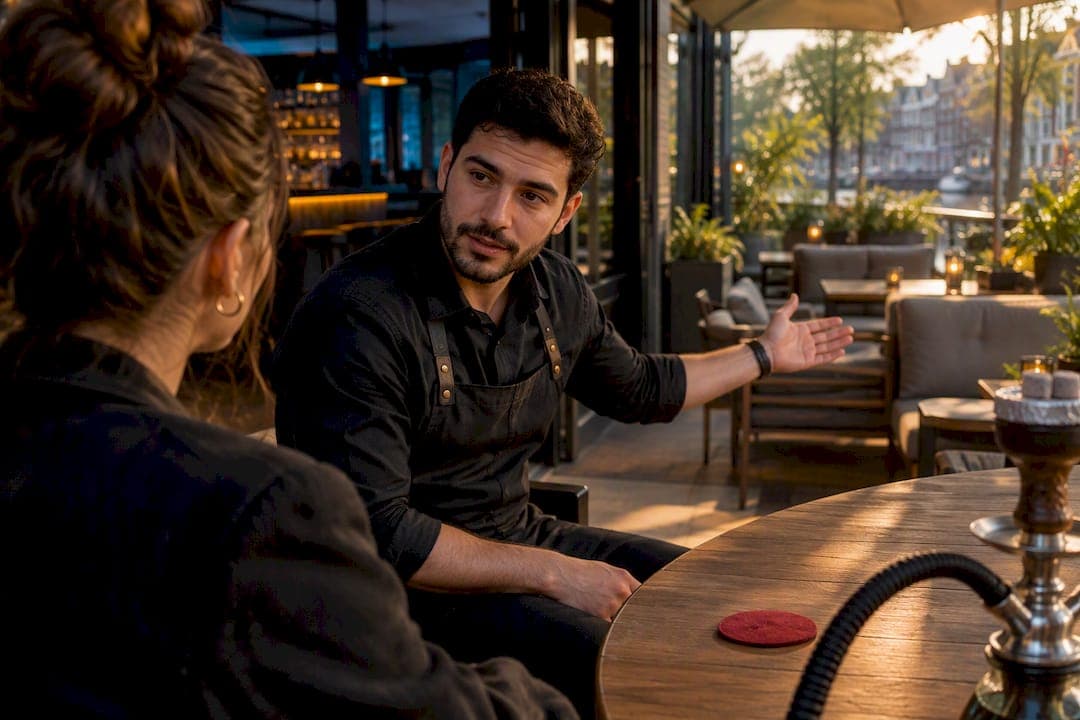
Short answer: no, not indoors. The Dutch national smoking ban stops you from using a personal shisha, whether it burns tobacco or a nicotine-free herbal mix, inside any bar, cafe, or restaurant. Outdoor terrace use might be possible, but only under strict conditions and only if the venue agrees. Check the terrace setup and ask staff before you pack a hose in your bag.
TL;DR:
- Indoor shisha use is strictly prohibited in all Dutch hospitality venues, including herbal or nicotine-free mixes, due to national smoking bans and enforcement by NVWA.
- Outdoor terrace shisha may be allowed only if the space is sufficiently open to fresh air and does not cause nuisance, but venue management retains the final decision.
- Amsterdam requires licensed shisha lounges to have a specific water pipe activity permit, meaning most general bars cannot legally permit shisha even if they have terraces.
- Carrying a shisha device on public transport or across borders is legal, but using it indoors without proper authorization can lead to fines and legal issues.
- Visiting a licensed lounge, such as Big Shots Amsterdam, ensures compliance, as they handle setup, ventilation, permits, and safety, providing a legal and safe smoking experience.
Table of Contents
- Dutch national rules: the smoking ban and how it applies to shisha
- When outdoor shisha use at a bar is permitted
- Municipal permitting: why Amsterdam treats shisha differently
- Why venues refuse personal shisha: carbon monoxide, fire, and licensing risk
- If you still want to try: how to ask a bar to allow a personal shisha
- Transport regulations for carrying a shisha device to a bar
- Customs rules when bringing shisha across a border
- Publisher perspective: how licensed lounge experiences operate
- Book a lawful lounge experience at Big Shots Amsterdam
- Sources
- FAQ
Dutch national rules: the smoking ban and how it applies to shisha
The legal baseline is simple to state and easy to misjudge. Dutch hospitality venues, from neighborhood bars to hotel restaurants, operate under a nationwide indoor smoking prohibition, and Rijksoverheid guidance confirms this covers water pipes and e-cigarettes as well as cigarettes. There is no separate category for shisha that lets it slide past the rule.
Many people assume a herbal or steam-based shisha mix, one with no tobacco or nicotine, might sit outside the ban. It does not. Guidance on tobacco and related product sales treats water pipes as covered whether they contain tobacco or a nicotine-free herbal alternative, so a "clean" mix offers no loophole indoors.
Enforcement falls to the Nederlandse Voedsel- en Warenautoriteit, the food and product safety authority better known as NVWA. Inspectors can visit hospitality venues, and owners who allow indoor smoking, shisha included, risk fines that can climb for repeat violations, according to the same business.gov.nl guidance. That risk sits with the venue, not just the smoker, which is a big part of why bar owners are cautious.
A few points worth holding onto:
- The ban applies to every enclosed hospitality space, not just traditional bars: restaurants, cafes, and dedicated shisha lounges are all included.
- Herbal, tobacco-free, and steam-stone shisha mixes are treated the same as tobacco under enforcement guidance.
- Violations expose the business, not only the individual smoking, to fines and repeat-offense penalties.
Venues that ignore the smoking ban risk escalating fines for repeat offenses, according to business.gov.nl. That single fact explains most of the "no" you will hear at the door: an owner is weighing your one evening against a compliance record that NVWA can act on repeatedly.
When outdoor shisha use at a bar is permitted
Terraces are where the rule gets genuinely conditional rather than a flat no, but the conditions are stricter than most smokers expect. According to terrace permit guidance from business.gov.nl, outdoor smoking is allowed only when the terrace is sufficiently open to the outside air and when the smoke does not create nuisance for guests seated indoors.
That "sufficiently open" standard matters more than it sounds. A terrace with a roof, glass walls on three sides, and heaters running does not automatically count as outdoor space for smoking purposes; a fully enclosed structure functions like an indoor room in the eyes of the rule. Smoke drifting back through an open doorway, or gathering under a low awning, is exactly the kind of nuisance the guidance is built to prevent.
Even where the physical terrace passes muster, the venue still decides. Bar owners can refuse personal shisha outright, and many do, because a smoldering bowl of charcoal on a busy terrace introduces liability and staff workload that a round of beers does not.
Practical conditions you are likely to run into:
- At least one full side of the terrace needs to be open to outdoor air, with no wall, glass panel, or dense awning sealing it off.
- Overhead parasols and light awnings are usually fine; enclosed or heavily curtained terrace structures generally are not.
- Smoke that drifts back indoors, near doorways, or under low canopies counts as nuisance and can void the exception.
- Staff and management retain final say and can prohibit personal shisha even on a qualifying terrace.
If a venue does say yes, treat it as a favor rather than a right. The rule permits it under specific circumstances; it does not obligate anyone to let you set up a hose and bowl next to their other customers.
Municipal permitting: why Amsterdam treats shisha differently
National rules set the floor, but Amsterdam adds its own layer that most visiting smokers never see coming. Under the city's horecabeleid, or hospitality policy, a venue has to list water pipe activity explicitly in its exploitation permit before it can lawfully offer or allow shisha on the premises.
This single requirement explains a lot of the confusion visitors feel. A standard neighborhood bar, sports pub, or restaurant that never applied for that specific permit line simply cannot allow shisha, whether it is house-owned equipment or something a customer carried in. It is not a matter of the manager being unfriendly. Allowing it would put the business outside its own permit terms, which is a different and arguably bigger problem than a smoking-ban fine alone.
In effect, this narrows lawful shisha use to venues built and licensed for it, dedicated lounges that applied for and received the specific permission, rather than general hospitality spots that happen to have a nice terrace.
Before you show up with your own setup:
- Confirm the venue actually holds a water pipe listing in its exploitation permit rather than assuming any bar can host shisha.
- Recognize that Amsterdam's approach limits shisha to specific licensed categories, not every hospitality business in the city.
- Ask staff directly whether their permit covers shisha activity, since this varies venue by venue even within the same neighborhood.
If you are outside Amsterdam, the same logic often applies locally. Municipalities set their own hospitality policy, so it pays to check your city's version before assuming a terrace or lounge can legally accommodate you.
Why venues refuse personal shisha: carbon monoxide, fire, and licensing risk
Set the permits aside for a moment and the safety math alone explains most refusals. A shisha bowl burns charcoal at high heat for an extended session, and in a space without dedicated ventilation, that means real carbon monoxide exposure and a live fire risk sitting a few inches from tables, tablecloths, and other guests.
For a venue owner, the exposure runs three directions at once. There is the smoking-ban fine risk from NVWA enforcement, there is the exploitation permit risk if Amsterdam or another municipality finds unlicensed shisha activity happening on-site, and there is the plain liability question of who answers for it if a coal tips, a guest is burned, or smoke sets off an alarm. Insurance policies written for a standard restaurant or bar rarely anticipate open-flame charcoal use, which leaves an owner personally exposed if something goes wrong.

None of that risk disappears just because the shisha is tucked under a table or brought out only after the manager steps away. A hidden setup does not change the legal exposure for the venue, and it does not change your own exposure either if an inspector or a fire incident brings it to light.
Pro Tip: If a bar hesitates, do not push. Ask instead whether they know of a licensed lounge nearby. It saves everyone the argument and gets you smoking sooner.
If you still want to try: how to ask a bar to allow a personal shisha
If you want to try your luck anyway, the way you ask matters more than most people think. A vague "can I smoke shisha here" invites an automatic no. A specific, well-informed question gives the manager something concrete to evaluate.
- Ask whether the venue's exploitation permit covers water pipe activity, since that is the real gatekeeping question in cities like Amsterdam.
- Ask whether their terrace qualifies as sufficiently open under local rules, and whether staff have handled shisha requests before.
- Offer to have staff handle the coals and setup yourself rather than leaving it unattended at the table.
- Propose a designated outdoor spot away from doorways and other guests to minimize nuisance complaints.
- Accept a no gracefully. It usually reflects permit limits or insurance terms, not a judgment on you.
A few small offers make the conversation easier: disposable mouthpieces signal you have thought about hygiene, and a willingness to sit at whichever outdoor table the manager prefers shows you are not trying to dictate terms to their business.
Pro Tip: Call ahead instead of asking at the door. A manager can check the permit and terrace situation calmly, without a line of guests waiting behind you.
If the answer is still no, or if you would rather skip the negotiation entirely, booking a venue built for it removes the guesswork. A licensed shisha lounge or a venue's own lounge experience already has the permit, the ventilation, and staff trained to handle coals safely, so you spend the evening smoking instead of asking permission.
Transport regulations for carrying a shisha device to a bar
There is no specific Dutch transport law banning you from carrying a shisha pipe, hose, or bowl in a bag on the street, on a bike, or on public transport. The equipment itself is legal to own and move around; the restriction sits entirely at the point of use, not the point of transport.
Where things get murkier is intent. Carrying a shisha openly to a venue that has already told you no, or concealing one specifically to use it once inside, does not create a transport violation, but it does put you squarely back in smoking-ban and permit territory once you try to light it. Packaging it discreetly for travel, in a padded bag or case, is standard practice and raises no legal issue on its own.
The practical advice is straightforward: transport is unrestricted, so pack your shisha however keeps it intact, but treat the venue's door as the real checkpoint. Nothing about how you carried it changes whether you are allowed to use it once you arrive, and no amount of careful packing turns a permit-less bar into a legal smoking spot.
Customs rules when bringing shisha across a border
If you are traveling into the Netherlands from elsewhere in the European Union with a personal shisha setup, the pipe and accessories themselves generally move freely, since there is no special import license for the hardware. Tobacco quantities are a separate matter: travelers bringing tobacco products across EU internal borders are subject to standard personal-allowance guidance, and quantities beyond typical personal use can draw customs attention regardless of what you plan to smoke it in.
Arriving from outside the EU changes the picture further, since tobacco and certain herbal products can fall under stricter import limits and duty requirements at the Dutch border. The equipment is rarely the issue; the shisha mix or tobacco you are carrying alongside it is what customs typically screens for.
None of this affects the venue-level rules covered above. Clearing customs with your shisha in your suitcase says nothing about whether a Dutch bar can legally let you use it once you reach the venue. Those are two separate checkpoints, and passing one does not clear the other.
Publisher perspective: how licensed lounge experiences operate
Running a licensed shisha lounge looks nothing like letting a customer bring their own setup to a table. At Big Shots Amsterdam, staff manage the charcoal, monitor ventilation, and handle setup and teardown themselves, which keeps the fire and carbon monoxide risks described earlier under direct control rather than left to a guest who may have never lit coals before. The charcoal handling process that lounge staff follow is part of what makes this the safer route: guests get the experience without carrying the liability.
Booking a session at a venue built for it also settles every legal question this article has raised at once. The permit already covers water pipe activity, the ventilation is designed for it, and the food and drink service, paired thoughtfully with cocktails, runs alongside it rather than around it. You are not asking a manager for an exception; you are using the venue exactly as it is licensed to operate.
— Leo
Book a lawful lounge experience at Big Shots Amsterdam
Skip the terrace negotiation and the permit guesswork entirely. Big Shots Amsterdam runs its shisha service as a proper lounge experience, with staff handling the coals, ventilation built for it, and a permit that actually covers the activity, so you spend the evening enjoying it rather than defending it to a manager.
A session at such a hospitality venue in Amsterdam gets you:
- Staff-managed shisha setup and charcoal handling, so you are not the one troubleshooting a smoldering bowl.
- A licensed indoor and terrace setup, meaning no last-minute refusal at the door.
- Full access to the menu, from steaks to cocktails, served right alongside your session.
- Sports on screen and a relaxed lounge atmosphere suited to groups, casual hangouts, or a low-key date night.
If you would rather order in than head out, our delivery service covers the food side of the evening too. For groups planning ahead, reach out through the lounge experiences page to check availability and lock in a table.
Sources
FAQ
Is it illegal to smoke shisha indoors at a Dutch bar?
Yes. The national indoor smoking ban covers water pipes along with cigarettes and e-cigarettes, and it applies to every hospitality venue, according to Rijksoverheid guidance. This includes herbal or nicotine-free shisha mixes, which are not exempt.
Can I bring my own shisha to a bar terrace instead?
It is possible only if the terrace is sufficiently open to outdoor air and the smoke does not create nuisance for guests indoors, per terrace permit rules. Even then, the venue can still refuse, so ask staff before assuming it is allowed.
Does Amsterdam have extra rules for shisha lounges?
Yes. Amsterdam's horecabeleid requires venues to list water pipe activity in their exploitation permit before they can lawfully offer it, which is why most standard bars cannot allow shisha even if they wanted to.
What happens if a bar allows shisha without the right permit?
The venue risks NVWA enforcement and fines under national tobacco rules, and repeat violations can lead to escalating penalties, according to business.gov.nl. It can also jeopardize the exploitation permit itself under municipal policy.
Is there a legal way to enjoy shisha at a bar in Amsterdam?
Booking a licensed shisha lounge, such as the lounge experiences at Big Shots Amsterdam, is the straightforward legal route. These venues hold the specific permit and staff the setup themselves, removing the permission problem entirely.