
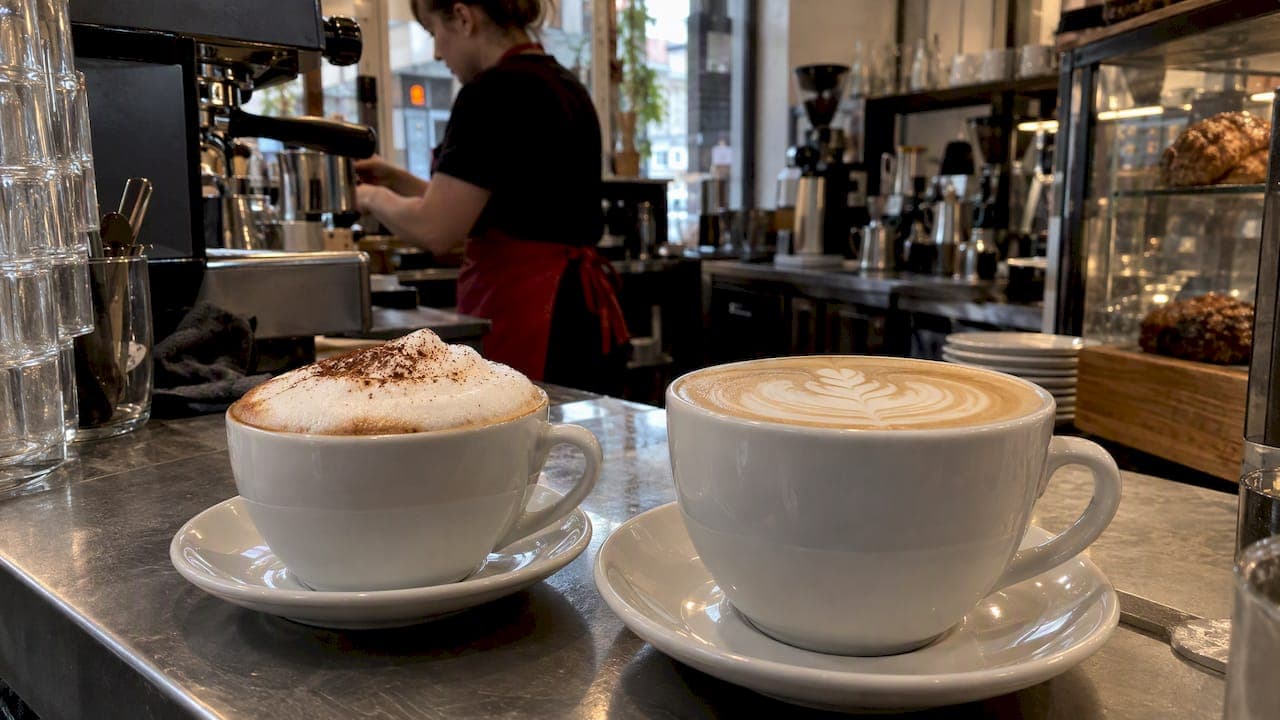
The difference is milk: a latte is milk-forward with silky microfoam, while a cappuccino has less milk and a thicker foam cap. Both start from the same espresso shot, but a latte stretches it with steamed milk for a smoother cup, and a cappuccino keeps the milk tighter and the foam denser. Ask for a cappuccino when you want espresso to lead, and a latte when you want a creamier, milder drink.
TL;DR:
- A traditional cappuccino uses roughly equal parts espresso, steamed milk, and foam, served in a 150 to 180 milliliter cup.
- A latte typically combines one part espresso with about two parts steamed milk and comes in a larger 200 to 300 milliliter serving.
- Both drinks contain the same caffeine per espresso shot; total caffeine depends on shot count, while milk choice changes calories, fat, and protein.
- Ask for a dry cappuccino if you want more foam and less steamed milk, or request silkier foam for either drink.
Table of Contents
- The main difference: milk amount and foam texture explained
- What is a cappuccino: composition, cup size, and foam
- What is a latte: composition, serving size, and microfoam
- Milk ratios and steaming technique: practical how-to and barista cues
- Taste, caffeine, and nutritional differences
- How we prepare and serve cappuccinos and lattes at Big Shots Amsterdam
- Quick decision guide: when to order cappuccino vs latte
- Where to taste both: menu and ordering links for Big Shots Amsterdam
- FAQ
- Sources
The main difference: milk amount and foam texture explained
Everything about how these two drinks taste and feel comes down to two variables: how much milk goes in, and how that milk gets textured. A cappuccino uses less steamed milk and tops it with macrofoam, a thick, airy layer with visible bubbles that sits like a cloud on the surface. A latte uses roughly double the milk and finishes with microfoam, where the air bubbles are so fine the milk turns glossy and pourable, which is what lets baristas draw hearts and rosettas on top.
That difference in foam type changes the sensory experience as much as the ratio does. A cappuccino hits your palate with a frothier, almost whipped texture before the espresso comes through underneath. A latte feels smoother and rounder, since the fine microfoam blends into the milk rather than sitting apart from it.
The practical takeaways:
- More milk and finer foam make a latte milder and creamier.
- Less milk and thicker foam make a cappuccino bolder and more textured.
- Foam type, not just milk volume, is what gives each drink its signature mouthfeel.
What is a cappuccino: composition, cup size, and foam
A classic cappuccino splits roughly into thirds: one part espresso, one part steamed milk, and one part foam. It is traditionally served in a smaller cup, around 150 to 180 milliliters, which keeps the ratio tight and the espresso flavor front and center. The foam is spooned or layered on top rather than blended in, giving the drink its characteristic cap of macrofoam that holds its shape.
Variations are common. Some cafes dust the foam with cocoa or cinnamon, and non-dairy milks like oat or soy can replace dairy without changing the basic structure. If you want a traditional cup, a quick note to your barista like "classic ratio, dry foam" sets the expectation clearly.
- Typical ratio: about one-third espresso, one-third steamed milk, one-third foam.
- Cup size: roughly 150 to 180 milliliters.
- Foam style: thick, spoonable macrofoam, often topped with cocoa or cinnamon.
Pro Tip: Ask for a "dry cappuccino" if you want more foam and less steamed milk underneath it.
What is a latte: composition, serving size, and microfoam
A caffè latte uses one part espresso to roughly two parts steamed milk, finished with a thin veil of microfoam rather than a thick cap. Serving sizes run larger, typically 200 to 300 milliliters, since the extra milk needs more room without crowding the espresso.
The microfoam is the real craft here. Steaming milk to a silky, almost paint-like consistency lets baristas pour patterns directly into the cup, which is why lattes are the usual canvas for latte art. The added milk also softens the espresso's edge, making the drink taste rounder and a bit sweeter from the lactose, while adding more calories than a smaller, less milky pour.
- Composition: one part espresso to about two parts steamed milk.
- Serving size: generally larger, suitable to hold the extra milk of a latte.
- Texture: thin, glossy microfoam that supports latte art.
Milk ratios and steaming technique: practical how-to and barista cues
Getting the ratio right starts with the steaming technique, since macrofoam and microfoam come from the same equipment used two different ways.
- Fill the pitcher with cold milk to about one-third full, leaving room to expand.
- Submerge the steam wand just below the surface to introduce air for a few seconds, more for a cappuccino's macrofoam, less for a latte's microfoam.
- Tilt the pitcher so the milk spins in a tight whirlpool, which breaks large bubbles into smaller ones for silkier texture.
- Lower the wand deeper once the milk is aerated, heating it to roughly 55 to 65 degrees Celsius without scalding it.
- Tap the pitcher and swirl before pouring to settle the foam and smooth out any remaining texture.
Barista cues matter as much as the steps themselves. A shallower wand position and a wider whirlpool build more air for a cappuccino's thicker foam, while a deeper wand position and a tighter spin produce a latte's fine microfoam. For more on how these espresso-based drinks compare side by side, this guide to espresso drink types breaks down cup sizes and prep basics.
Pro Tip: If your foam looks grainy instead of smooth, the wand was probably too shallow for too long, pull it deeper sooner next time.

Taste, caffeine, and nutritional differences
A latte tastes milder and a touch sweeter because the extra steamed milk dilutes the espresso and brings out natural milk sugars. A cappuccino tastes sharper and more espresso-forward since there is simply less milk to soften it.
Caffeine per shot of espresso is identical in both drinks, but total caffeine depends on how many shots and how much milk go into the cup, which tends to track with the larger serving size of a latte. Milk choice also shifts the nutrition profile: whole milk adds more fat and calories than semi-skim, while oat or soy milk changes the protein and fat content differently depending on the brand, a comparison worth checking directly in the USDA FoodData Central database by serving size.
- Cappuccinos: bolder taste, smaller serving, less total milk.
- Lattes: milder taste, larger serving, more total milk and typically more calories.
- Milk type: the biggest lever on fat, protein, and calorie count in either drink.
Caffeine and composition vary by drink volume more than by type: cappuccinos run about one-third espresso, one-third steamed milk, one-third foam, while lattes use more steamed milk and a thinner foam layer, which is the main reason lattes read as creamier and higher in calories.
How we prepare and serve cappuccinos and lattes at Big Shots Amsterdam
Our approach to milk-based coffee drinks is straightforward: proper cup sizing, fresh steaming for each order, and foam texture built to match what the espresso needs. Cappuccinos are poured into smaller cups with a macrofoam cap and lattes into larger cups with silky microfoam, so each drink shows up looking and tasting the way it should.
If you want your foam firmer or your milk silkier than the standard pour, just say so when you order, baristas can adjust the steaming technique on the spot.
- We size cups to match the drink, smaller for cappuccino, larger for latte.
- We steam milk fresh per order rather than holding it.
- We adjust foam texture on request, drier or silkier depending on your preference.
Quick decision guide: when to order cappuccino vs latte
If you want espresso to lead, order a cappuccino; if you want a creamier, milk-forward cup, order a latte. A quick checklist helps when you are deciding on the spot.
- Time of day: cappuccinos suit a quick morning jolt, lattes suit a slower sit-down.
- Food pairing: cappuccinos pair well with pastries, lattes pair well with breakfast plates.
- Texture preference: pick thick foam for cappuccino, smooth microfoam for latte.
Baristas can always tailor the milk texture to your taste, so treat these as starting points, not strict rules.
— Leo
Where to taste both: menu and ordering links for Big Shots Amsterdam
Both drinks are easy to compare side by side when you can order them from the same counter. We serve cappuccinos and lattes as part of our café and drinks menu, alongside breakfast plates, tapas, and steaks if you want to turn your coffee order into a full sit-down. Prefer to stay in and compare both from home? Our delivery service covers that too.

- Dine-in: full menu with cappuccino, latte, and food pairings.
- Delivery: order either drink without leaving home.
- Lounge: pair your coffee order with a relaxed seating experience.
| Option | Best for | Link |
|---|---|---|
| Dine-in menu | Trying both drinks fresh with food | Menu |
| Delivery | Ordering from home | Delivery |
| Lounge Experiences | Sitting in for a slower visit | Lounge Experiences |
FAQ
Does a cappuccino or latte taste better?
Neither is objectively better, it depends on whether you prefer a stronger espresso presence or a creamier, milder cup. A cappuccino tastes bolder because it has less milk, while a latte tastes smoother and sweeter because of its larger milk volume.
What is the difference between a latte and a macchiato?
A latte uses roughly one part espresso to two parts steamed milk with a thin microfoam layer, while a macchiato is espresso "stained" with just a small splash of milk, making it far stronger and smaller. A latte macchiato reverses that order, pouring milk first and marking it with espresso.
What is cappuccino?
A cappuccino is an espresso drink made with roughly equal parts espresso, steamed milk, and thick milk foam, traditionally served in a 150 to 180 milliliter cup, according to Britannica. The thick macrofoam on top is what distinguishes it from a latte's thinner, silkier foam.
What exactly is in a macchiato?
A macchiato is espresso with a small amount of milk, traditionally just enough to "stain" or "mark" the shot rather than dilute it. It is the smallest and strongest of the common milk-based espresso drinks, far more concentrated than either a cappuccino or a latte.
Sources
- Latte vs. Cappuccino: What’s the Difference? | Britannica
- Cappuccino vs. Latte vs. Macchiato — What’s the Difference? | Healthline
- Cappuccino