
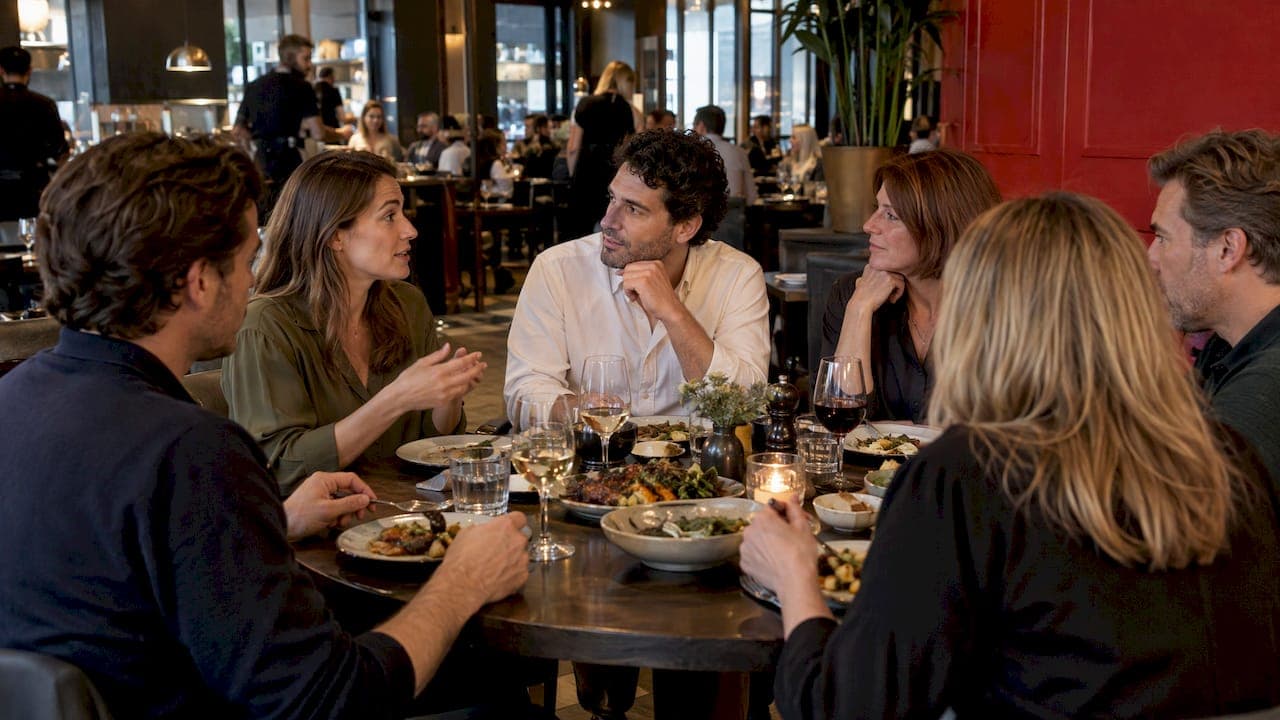
A private dining room in Amsterdam is a separate space in a restaurant or bar, reserved for your group so you eat, drink and talk without sharing the room with other guests. It suits birthdays, team dinners, farewells and family celebrations. The right choice depends on four things: group size, what the venue requires you to spend, how private the space really is, and whether the atmosphere matches the occasion. This guide walks through each one, so you can ask the right questions before you send a booking request.
TL;DR
- A private room gives your group its own space inside a working venue. A full buyout gives you the whole place, usually at a higher cost and with a minimum spend.
- Most private spaces are priced through a minimum spend on food and drinks, not a flat fee. Ask for it in writing and ask what it covers.
- Confirm capacity, opening hours, music and sound rules, menu format and how the room is separated from the rest of the venue.
- Friday and Sunday dates can lower a buyout minimum compared with a peak Saturday, so be flexible if you can.
- If your group wants sports on screen, shisha or a livelier mood, a bar-restaurant hybrid can fit better than a formal dining room.
Table of Contents
- What private dining in Amsterdam actually includes
- Private room or full buyout: which one do you need?
- How much does a private dining room cost in Amsterdam?
- What to check before you book
- A simple booking timeline
- Picking the right atmosphere
- Our perspective
- Plan your group evening with us
- Questions people ask about private dining in Amsterdam
- Sources
What private dining in Amsterdam actually includes
Private dining sits between a normal reservation and a full event hire. At a regular table, you share the room, the noise and the service pace with everyone else. In a private space, your group gets a defined area, usually a dedicated server or team, and a menu agreed in advance.
What you get differs a lot from venue to venue, so treat these as the usual building blocks:
- A defined space. A separate room, a section behind a partition, a mezzanine or a corner of the venue set aside for you.
- A set or pre-ordered menu. Groups of ten or more are normally asked to choose a menu format ahead of time: shared plates, a set menu or a walking dinner. That keeps the kitchen on time and the food arriving together.
- A drinks arrangement. Pay per drink, a drinks package or a tab with a cap. Agree which before the night, not at the bar.
- A host contact. One person at the venue who knows your booking and can answer questions on the day.
The real difference from a regular table is control. You decide the pace, the seating plan and the moment the dessert or the toast happens. In return, the venue asks for a commitment: a headcount, a menu choice and, very often, a minimum spend.
Private room or full buyout: which one do you need?
The two options are easy to confuse because both are sold as "exclusive." They are not the same product.
A private room is one space in a building that stays open to other guests. A buyout means the venue closes to the public and the whole property is yours for set hours. Industry guidance on venue hire describes the trade-off clearly: single-room hire usually costs less, but you share the building and have limited creative control, while a whole-venue buyout gives total exclusivity and control but costs more and comes with a minimum spend.
| Private room | Full venue buyout | |
|---|---|---|
| Privacy | Your own room, shared building | Whole venue to yourselves |
| Control over music, layout, decor | Limited | Wide |
| Typical cost | Lower | Higher, with minimum spend |
| Best for | Dinners of roughly 8 to 40, birthdays, team meals | Weddings, company events, milestone parties |
| Booking lead time | Shorter | Longer, often several weeks |
When a private room is enough
Choose a room when your group wants conversation and a good meal without a crowd at the next table. Think of a 12-person birthday dinner, a farewell for a colleague or a family reunion. You do not need the entrance, the bar and the toilets to yourselves. You need a space where your voices will not be competing with a stranger's evening.
When a buyout makes sense
Go for a buyout if you want to set the music, bring in your own decor, hold speeches with a microphone, show a video or have guests drift between bar, tables and lounge areas. If you are above roughly 50 guests, a buyout is often simpler than looking for a room that fits everyone. We cover this in more depth in our guide on how to rent a bar in Amsterdam for a group event.
How much does a private dining room cost in Amsterdam?
There is no single price. Venues price private space in three main ways, and the headline number means different things in each.
- A minimum spend. The most common model. You commit to spending a set amount on food and drinks, and the room itself is free or carries a small fee. The amount rises for Friday and Saturday nights and for busy periods like December.
- A room fee plus the menu. You pay a fixed fee for the space and then a per-person price for food and drinks.
- A per-person package. Food, a drinks round or two, and the room in one price. Easiest to compare, but check what happens when guests want a drink outside the package.
To compare quotes properly, ask each venue the same questions in the same order:
- Is there a room fee, a minimum spend, or both?
- Does the minimum spend count food and drinks, or food only?
- Are service charge, VAT and any extras included in the quote?
- What happens if fewer guests turn up than you booked for?
- What is the deposit and the cancellation deadline?
The single most useful habit is to get the minimum spend in writing and ask whether it covers food and beverage only or also includes the room fee. Two venues can quote the same figure and mean very different things.
Minimum spend is a number you can plan around
A minimum spend sounds like a hurdle, but with a group it is usually easy to meet if you plan the menu around it. Divide the minimum by the number of guests and you get a per-head budget. If that figure matches what you would spend anyway on a dinner with drinks, the minimum costs you nothing extra. If it does not, adjust the date, the group size or the venue before booking, not after. Our article for planners explains how to avoid very high weekend minimums at Amsterdam bars.
Pick your date with the price in mind
Date drives cost more than anything else. Saturday evenings and the weeks before Christmas carry the highest minimums. The same guidance notes that a Friday or Sunday buyout can lower the minimum spend by 20 to 40 percent for the same exclusive access. That figure comes from a general venue-hire checklist, not from an Amsterdam price list, so use it as a reason to ask about alternative dates, not as a promise. A weekday lunch or an early Sunday evening often gives your group the same room for less.

What to check before you book
A good private dining room is more than a pretty space. These are the details that decide whether the evening runs smoothly.
Capacity and layout
Ask for the seated capacity and the standing capacity separately. A room that holds 40 people standing may seat only 24 comfortably at tables. Ask whether the number includes the server's walkway, and whether long tables, round tables or a mixed layout are possible. For groups with a wheelchair user or guests with limited mobility, ask about steps, narrow stairs and the route to the toilets. Many Amsterdam buildings are old and narrow, and a private room upstairs may mean a steep staircase.
Real privacy
"Private" can mean a door, a curtain or just a reserved corner. Ask:
- Is the room closed off with a door, or open to the main floor?
- Will other guests walk through it to reach the bar or toilets?
- Can your group hear the main venue, and can the venue hear you?
- Is there a separate entrance or coat area?
If you plan speeches, a presentation or a surprise, privacy matters more than a nice view.
Food: format and dietary needs
Pick a format that suits the group. Shared plates work for relaxed gatherings and mixed tastes. A set menu is best for formal dinners and large groups because everyone is served at the same time. A walking dinner suits standing mingling.

Collect dietary needs before the booking deadline, not on the evening. Ask guests for allergies, vegetarian, vegan, halal and other requirements, and send the list to the venue with your final headcount. If you are looking for ideas on festive group food, this festive meal offerings list for event planners shows how caterers think about seasonal menus, vegan options and drinks.
Drinks and rules
Agree on the drinks format in advance: a tab, a package, drinks on consumption or a mix. Ask about the closing time, the last-order time and whether the music can be adjusted. If your group includes smokers, ask where smoking is allowed, because rules depend on the venue and the type of space, and venues set their own house policies for areas such as lounges.
Time and access
Confirm exactly how long you have the room. Ask whether the clock includes setup and clear-up, when your decorations or a cake can be delivered and who handles them. For buyouts, ask what "exclusive" includes: hours of access, setup and breakdown windows, staffing, and whether nearby rooms or outdoor areas are really yours.
A simple booking timeline
- Four to six weeks out (more in December): Decide group size, rough budget and two possible dates. Send enquiries to a few venues of different types.
- Three to four weeks out: Compare quotes using the same questions. Confirm the minimum spend, the deposit and the cancellation terms in writing.
- Two weeks out: Lock the menu format and collect dietary requirements. Confirm the final headcount and the arrival time.
- The week of: Confirm the seating plan, any decorations and the person who will be your contact at the venue.
- On the day: Arrive early, check the room, and agree with your host when the first course and the speeches should happen.
For bigger or more formal gatherings, our guide to planning group dining for any occasion gives a longer checklist, and the guide to hosting parties in restaurants covers the practical side of the night itself.
Picking the right atmosphere
The most overlooked criterion is mood. A grand canal-house dining room is perfect for a quiet anniversary or a business dinner, but it may feel stiff for a group of friends who want to laugh loudly, watch a match and keep the evening going late.
Match the venue to the group:
- Formal dinner, clients or family elders: a quiet room, a set menu, a low music level.
- Friends, birthdays, stag and hen groups: shared plates, cocktails and the freedom to be loud.
- Sports fans: a venue with screens, so the match is part of the plan and not a conflict with it.
- Mixed groups with smokers and non-smokers: a venue with separate areas, so nobody has to leave the table.
If you are choosing between types of venue for an Amsterdam celebration, our overview of Amsterdam venues for dining and sports can help you narrow the field.
Our perspective
Most people searching for a private dining room are really looking for one thing: an evening where their group can relax together without worrying about anyone else. The formal dining room is one way to get there, but it is not the only one.
At Big Shots Amsterdam we combine a sports bar, a shisha lounge, a restaurant and a café across three central venues. That mix suits groups that want more than a seat at a table: a meal that starts with steaks, burgers, tapas or pizza, drinks that carry on through the evening, and a lively but relaxed setting where a match, a lounge corner or a cocktail round is part of the night.
Our advice to any host is to start with the atmosphere and the group, then work back to the room. Tell the venue what the evening is for, how many are coming and how you want it to feel. A good venue will tell you honestly which of its spaces fits. We would rather match your group to the right setup than sell you a bigger one than you need.
If you are planning a birthday, a team night or a get-together with friends in central Amsterdam, talk to us early. The earlier we know your date and headcount, the more options we can offer.
Leo
Plan your group evening with us
Big Shots Amsterdam is a restaurant, sports bar, shisha lounge and café in one, with three central venues in Amsterdam. Our menu covers breakfast, tapas, soups, salads, steaks, burgers, pizza, pasta and shared plates, plus a full drinks list, so a group with different tastes can all find something they like. For a group night with a lounge feel, see our lounge experiences.
Look through the full menu to plan the food, then get in touch through our website with your date and group size. If you would rather bring the meal to your own place, we also offer delivery.
Questions people ask about private dining in Amsterdam
How far ahead should I book a private dining room in Amsterdam?
Four to six weeks ahead is a sensible default for a group of ten or more. In December, around King's Day and on Saturday evenings, book earlier. Smaller groups on weekdays can often get a space with less notice, but the menu and the deposit still need to be agreed.
Is a private room the same as a buyout?
No. A private room is one space in a venue that stays open to others, while a buyout closes the whole venue to the public for your event. Buyouts offer more control and privacy but usually come with a higher cost and a minimum spend, so they suit larger or more formal events.
What is a minimum spend, and do I pay it on top of the food?
A minimum spend is the amount your group commits to spending on food and drinks for the space. You do not pay it on top of your meal: your meal counts toward it. If the bill ends up below the minimum, the venue may charge the difference, so confirm in writing what counts toward it.
Can I bring my own cake or decorations?
Many venues allow it, but not all, and some charge a cake fee or restrict what you can put on walls and tables. Ask when you request the quote and agree on delivery times so someone at the venue can receive them.
What is the best group size for a private dining room?
It depends on the venue, but most private rooms work best between 8 and 40 guests. Under 8, a regular table with a reservation is usually enough. Over about 50, a partial or full buyout is generally easier to organize.
Sources
- Whole-Venue Buyout Hire: What To Expect, Eventory
- Festive Meal Offerings List for Event Planners in 2026, Wild Foodz