
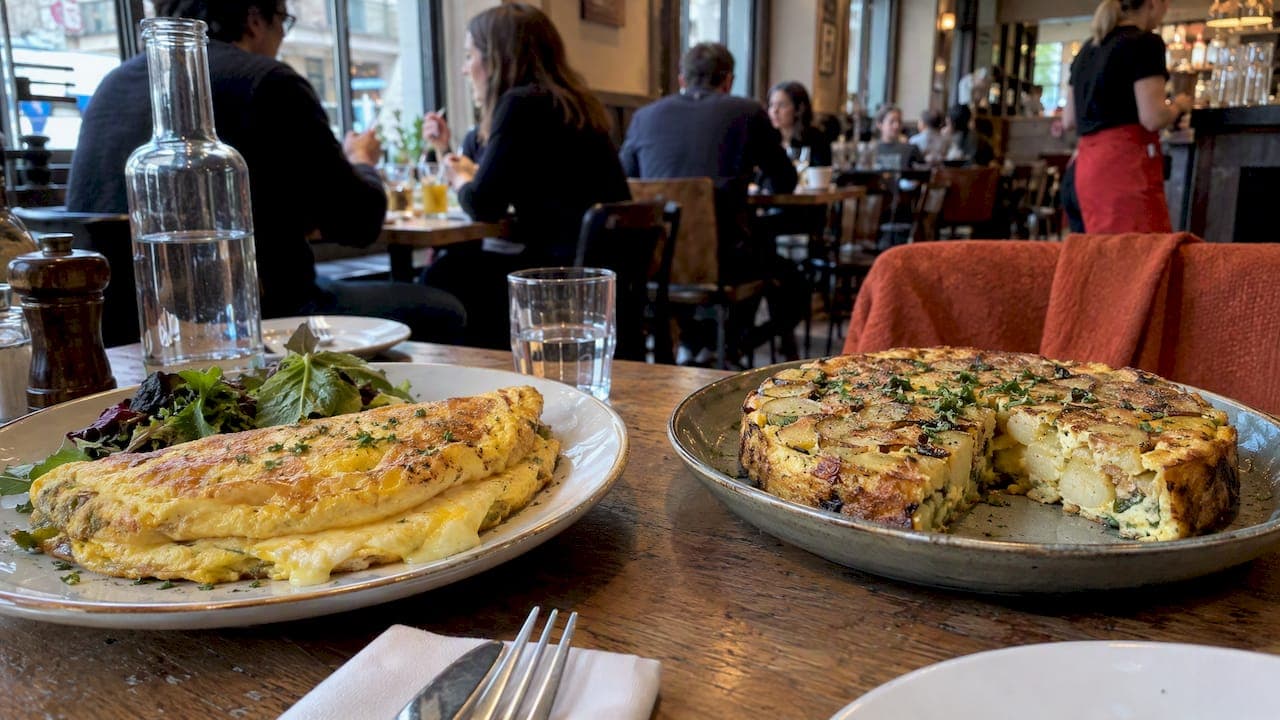
An omelette is a quick, made-to-order egg dish: the eggs set in a hot pan and fold around a filling. A frittata is thicker and open-faced. The fillings are stirred into the eggs, the dish cooks slowly, and it is cut into wedges. Order an omelette when you want a hot, personal plate. Choose a frittata when you are feeding a table or want something you can prepare ahead.
The rest of this guide covers the details: technique, texture, nutrition, food safety and how to choose when you are out for brunch in Amsterdam.
TL;DR
- An omelette is folded around a separate filling and cooked fast over higher heat. A frittata has the filling mixed into the eggs and cooks slowly, often finishing in the oven or under a broiler.
- Omelettes are usually one portion served at once. A frittata serves one or many and can be eaten hot or warm.
- Neither is healthier by name. Cream, cheese, oil, bacon and salt matter more than the label.
- "Room temperature" is a serving style, not a storage rule: Dutch guidance says to refrigerate egg dishes.
- Rule of thumb: omelette for a solo, customized breakfast or post-match meal; frittata for groups and sharing.
Table of Contents
- The core difference in one minute
- How an omelette works
- How a frittata works
- Is a frittata just a baked omelette?
- Frittata vs crustless quiche vs Spanish tortilla
- Which is healthier?
- Food safety: room temperature is not a storage rule
- When to choose which
- Our perspective at Big Shots
- Eat eggs with us in Amsterdam
- Quick tips for cooking either at home
- FAQ
- Sources
The core difference in one minute
Both dishes are beaten eggs in a pan, which is why people confuse them. The difference is where the filling goes and how the egg cooks.
According to The Kitchn's comparison, an omelette is cooked quickly, the filling goes in the center, and the egg is folded or rolled around it. A frittata is thicker, the fillings are mixed into the beaten eggs, and it cooks more slowly, commonly starting on the stovetop and finishing in the oven.
That single choice, filling inside versus filling throughout, drives everything else: texture, size, timing and how you serve it.
| Omelette | Frittata | |
|---|---|---|
| Filling | Added to the center after the eggs begin to set | Mixed into the beaten eggs |
| Heat | Higher, fast | Lower, slow |
| Finish | Folded or rolled in the pan | Often oven or broiler, then sliced |
| Thickness | Thin, tender | Thick, set through, sometimes custardy |
| Portion | Usually one, made to order | One or many, cut in wedges |
| Serving | Hot, straight from the pan | Hot, warm or room temperature |
| Origin of the style | French tradition | Italian tradition |
How an omelette works
A good omelette is about speed and restraint. Delia Smith's classic omelette method calls for 2 to 3 large eggs per person and folding after roughly half a minute of active setting. Exact timing shifts with your pan, heat and egg count, so watch the egg rather than the clock.
What you get is a tender, almost silky exterior with a soft interior and a separately chosen filling. Because you add the filling after the egg starts setting, each omelette can be different. At a table of four, you can have a cheese omelette, a mushroom one, a ham one and a plain one, each cooked to the person's taste.
The trade-off is timing. An omelette is best the moment it leaves the pan. It does not wait well, and it does not scale: you cook them one at a time.
How a frittata works
A frittata behaves more like a savory baked custard in a skillet. You sauté the fillings, pour the beaten eggs over them (or stir them in), cook gently, and finish the top so the middle sets.
Epicurious describes it as a free-form Italian egg dish and pitches it as the better choice for a batch-cooked breakfast or an easy brunch, instead of made-to-order omelettes. It also treats flipping the frittata on the stovetop as risky, which fits a common failure: treating a frittata like a giant omelette and flipping it while the center is still liquid.
The gentler route is to use an oven-safe pan and finish it in the oven or under the broiler. Jacques Pépin's PBS demonstration of a country omelet is a good example. He describes it as a rough omelet in the style of a Spanish tortilla or Italian frittata: potato and onion are sautéed first, eggs and cheese go in, and the top is finished under the broiler.

The result is thicker, more even and sliceable. It also tolerates sitting for a few minutes, which is exactly why it suits sharing.
A note on dairy
If you cook frittatas at home, a conventional ratio from University of Wyoming Extension is half a cup of dairy per 12 eggs. Treat it as a convention rather than a law. More dairy gives a more custard-like texture and a softer slice, and less gives a firmer, more eggy bite.
Is a frittata just a baked omelette?
Not exactly. They overlap, but the construction differs. In a frittata the fillings are incorporated into the egg mixture, the dish is thicker, it is cooked through (on the stovetop and often in the oven), and it is cut into portions. An omelette is folded around a center filling. If you bake an omelette you simply get a baked omelette. If you stir the filling through the eggs and cook it slowly, you have a frittata.

Frittata vs crustless quiche vs Spanish tortilla
Three neighbors often get mixed in with these two.
- Crustless quiche. Close to a frittata, but not identical. Quiche traditionally has a pastry crust and is more strongly associated with baked custard. The Spruce Eats notes that a frittata is an Italian egg dish that may start in a skillet and develop a browned top.
- Spanish tortilla. A related but separate egg dish. Potato is the strongest signal: a potato-and-egg cake points toward tortilla or frittata style, not a classic folded French omelette.
- Scrambled eggs. Stirred constantly into soft curds. Neither of the two dishes here is stirred once the eggs hit the pan.
Does a frittata taste like an omelette? Mostly yes, since both are eggs with savory fillings. The difference you notice is texture: the omelette is delicate and soft, the frittata denser, with a more cohesive, sliceable bite and often a lightly browned top.
Which is healthier?
Neither, by default. The honest answer is that the build decides.
The Dutch nutrition institute Voedingscentrum lists a 50 g hard-boiled egg at 64 kcal, 4.4 g fat, 1.4 g saturated fat and 6.2 g protein. That is the egg itself. What turns a light plate into a heavy one is what you add to it.
To keep either dish lighter:
- Load it with vegetables: spinach, peppers, tomato, mushrooms, onion.
- Go modest on cheese and cooking oil.
- Be careful with cream, bacon and other salty processed fillings.
- Mind the portion. A frittata wedge from a large pan can be bigger than you think, and a three-egg omelette with extra cheese adds up fast.
- Pair it with something fibrous. Voedingscentrum's guidance on a healthy breakfast favors whole-grain bread, fruit or vegetables, and limited saturated fat and salt, which an egg dish with a slice of whole-grain bread can fit.
A vegetable-heavy omelette or frittata with modest cheese can fit that pattern. Either can also be heavy. If you have a medical condition, a cholesterol concern or a specific diet, ask your GP or a registered dietitian (diëtist) how many eggs suit you, since recommendations vary by target group.
Food safety: room temperature is not a storage rule
One line you will see in every frittata guide is that it can be served at room temperature. That describes how it tastes best at a table, not how long it can sit out.
Voedingscentrum's five tips for eating eggs safely advise cooking egg dishes thoroughly, keeping prepared food away from raw egg, refrigerating egg dishes, and keeping dishes made with raw egg for no more than 24 hours in the fridge. The same page advises people who are pregnant, young children, older adults and people with reduced resistance not to eat dishes where the egg is still raw.
That matters for the two dishes in different ways:
- Omelette: a soft, barely set center is a texture some people love. If you are in one of the groups above, ask for it cooked through.
- Frittata: it is cooked through by design, but a brunch buffet or a leftover wedge still belongs in the fridge once it has cooled. The Dutch food safety authority NVWA says Listeria is killed when food reaches 70°C internally for at least 2 minutes in its consumer guidance, so reheat leftovers thoroughly rather than just warming them.
When to choose which
Here is the practical version, for home or for a table out.
Choose an omelette when:
- You want a hot, fast, personal plate.
- Everyone at the table wants something different.
- You want precise control of the filling.
- It is a post-sports or late-morning meal and you want something quick and satisfying.
Choose a frittata when:
- You are feeding friends and want to share slices.
- You have cooked leftovers to use: roasted vegetables, potatoes, cooked pasta, herbs.
- You want something you can prepare ahead and serve warm.
- You prefer a thicker, more substantial bite.
Sharing across cultures is part of this too. If you enjoy comparing how different places do eggs, this Kraków host's take on Polish breakfast foods shows how jajecznica, the Polish scrambled egg dish, fits into a morning table.
Our perspective at Big Shots
We run a sports bar, shisha lounge, restaurant and café across three central Amsterdam venues, so we watch how groups actually eat. A table of friends before a match rarely wants to wait for four separate dishes to land at different moments. Our guests tend to want something satisfying, shareable and good with a coffee or a drink.
That is why we think of these two dishes differently. The omelette is the personal order: quick, customized, hot. The frittata is the social dish: one pan, many forks. Neither is better, and the choice depends on who is sitting with you.
Three things we would tell anyone ordering eggs out:
- Say how you like them cooked. A soft center and a fully set one are both legitimate, and kitchens are happy to be told.
- Ask what goes in. If the vegetables, cheese or meat are the point, you want to know whether they are inside the eggs or beside them.
- Think about the whole plate. Eggs with bread, greens and a fruit juice make a different meal than eggs with extra bacon and cheese, and both have their place.
We list breakfast, tapas, soups, salads, steaks, burgers, pizza, pasta and shared plates on our menu, so check what is on offer on the day you visit.
— Leo
Eat eggs with us in Amsterdam
If you want a relaxed brunch, a late breakfast before a match or a long table of friends, see what we serve on our menu, which includes breakfast. Prefer to eat at home? You can order through our delivery page. If you are planning a longer evening, our lounge experiences are worth a look.
More local reading: what makes Amsterdam brunch special and how breakfast menus shape your Amsterdam experience.
Quick tips for cooking either at home
Omelette
- Beat 2 to 3 eggs per person with a pinch of salt.
- Heat a non-stick pan until the butter foams, then pour in the eggs.
- Stir briefly, then let the base set while the top stays soft.
- Add the filling to one side, fold, and slide it onto a warm plate right away.
Frittata
- Cook your fillings first (onion, potato, vegetables) in an oven-safe pan.
- Pour in the beaten eggs, with a splash of dairy if you like. The conventional ratio above is half a cup per 12 eggs.
- Cook gently until the edges set.
- Finish in the oven or under the broiler until the center is firm, rather than flipping it.
- Let it rest a few minutes, then cut into wedges.
Use low to medium heat for a frittata. High heat browns the bottom before the middle sets, which is the classic way to end up with a burnt base and a runny middle.
FAQ
Is a frittata or omelette healthier?
Neither is healthier by name. A plain egg is modest in calories, and what you add changes the picture: cream, cheese, bacon, oil and salt make either dish heavier, while vegetables and a smaller portion lighten it. Judge the whole plate, as Dutch breakfast guidance does.
Is a frittata just a crustless quiche?
Close, but not the same. Both are open-faced egg dishes and can be custardy. Quiche traditionally has a pastry crust and leans toward baked custard, while a frittata is an Italian egg dish that starts in a skillet and often finishes under heat for a browned top.
Is a frittata just a baked omelette?
Not quite. In a frittata the fillings are mixed into the eggs, it is thicker and it is cut into portions. An omelette is folded around a filling in the center. The two overlap in ingredients but differ in construction.
Does frittata taste like omelette?
Very similar flavor, different texture. An omelette is delicate and soft, while a frittata is denser and holds together as a slice. Because the filling is spread through it, each bite of a frittata tastes more evenly of the fillings.
Can I eat a frittata cold or at room temperature?
You can serve it that way, but do not leave it out for long. Dutch guidance says to refrigerate egg dishes and reheat leftovers thoroughly. Pregnant people, young children, older adults and people with reduced resistance should be especially careful.
Sources
- The Kitchn: What's the Difference Between a Frittata and an Omelet?
- Delia Smith: How to Make an Omelette
- Epicurious: Easy Frittata Recipe
- PBS American Masters: Jacques Pépin makes a country omelet
- University of Wyoming Extension: Distinction Between Egg Dishes
- The Spruce Eats: The Difference Between Omelets and Frittatas
- Voedingscentrum: nutritional value of a hard-boiled egg
- Voedingscentrum: What is a healthy breakfast?
- Voedingscentrum: 5 safe tips for eggs
- NVWA: What can consumers do about Listeria