
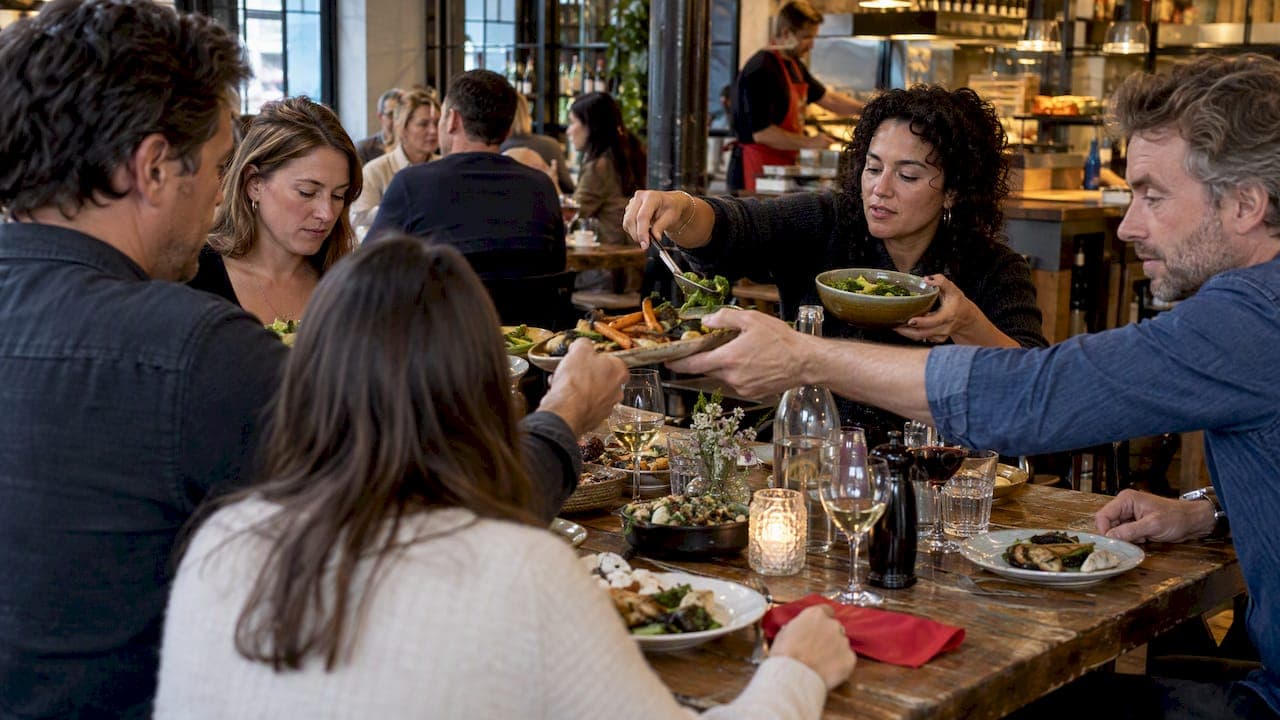
Family style dining means platters of food are brought to the table and guests serve themselves, sharing everything rather than eating from individual plates. The format keeps a table talking, lets diners sample several dishes instead of committing to one, and sets a slower, more social pace than standard plated service. This guide covers how it works in restaurants, how to host it at home, and what research says about its effect on children's eating habits.
TL;DR:
- Using size tiers of two, four, or six servings for shared dishes helps ensure predictability and prevents under-portioning during family style service.
- Dedicated serving utensils for each dish and passing food in a single direction significantly reduce cross-contamination and maintain sanitation.
- Family style dining is most effective in casual settings like gatherings, weddings, or tasting dinners, while formal or quick meals are better suited to plated or buffet formats.
- Research indicates that family style service in schools can improve children's nutrient intake and reduce food waste when combined with adult role-modeling and proper supervision.
- Proper planning, plating all dishes before guests arrive, and instructing children on serving help create a smooth, engaging, and hygienic family style dining experience at home.
Table of Contents
- What family style dining actually means
- Benefits for groups, restaurants, and guests
- Family style versus buffet and plated service
- How restaurants and caterers implement family style service
- How to host family style at home: step by step
- Etiquette for guests and hosts during family style service
- Research evidence and benefits for children in school and childcare settings
- Common challenges and how to fix them
- A publisher's take on shared meals
- Bring shared plates to your next night out
- FAQ
- Sources
What family style dining actually means
Family style dining sits between a buffet and a plated meal. Servers bring shared platters to the table, and guests pass them around and serve themselves, which industry explainers describe as a hybrid of the two formats. Unlike a buffet, nobody leaves the table to collect food, and unlike plated service, nobody gets a pre-portioned individual dish.
The format has cousins across food cultures: Spanish tapas, Middle Eastern mezze, Chinese hot pot, and Korean barbecue all rely on shared dishes at the center of the table. The terminology gets muddled often. "Family dining" sometimes just means a casual restaurant welcoming families, while "family style" and "communal dining" both point to the shared-platter format itself. A related overview of community dining formats breaks down these distinctions further.
- Server-delivered platters, self-served by guests at the table.
- No individual trips to a buffet line.
- Common in tapas, mezze, hot pot, and Korean barbecue traditions.
Benefits for groups, restaurants, and guests
Shared plates change how a table behaves. Passing dishes back and forth keeps everyone engaged for longer, and the format naturally slows down meals so no one finishes early and sits waiting. For restaurants, it offers a chance to put several dishes in front of a table at once rather than hoping a single plated order impresses.
Family-style service can reduce wrong-order risk and encourage guest mingling at catered events, since event-planning resources favor the format for group experiences where individual pre-orders would slow things down. It also functions as a social engine of sorts: a table passing dishes stays occupied and talking rather than each diner finishing a plate in isolation.
- Diners sample more dishes than a single plated order allows.
- Tables stay socially engaged longer, since passing food keeps everyone involved.
- Restaurants showcase variety instead of betting on one dish per guest.
- Catered events reduce individual pre-order complexity for large groups.
Family style versus buffet and plated service
Each format fits a different occasion. Plated service gives tight portion control and a formal feel, but limits variety per guest. Buffets offer maximum choice but can feel impersonal and often generate more food waste. Family style splits the difference: guests get variety and company without leaving their seats.
Weddings, family gatherings, and tasting-style dinners tend to suit family style well, since the format rewards a table that wants to linger. A formal business dinner or a fast-turnover lunch service usually works better plated. Buffets still make sense for very large groups where speed matters more than cohesion. Many venues now mix approaches, serving shared starters followed by individual plated mains, a hybrid covered in more detail in this comparison of dining formats.
- Plated: best for formality and precise portions, worst for variety.
- Buffet: best for speed and choice, worst for waste control.
- Family style: best for social pacing, requires more table space.
- Hybrid (shared starters, plated mains): balances both for mixed-need events.
How restaurants and caterers implement family style service
Running family style well is a planning exercise before it's a serving style. Kitchens typically order ingredients by cover count, then offer shareable dishes in size tiers built for two, four, or six guests, which simplifies ordering and keeps portions predictable. Hospitality guidance also stresses abundance-based planning: platters need to look generous, not rationed, since a sparse platter reads as a mistake rather than a style choice.
- Plan portions by size tier (two, four, or six servings) rather than per-head guessing.
- Stock platters, risers, and dedicated serving utensils for every shareable dish.
- Train staff to present dishes, monitor pace, and replenish before a platter runs empty.
- Reserve larger tables or stagger dish placement so settings do not feel cramped.
Staff play a bigger role here than in plated service. They are not just delivering food, they are coaching unfamiliar guests on how to serve themselves, catching a platter that's running low, and keeping hot dishes moving safely around a crowded table. Service logistics from sharing-focused cuisines, as covered in Shawarma Kingdom's service write-ups, offer a useful parallel for platter presentation and pacing.
Pro Tip: Offer a size-tiered menu for shareable dishes so guests know exactly how much food a platter feeds before they order.

How to host family style at home: step by step
Hosting family style at home comes down to menu balance and a clear serving order. Build a menu with at least one protein, one vegetable dish, one carb, and one neutral option that even picky eaters will take, so nobody is stuck with nothing to eat.
- Plan one protein, one vegetable, one carb, and one neutral dish per meal.
- Portion generously. Family style works best when platters look full, not rationed.
- Prep and plate everything before guests sit down, so nothing arrives cold mid-conversation.
- Pass dishes in a single direction around the table to avoid crossed arms and spills.
- For children, set out child-sized utensils and let them serve themselves under light supervision, following a division-of-responsibility approach where adults choose what's offered and kids choose how much to eat.
This mirrors guidance from event-planner menu ideas on portioning shared meals for groups, scaled down for a home table. A practical primer on planning group dining covers menu composition in more depth for larger gatherings.
Etiquette for guests and hosts during family style service
Shared plates come with a few unwritten rules. Always use the serving utensil provided for a dish rather than a personal fork, and pass platters in one direction, usually clockwise, to keep the table orderly. Double-dipping a used utensil into a shared dish is one of the fastest ways to put other guests off their food.
- Take a reasonable portion first, since slower or shyer guests may not reach the platter again soon.
- Use the dish's own serving spoon or tongs, never a utensil already in your mouth.
- Hosts should keep an eye on hot dishes and offer refills rather than waiting to be asked.
Research evidence and benefits for children in school and childcare settings
The evidence on family style feeding for children is strongest in early education settings. The Ellyn Satter Institute frames family-style service as a responsive feeding practice built on the division-of-responsibility model: adults decide what, when, and where food is offered, and children decide how much and whether to eat. Children raised under this kind of authoritative feeding show lower overweight rates compared with permissive and authoritarian feeding styles, according to the Ellyn Satter Institute.

A 2017 review of preschool food service trials found family-style service can increase intake of key nutrients and reduce food waste compared with pre-portioned meals, though results varied by menu and setting. The School Nutrition Association adds that family-style cafeteria service can support role-modeling and social development, while noting the evidence base is still growing and outcomes depend heavily on supervision and menu design. For educators, the practical takeaway is to pair family-style serving with modeling: adults who sit and eat the same food tend to see better uptake than those who simply supervise.
Common challenges and how to fix them
Family style service runs into predictable snags, most of them solvable with small procedural fixes. Shared utensils touching multiple dishes is the main sanitation risk, so dedicate one serving utensil per dish and keep hand sanitizer within reach of the table. Under-portioning is the next most common complaint, which is why offering explicit size tiers for two, four, or six guests works better than guessing per head.
- Sanitation: assign one serving utensil per dish, never a personal fork.
- Portioning: offer clear size tiers instead of improvising quantities.
- Table clutter: use larger tables or stagger dishes so platters have room to sit.
- Pacing: have staff or hosts prompt shy eaters with a gentle offer rather than letting a dish stall.
Pro Tip: Pass dishes in a single direction and keep a dedicated serving utensil in each platter. It sounds minor, but it's the single biggest fix for cross-contamination complaints.
A publisher's take on shared meals
Shared plates work because they match how people actually want to spend an evening out: together, talking, reaching across the table rather than staring at their own plate. A sports bar crowd splitting a platter during a match, or a lounge group passing shisha and sharing starters, both run on the same social logic as a family dinner table. The format rewards venues built for groups rather than solo covers.
— Leo
Bring shared plates to your next night out
If you want the family-style experience without hosting it yourself, Big Shots Amsterdam's menu includes tapas, several plates, and steaks built for sharing across a table of friends.
Our lounge experiences are set up for groups who want to linger over shared food, and our delivery option covers it when the group would rather stay home.
FAQ
What does family style dining mean?
Family style dining means shared platters of food are brought to the table by servers, and guests pass them around and serve themselves rather than receiving individually plated meals. It sits between a buffet and plated service, combining self-serving with table-side delivery, as described by industry explainers.
What does "family dining" mean?
"Family dining" usually refers to a casual restaurant category welcoming families with children, which is a different idea from "family style," the shared-platter service format. The two terms get used interchangeably often, but one describes a venue type and the other describes how food is served.
What is another name for family-style dining?
Family-style dining is also called large-format dining or communal dining, terms used interchangeably in hospitality trade coverage to describe the same shared-platter format. Cultural equivalents include tapas, mezze, hot pot, and Korean barbecue service.
What is the etiquette for family style dining?
Use the serving utensil provided for each dish rather than your own fork, and pass platters in one direction, typically clockwise, around the table. Take a reasonable first portion so other guests have access, and avoid double-dipping a used utensil into a shared dish.
Sources
- Family Meals Focus Article 62 | Ellyn Satter Institute
- Effects of Pre-portioned and Family-style Food Service on Preschool Children's Food Intake and Waste at Snacktime — PMC
- Building Healthier Children Through Family-Style Service in School Cafeterias — School Nutrition Association
- What Is Family Style Dining — Restaurantware
- What family-style dining — TheFork Manager